Showing posts with label books on China. Show all posts

Sunday, January 9, 2022

China books of the year in review: Red Roulette and Invisible China

I read a lot of books in 2021, a handful of which were on China. There were two China-related books that really stood out for me: Red Roulette by Desmond Shum, and Invisible China by Scott Rozelle. 

If you take an interest in Chinese affairs, you've probably heard of the first book. It's a memoir by a man who reached the top echelons of China's business world thanks to his marriage to a woman, Whitney Duang, who had cultivated deep connections within the Communist Party's leadership. The couple were central to a number of important deals, including a project to expand Beijing's Capital Airport. Mr. Shum later fell out of favour and left China, while his former wife and business partner was disappeared by the Chinese state. 

The book is a very readable and revealing depiction of how things work at the top of the Chinese system. Shum is from Shanghai, but grew up mostly in colonial Hong Kong and studied in the US, so he possesses both an outsider's and an insider's perspective on China. Others have already analysed Shum's revelations concerning the country's top leaders and their shady deals, and the general conclusion is that he is telling the truth, if perhaps not all of it. 

What I found particularly interesting, though, is the insight the memoir provides regarding the political and psychological factors that motivated Shum and his wife. Billionaires like to think they are moved by more than just greed, and these two were no exception. Once the couple had made it to the top, they convinced themselves that they could use their position to push for broader positive change in China as a whole. 

Shum felt political change would be beneficial to him personally, and thinks other entrepreneurs shared his ideals: "those of us who identified as capitalists wanted a voice. We wanted protection for our property, our investments, and other rights. We wanted, if not an independent judiciary, at least a fair one where judgments were made on the basis of law, and not on the whims of the local party boss. We craved predictability in government policies, because only then could we invest with confidence."

He got involved in philanthropy, creating a scholarship for students from poor regions studying in Tsinghua. He also joined the Beijing branch of the Chinese People's Political Consultative Conference (CPPCC), officially China's "second parliament", which as he says himself was more of a networking platform. "Membership was a sign that the Party saw you as a potentially useful agent of the party's influence." He noticed that bolder members of the body were starting to advocate for democracy within the Party, and he wondered if the CPPCC could become more relevant, like a real second chamber of parliament.

Shums' wife Whitney, who had grown up in anonymity in Shandong, was a Christian, and wished for more religious freedom, or at least a recognition that you could "love god and love China at the same time". Shum and Whitney worked with foreign think tanks to educate Chinese scholars about how democracies work, and around 2010 they funded a European delegation led by Romano Prodi to come to China and have a private chat on foreign policy with Chinese officials. As he puts it, "we tried not to cross any redlines. We truly believed in the promise of China. We were all in.

Around the turn of the decade, Shum noticed with concern that things had started to change. In 2013 he was summoned to a meeting of the Beijing CPPCC, where a senior official gave a hard-line speech that put to rest any fantasies of democratic reform. Then in 2014, Shum and other CPPCC members from the Hong Kong SARS (the place where he grew up and of which he is a citizen) were directed to go to Hong Kong and take part in an organised counter-protest against the Umbrella Movement. Shum made sure he was seen at the march, even though he didn't really believe in what he was marching for. Quite simply, he was deeply embedded in the system and could not afford to break ranks.

In the end the couple paid the price for having got to the top through the support of prime minister Wen Jiabao's wife. After Xi took office, and Hu Jintao and Wen Jiabao's allies were purged one by one, this turned into a liability. Meanwhile the couple grew estranged and divorced, after which Shum had to threaten his wife in order to ensure that she gave him a fair amount of the funds from their joint business, since she controlled all their money and the local courts could not be relied upon to protect his interests. Disillusioned with China, he left and made a life for himself in Britain with his son, while his wife met the unfortunate fate of disappearing into detention.

In the end, it is hard to argue with Shum's conclusion that modern China is a harsh, unforgiving place. It must also be said, though, that he comes across as an opportunist who is now spilling the beans because he has nothing left to lose. It is true that it was easier to believe in democratic change back in the 2000s, and I have no doubt that he was genuinely convinced he was helping to steer the country in the right direction. At the same time, I would advance a guess that Shum would never have left China and rejected the system if he had been given a chance to hold on to his billions and his privileged position.


The other book, Invisible China: how the Urban-Rural Divide Threatens China's Rise, focuses on a problem that tends to be overlooked: the dismal educational and cognitive level of a big chunk of China's population, particularly in the countryside, and how this affects the country's prospects. The book makes a very convincing case that much of the Chinese population is simply not skilled enough to take up the kind of jobs in services that will open up once the manufacturing jobs move to cheaper countries, and this could keep China stuck in the so-called "middle-income trap" that bedevils countries like Mexico, Brazil and South Africa.

The book is co-authored by Scott Rozelle and Natalie Hell, two Stanford scholars. The most well known of the two is Rozelle, an American economist who has spent 30 years researching poverty and education in rural China. Over the years he has drawn some criticism for his positions, but he clearly knows what he is talking about. The book uncovers a reality that is not easy to see for those who only experience middle-class urban China. 

First of all, it may be a revelation for some to realise that China's masses are in fact under-educated relative to other countries that are similarly or less developed. In 2015, 70% of working-age adults in China had not completed high-school, compared to 58% in South Africa and 42% in the Philippines. Even among Chinese 25 to 34 year olds, the figure was 60%.

Rozelle and Hell place part of the blame for this on the fact that, during the first decades of the "reform and opening up", public education was not really made a priority by Chinese administrations. School attendance was not mandatory or free of charge, and tuition fees often kept poorer children from going past primary school. Things have changed since then, with the first nine years of schooling made mandatory and free in 2006, and attendance in junior high school becoming almost universal. Even attendance in senior high school is increasing, with 80% of 15 to 17 year olds in school in 2015, up from 53% in 2005.

But these gains are probably insufficient. Educational levels remain worrying low among rural youth. This is hardly a small issue, when you consider that in 2015, 75% of Chinese children under three had a rural hukou, meaning that regardless of where they actually lived, they can be counted as "rural" in terms of their access to education. 

Rozelle and Hell claim that rural schools in China have improved a lot over the last decades. They now have qualified teachers, good facilities, and the same curriculums as everywhere else in the country. Senior high school is still not free, however, and the cost remains considerable for rural families. But there is an even more basic problem: most rural youth in China suffer from cognitive deficiencies and learning difficulties because of problems that begin at home.

First of all, the health of rural children is dismal. Millions of them suffer from iron-deficiency anemia, which is strongly correlated with worse educational outcomes, and intestinal worms. Millions more are short-sighted and are not given the glasses they need, which obviously impacts their schooling. These problems could easily be solved with cheap medication, food supplements and glasses, but they are not addressed because no on understands their importance. Millions of "left-behind children" have parents who work in the cities, and are brought up by grandparents who are usually barely literate, and do not realise that these health issues exist, or believe destructive myths about them (you need intestinal worms to digest your food; if a child wears glasses, their vision will deteriorate further).

What's more, most of these children suffer from a lifelong cognitive deficiency compared to urban children because of they way they are brought up as toddlers. In rural areas caregivers, even if loving, do not talk to their babies and stimulate them in the way that parents naturally do in urban China and in richer countries. Babies may spend hours strapped to their grandmother's back, without any stimulation whatsoever. By the time they are three, they already score worse on cognitive tests compared to urban children, and they will probably carry this disadvantaged throughout their lives. These problems ensure that, no matter how good Chinese rural schools become, or how many children go to them, educational and cognitive levels will remain low. 

The book's arguments are compelling. The countries that made it out of the "middle-income trap" in recent decades, like South Korea and Ireland, all invested heavily in education, and a much higher proportion of the workforce had completed high school by that point compared to China today. If this issue gets so little attention, it may be because most foreign analysts, and the Chinese they talk with, spend so little time in rural China. It is very hard to remember, when you visit the campuses of globally competitive and well-funded universities like Tsinghua, that average educational levels across the country are so low. It is also hard to remember, when you only travel in high-speed trains and only stay in the nicer parts of China's huge and well-run cities, that there is another China, one of unheated rural homes, poverty and left-behind children.

What I find less convincing are the book's general predictions about China. It may well be that, due to the problems it describes and other factors, China will indeed remain stuck in a middle-income state. I find it hard to imagine, as Rozelle and Hell predict, that this could lead to a collapse in law and order, as unemployed and aimless young men turn to crime. Their point of comparison seem to be Mexico and Brazil, societies which have indeed been beset by gang violence and appalling crime rates for decades. This does not mean, however, that things would have to go the same way in China. Countries in Asia that some might describe as falling into the "middle-income trap", like Malaysia, hardly seem to be mired in criminality. China is also far better organised and more regimented than most countries, and it seems unlikely that a massive wave of crime could really take off under the Party's watch. 

It is also a fact that today's "middle-income" China is already an economic and military superpower simply as a function of its size, in spite of its poor rural interior. This was never true of Mexico, Brazil or South Africa. Even if it remains more or less stuck at its current level of development, I see no reason to believe that China cannot continue to be an internally stable and externally assertive power, or that its rulers will stop wanting to remodel the international order in a way that is more congenial to them.

Sunday, September 24, 2017

Five books that will help you understand modern China

Reading books about China can become quite addictive once you get started. There are lots of them, and many are just run of the mill. There are some however that can really give you fresh insight into how this confusing country works. Below are five I would recommend to anyone interested in modern Chinese politics and society.


China Alone: the Emergence from and Potential Return to Isolation by Anne-Stevenson Yang

Anne-Stevenson Yang is an American lady who has spent most of her life in China since the mid-eighties, working as a journalist, executive and researcher. She writes about China perceptively and knowledgeably, giving an overview of the political-economy's current woes, from real estate to government debt. She also provides an insightful description of how the country is run, explaining for instance about the networks of "red princelings" that act as intermediaries between the different government departments, in spite of their lack of formal positions in the bureaucracy. Finally she takes a broader view to look at where China is headed. The old model of development has outlived its usefulness, she argues, and China may well be heading back into isolation and insularity. Only real systemic change can break the cycle of opening up to the outside world and then closing down again.


China's Economy: What Everyone Needs to Know by Arthur R. Kroeber

This book provides an excellent overview of all of the salient facts about the Chinese economy in every sector, from agriculture and industry to finance and real estate. Without getting excessively technical or falling into too much detail, it gives the reader a realistic picture of the economy's strengths and weakness, and how they link to the political system. It avoids being too catastrophic, for instance it gives little credit to the idea that China is set for some kind of terrible financial crash due to the real-estate bubble popping or a credit default. At the same time it also avoids the silly triumphalism of certain works about China, arguing that the talk about China becoming a hub of creative innovation is basically hot air, and will remain so as long as the political system doesn't loosen up.

Gao Village: Rural Life in Modern China by Mobo Gao

This book by Mobo Gao is an unusual one, but definitely deserves to be read by anyone interested in China's recent history. It is an account of the history of the author's birthplace, Gao Village in Jiangxi province, since the Communist Party took power in 1949. Mobo Gao was only the second person from this village to gain a higher education in its 200 year history, and ended up becoming a university professor in Australia. His views are controversial, as he is a "leftist" (in Chinese terms) with a tendency to minimise the impact of the disasters of the Mao Era, claiming that they mainly affected the elite, while the peasantry that constituted the overwhelming majority of the population actually benefitted from the era's radical policies, and even from the Cultural Revolution. At the same time, he is disparaging about most current Chinese policies, claiming that they do not really benefit the poor.

While his defence of Mao's rule, which he lays out in his other book "the Battle for China's Past", might seem to be based on a certain selective blindness, this book does a good job of explaining where he is coming from. Enriched with personal memories and anecdotes, but by no means a memoir, the book gives you a vivid picture of this little village and its recent history. He claims that the Great Leap Forward's craziest polices were mitigated by the common sense of the villagers, while the only local culture that was actually lost during the Cultural Revolution was the original copy of the local genealogical tree, which was burnt. He later describes the return of clan-based local struggles, the unjust taxation, the increase in general amorality and insecurity, and the continuing poverty of the villagers during the market reforms of the eighties. He claims that the first real material improvements for the villagers only came in the nineties when the young started to go out and work in the nearby cities, where they were often horribly exploited.

Capitalism with Chinese Characteristics by Huang Yasheng

This book by Huang Yasheng, a Beijinger who teaches at Harvard, offers a different set of insights into how modern China works. Huang is also motivated by concern for the poor and underprivileged, but he sees things very differently from the aforementioned Mobo Gao. Huang is a great fan of the policies followed under Deng Xiaoping in the eighties, which in his view were able to free up the great reservoir of enterpreneurial potential of the Chinese countryside. Peasants were enabled and encouraged to start their own businesses, which they often did quite successfully. After the sad events of 89, however, China changed course. The new model of growth favoured the urban areas, the state-owned enterprises and foreign invested companies, while it was inimical to small indigenous entrepreneurs, and the countryside became nothing but a reserve of cheap labour. While the GDP continued to grow impressively, this form of growth was less beneficial for the well-being of the ordinary Chinese. He calls China's current system "crony capitalism", and calls for genuine protection of property rights to be ensured as a way of checking the system's inherent corruption and cronyism.

You Don't Know China: 22 Enduring Myths by John Ross

China is a country that lends itself uniquely well to myth-making and urban legends. This book is a really good take down of some of the most widespread myths about China, from the mundane (cats and dogs as an everyday dish) to the more consequential (the supposed Dickensian conditions in Chinese factories, China as the new "place to be"). The book does a great job of disposing of some of the new myths about China created by the international media, for instance the huge ghost cities sitting in the desert that on further inspection are not quite as deserted as they seem. Not everyone might agree with some of the authors' points, for instance his complete rubbishing of traditional Chinese medicine, or his contention that China was never really that isolated from foreign influences throughout its history. The inclusion of the Tiananmen Square massacre as a myth, purely because the killings didn't take place within the square itself, strikes me as rather unconvincing. But all in all the book is still a compelling read, and it finishes with a convincing take down of one of the most consequential modern myths about Chinese history, the occurrence of a "century of humiliation".

Wednesday, August 31, 2016

Not being Chinese in your next life

I have just powered through a full-length book in Chinese. No, it wasn't the Romance of the Three Kingdoms, but a polemic by Hong Kong journalist Joe Chung. Its title, 来生不做中国人, is officially translated into English as "I don't want to be Chinese again", but a more exact rendering would be along the lines of "I won't be Chinese in my next life" or "not being Chinese in your next life" (the subject of the sentence is unstated). It has yet to be translated into English or any other language.

The book is actually a collection of the author's essays and articles. It is basically a frontal attack on Chinese culture and everything it stands for, written from the point of view of a Chinese from Hong Kong. The book's title was inspired by an opinion poll which appeared on Netease, one of China's main web portals, in 2006. The poll asked people whether they would want to be reborn as Chinese in their next life. Over the next few days thousands of Chinese took the survey, with a whopping 65% of people answering "no", until the government noticed and demanded that the poll be taken down. A Netease editor lost his job as a result.

Drawing inspiration from this episode, the author engages in a full-blown polemic against his own culture. He attacks the Chinese mindset as selfish, irrational, antiquated, petty and incapable of changing, and criticizes the Chinese people for accepting injustice by their own leaders and blaming others for their misfortunes. Unlike many Hong Kongers would do, he doesn't limit his critique to the Mainland, but criticises his native Hong Kong's culture as well, seeing in it the same flaws that hold back the whole of China.

The author dismisses Chinese culture as a culture which has long outlived its usefulness and should have disappeared long ago, and compares its survival to the Roman Empire surviving until the present day. Although he doesn't make a very big thing about it, the author is in fact a Christian, and blames the lack of a strongly held religious faith for what he perceives to be his countrymen's flawed and underdeveloped sense of morality. He claims that Confucianism is an ideology which cannot act as a substitute for true religion.

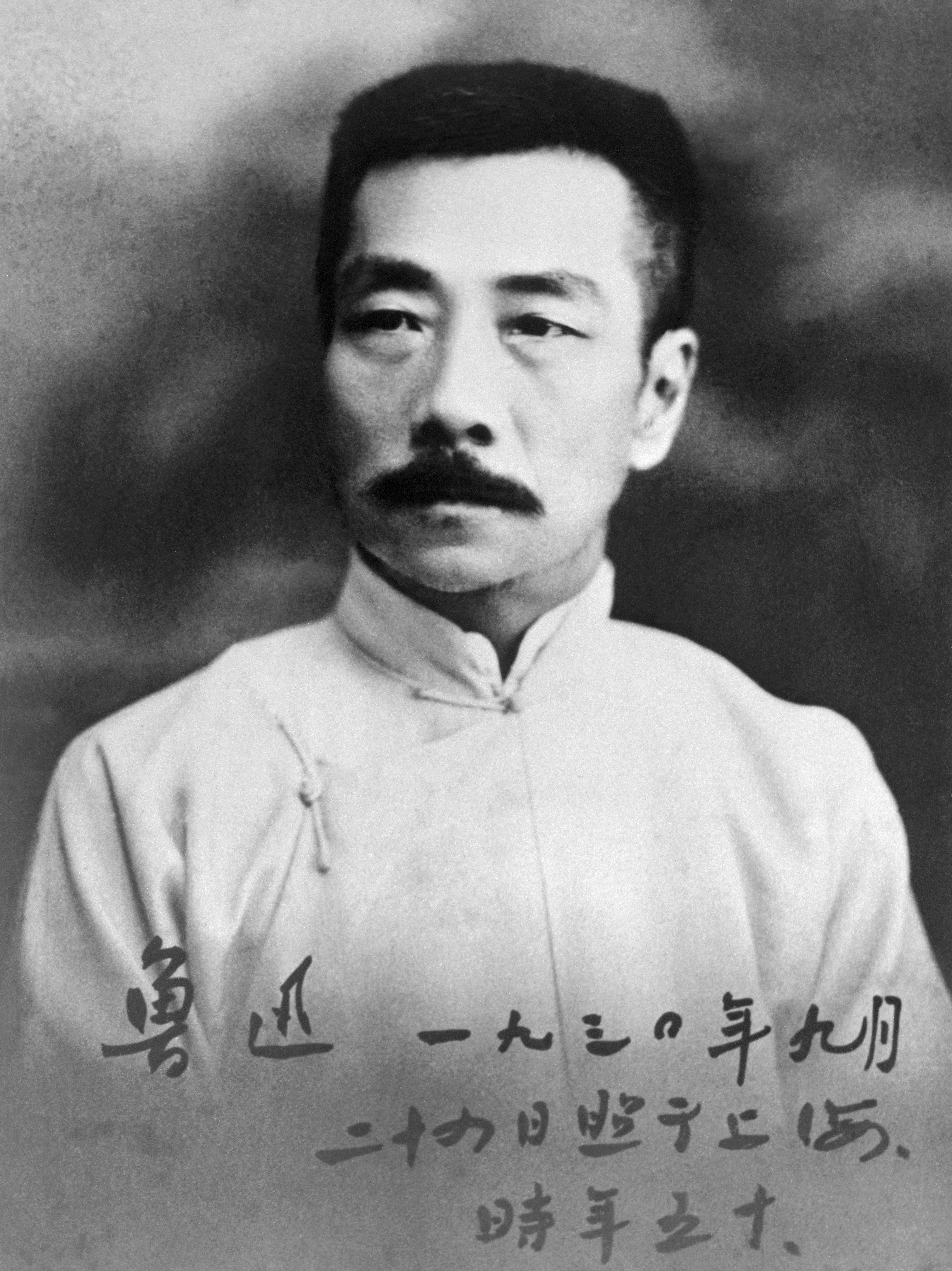
Such total dismissals of their own culture by Chinese intellectuals are actually not entirely new. A famous example is Taiwanese author Bo Yang and his well known book that came out in 1985 with the English title "the Ugly Chinaman and the crisis of Chinese culture". Under the relatively liberal atmosphere of the time, the book was actually distributed in the Mainland as well. Going back even further, China's most famous modern writer Lu Xun had some very harsh things to say about the "Chinese national character" and his own people's 劣根性 or "deep-rooted flaws". What's more he felt that the defects of the Chinese mentality had not really been improved with the Xinhai Revolution and the end of the empire. There is in fact a vein of self-hatred that has run deep within Chinese culture since at least the nineteenth century. This self-hatred actually survives in Mainland China too, although it is buried under the veneer of state-sponsored nationalism and pride.

It is certainly true that China's particular version of a modern society leaves a lot to be desired. Sometimes China can seem like a country trapped in its own history, unable to find a way out, in spite of all the economic growth and material development of the last decades. But total rejections of Chinese culture aren't really convincing either. If China's problem is the Confucian tradition and the lack of a strong religious faith, then why have the Japanese and South Koreans, who come from a similar religious and ethical tradition, been so much more successful at creating decent modern societies then the Chinese have?

Traditions and cultures all have good and bad sides. Cultures based around monotheistic religions can lead to rigidity and fanaticism, while East Asian cultures sometimes appear to lack a concept of basic moral norms that have to be abided by at all times, and lead to extreme utilitarianism and only caring about your "in-group". But the reality is that until the enlightenment took off, European societies (and other Asian ones) never appeared to be any more successful than China at producing peaceful or civilized behaviour. In fact when Marco Polo travelled around China he remarked with wonder that the men did not need to carry weapons with them when they went out, unlike in Europe at the time.

It is certainly true that China has found it harder than most countries to reconcile itself with modernity, and many progressive values which much of the modern world takes for granted still struggle to take root in China (the value of life, equality, moral concern for strangers etc...). The country's size and its isolation from "global culture", part natural and part intentional, also contribute to keep things this way. But it can only be hoped that when China finds a system that can bring out the best in its culture and people, then things will no longer be so.

Lu Xun

Monday, December 21, 2015

Five great China expat memoirs

Many foreigners who have spent time in China feel compelled to write a memoir about their experiences in this big, mysterious country. Unfortunately many of these books turn out not to be especially entertaining or interesting. Just because you've lived in China, it doesn't mean you have either good writing skills or anything insightful to say about the place. Every now and again though, a book comes out which really manages to capture the essence of the foreign experience in China. Here are a few of the best ones I have read so far.

River Town, by Peter Hessler

This classic remains the standard for the "foreigner in China" genre. In 1997 young American literature graduate Peter Hessler ends up on a two year stint teaching english in Fuling, a small town near Chongqing, in the proverbial middle of nowhere. New to China and not knowing a word of Chinese, he has to figure everything out for himself. His book is a superbly crafted description of his experiences, and what he comes to understand about China and his own culture in the process.

The book doesn't gloss over some of the less savoury aspects of the society which Hessler finds himself immersed in, but he always does his best to find poetry and beauty where he can. Hessler's students, young adults from the Sichuanese countryside training to be teachers, really come alive in his description. The challenges and the fun of teaching English literature in the middle of China are also described quite vividly.

After writing this book Hessler moved to Beijing, where he wrote another two books about China and became well known for his ability to describe the country to American audiences. He has now moved to Cairo, where he is trying to learn Arabic and write about the Middle East.

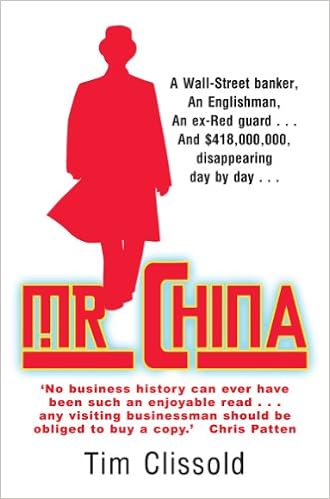
Mr. China, by Tim Clissold

A memoir by Tim Clissold, an englishman who set up shop in Beijing in the early nineties as a young, starry-eyed businessman with dreams of making it big in China's new market economy.

After a year of studying Chinese in Beijing, Tim was hired by a Wall Street banker referred to only as "Pat" (in actuality Jack Perkowski), who needed someone to oversee how the millions of dollars he was pouring into Chinese factories were being put to use. Inevitably all sorts of unforseen problems arose, from factory bosses escaping to Las Vegas with 58 million in cash, to other bosses transferring land to rival factories personally owned by their associates. Tim had to run around China from one end to the other, trying to deal with all the mishaps and explain them to incomprehending American investors.

The book is certainly entertaining, and does its best to be culturally sensitive. At the same time, it reads a bit like an expose' of the kind of business ventures which unprepared, amateurish Westerners would throw themselves into in the China of the nineties. Apparently Jack Perkowski now blames Tim Clissold for many of the problems the book describes, and has refused to read it. Perhaps he should have thought it through before hiring a clueless young man with one year's experience in China to oversee 418,000,000 dollars in investment?

The Forbidden Door (La Porta Proibita), by Tiziano Terzani

Tiziano Terzani was an Italian writer, journalist and adventurer who spent decades living all across Asia. He was well known in Italy for his deep knowledge of Asian languages and cultures, and for his fascinating travel books.

Terzani and his wife eating with some Chinese friends
Terzani was fluent in Chinese, a language he learnt in Stanford in the late sixties, and always curious about China. As soon as the country opened up slightly to the outside world in the early eighties, he moved to Beijing as a correspondent for a German magazine. Terzani arrived in the Chinese capital in 1980, when foreigners where still extremely rare. He immediately did his best to integrate and learn about his new home, refusing to remain confined within the diplomatic compound where foreigners were forced to live at the time. He rode a bike, sent his children to a local school (which they hated), travelled around the country hard class, and got to know as many people as possible. In the end the authorities got fed up with this man who just wouldn't stick to the script; in 1984, Terzani was arrested on the fabricated accusation of smuggling artistic treasures out of the country, "re-educated" for a month (which mainly consisted in him having to write nonsense confessions), and then kicked out of China.

The book he wrote on his years in China (called La porta Proibita in Italian) is a fascinating portrayal of the country in the early eighties: in some ways so different from now, and in some ways exactly the same. It also offers something different from the Anglo-Saxon perspective of many foreign authors who have written about China. Although Terzani was enthralled by Maoism as a young man, he became highly critical of the Chinese system after moving there. At the same time he discovered the real, human side of China, which he found much more interesting and exciting than the faultless facade which the authorities attempted to show the outside world.

Unfortunately Terzani died of cancer in 2004, after spending his last few months in the hills of his native Tuscany. No other Italian has since written about China as insightfully as he did.

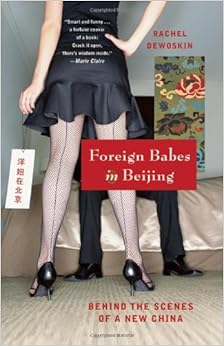
Foreign Babes in Beijing, by Rachel DeWoskin

Rachel DeWoskin, the daughter of an American Sinologist, arrived in Beijing in 1994, aged 23, to work in an American PR firm. Before long Rachel, who had no acting experience and shaky Chinese, was offered the starring part in a TV soap on a foreign lady who falls in love with a Chinese man. The show was hugely successful, gaining over 600 million viewers, and Rachel turned into a celebrity and a sex symbol overnight.

Her memoir is a sensitive, amusing description of her five years in the Chinese capital, during which Rachel delved into the city's emerging alternative arts and rock music scene and met all sorts of curious characters, while holding down a variety of jobs. China was an exciting and bewildering place to be at the time, and Rachel always did her best to keep an open mind on what she experienced.

The book is a great portrayal of what expat life was like in Beijing in the nineties, a time when you could receive an offer to appear on TV just for having a foreign face and being able to put three words of Chinese together, everyone was curious about Westerners and their culture, foreigners were only allowed to live in certain neighbourhoods but would happily flout the law, and the traffic and pollution were still at bearable levels.

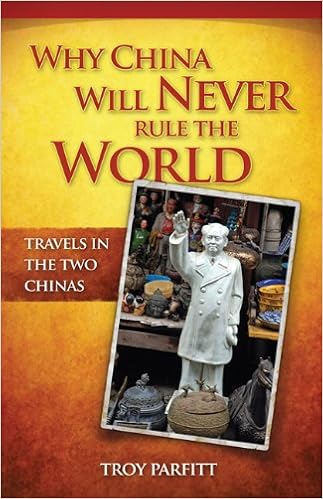
Why China will Never Rule the World, by Troy Parfitt

After a decade spent living in Taiwan as an anonymous English teacher, Canadian Troy Parfitt got fed up with hearing supposed experts back in the West go on about how China was going to become the next superpower and a dominant influence throughout the world. This just didn't chime with his experience. So armed with his ability to speak Chinese and his first-hand knowledge of Chinese culture, Parfitt decided to embark on a long journey through Mainland China and Taiwan, and craft it into a travelogue with an agenda.

The first part is a bitter and sometimes hilarious description of his travels through the Mainland, which are replete with the sort of of misadventures any old China-hand will be familiar with: revolting restrooms, rude, unresponsive or just plain idiotic staff, dismal accommodation, tacky "ancient ruins" rebuilt 20 years ago, scams and touts etc.... Parfitt finds almost nothing to like in China, and he is not afraid to say it like he sees it. His descriptions of his travels are replete with historical and cultural digressions, during which he dismisses Chinese culture and all it stands for. In the end, Parfitt concludes that China is condemned to remain authoritarian forever, and has no hope of gaining any kind of real global influence any time soon. Although he has no love for China's current rulers, he sees the roots of the problem as lying even deeper, in Confucianism and the country's basic cultural identity.

In the second part of the book, Parfitt tours his adopted homeland of Taiwan, and meanwhile tells us his impressions of Taiwanese society which he gained from his years of living there. He describes Taiwan as being a better place than the Mainland in almost every way, but he still finds Taiwanese society to be lacking in many important respects, and he blames Chinese culture and education for the lack of critical thinking, ignorance and obtuseness which he perceives all around him.

Obviously Parfitt's conclusions are highly provocative and debatable, and not everything he claims about China is true. It is not true, for instance, that you never see people exercise outdoors (has he ever been to a Chinese park?). I don't find it to be the case that nobody ever knows the way to anywhere, a constant theme throughout the book. Parfitt's historical anecdotes are interesting and informative, but often biased, and dismissing the whole of Chinese history as nothing but war and chaos is highly simplistic. At the same time, I think anyone who knows China properly will find themselves secretly agreeing with him every once in a while.

If this book deserves to be read, it is mainly because it gives vent to some of the negative attitudes and frustration which many long-term foreign residents develop towards Chinese culture. At the end of the book Parfitt describes how he decided to move back to Canada, finally fed up with Taiwan and Chinese society as a whole. This was clearly a long overdue decision.

Thursday, April 2, 2015

Capitalism with Chinese characteristics

Some of the most insightful books on China that I have read were written by Chinese academics who work in Western countries. Able to draw both on their insider understanding of the Chinese system and on the outside perspective which comes from living abroad, and liberated from censorship, they are sometimes able to provide real insight into the workings of this perplexing country.

I have recently finished one such book: an original and interesting study of China's economy called "Capitalism with Chinese characteristics". It was written a few years ago by Huang Yasheng, a Beijinger who teaches at Harvard. Analyzing China's economy is an arduous task due to the opaqueness and ambiguity inherent in the system. As Huang points out in the introduction, while in the US a study might focus on the effect of a tax raise, a similar study on China might focus on the question of whether China's government really has raised taxes or not.

All the same, Huang's book makes a pretty convincing case in favour of a thesis which, as far as I know, is new: according to him, the economic policies which China followed during the eighties were substantially different from the ones it followed in the nineties and later on, and much more conducive to the Chinese people's general well-being.

Huang claims that during the eighties, the Chinese government was following a clear path towards greater liberalism. Economic reform was focused on the countryside, where enterprising peasants were enabled and encouraged to start their own private businesses. Growth was fueled by the so-called "Township and Village Enterprises" (TVEs), which according to Huang are usually misunderstood by Western observers to have been state-owned enterprises, when in fact they were usually private companies begun by individual peasants. Rural residents were allowed to poll money informally to set up their businesses, or they were enabled to borrow money from the banking system.

Although the protection of property rights in China was sketchy (as it remains today), it was still far better than it had been under Chairman Mao before 1978, and this was sufficient for the Chinese to feel encouraged to take risks and make money. People felt that things were changing for the better, and they had faith in Deng Xiaoping's determination to keep it that way.

After the events of 1989, however, the conservative faction within the government gained the upper hand (especially the so-called "Shanghai clique"), and the country significantly changed course. Most Western scholarship assumes that after 1989 there was just a brief setback in the liberalization of China's economy, knows as the "Tiananmen interlude" (1989-1992), and that after Deng Xiaoping's famous "Southern Tour" China's reform once again picked where it had stopped in 1989.

Huang claims that this is a misunderstanding. In reality, China's policies never again veered in the same virtuous direction as they had done in the eighties. Instead, during the nineties what was created was a model of development based on a clear bias in favour of the cities, state-owned enterprises and foreign investment.

The policy environment became much less favourable to small indigenous entrepreneurs, due to restrictive regulations and policies which made it much harder to get credit from the banks. Instead of following in the path of other East Asian economies like South Korea, China became a "commanding heights" economy in the South American style, with economic growth fueled by imposing infrastructure projects mandated by the government, including all the first-class amenities and skyscrapers in the big cities which are superficially so impressive.

This mode of development has also been able to produce spectacular GDP growth, and it has continued to make the country more prosperous. On the other hand, it has been much less beneficial for the well-being of the Chinese people. Income disparity has become huge, and private incomes have become a smaller proportion of national GDP. Rural residents have become nothing more than a pool of cheap labour for the cities. Huang attempts to demonstrate that the provision of educational and health services in the rural areas suffered as a result of the strong urban bias of the policy makers, and that literacy rates actually declined in the countryside in the early 2000s as a result.

Huang also claims that the few big Chinese companies which are starting to make a name for themselves in the world are either not really private or not really based in Mainland China. For instance Lenovo, China's biggest computer company, has long been controlled and run mainly from Hong Kong, out of the reach of the Chinese system, where it has access to world-class financial and judicial institutions. 

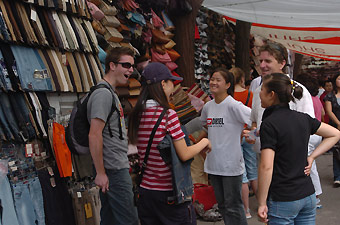
Huang repeatedly calls China's current economic system "crony capitalism", and uses a compelling example to prove his point: the case of Beijing's famous (or infamous) "Silk Street". The Silk Street is a large shopping center near Beijing's embassy district, always extremely popular with tour groups. It is notorious for its wide selection of counterfeit designer goods.

Tourists haggling in Beijing's Silk Street

Although I have been there a few times, what I didn't know was the history behind the place: the market was apparently started spontaneously in 1985 by a group of small Beijing traders. By 2004 it was a thriving outdoor market which attracted dozens of thousands of visitors a day. Then the city government suddenly decided to close down the outdoor market and build the nearby indoor market which exists currently. They claimed this was to clamp down on the selling of fake products, but the problem with this explanation is that ten years later there are still just as many fakes on sale as before.

The government arbitrarily awarded the right to operate the new market to a private entrepreneur who did not have a stall in the old market. There was no bidding, and no rationale for the decision was ever made known. It is reasonable to suspect that this person did not win the deal just for making the best offer. The original traders were not allowed to keep their stalls, and the valuable right to own a stall in the new market was auctioned off. The bids fetched millions of Yuan. 

In essence, the hundreds of traders who had created the valuable "Silk Street" brand were expropriated out of it, in favour of an entrepreneur with political connections. As Huang points out, this is obviously not any kind of socialism, as the authorities did not retain control of the market themselves, but gave it away to a private businessman. Rather, it is "crony capitalism built on systemic corruption and raw political power", in which property rights are not properly guaranteed by the legal system. 

Huang also dedicates an entire chapter to Shanghai, or rather to attacking Shanghai and all it stands for. He claims that the infatuation of many foreign observers with the city is based on a superficial view. In reality, Shanghai represents all the worst of China's economic system. Contrary to popular perception, it follows policies which are deeply inimical to home-grown innovation and entrepreneurship, but friendly to foreign FDI and state companies. The share of the city's wealth which goes to private households is low even by China's standards. Shanghai's impressive skyscrapers and luxury amenities have actually been heavily subsidized by the rest of the country, especially its more productive parts like Zhejiang and Guangdong.
 
Huang's indictment of China's system is certainly heartfelt, and based on an enormous amount of research of Chinese statistics which would have been impossible without a deep knowledge of the language and culture. His description of China's ills will chime with anyone who has lived in the country for long.

At the same time I think he has a misplaced faith in what he calls a "virtuous" form of capitalism, one driven by private entrepreneurs which protects property rights, to deliver social equity and fairness on its own. After all this form of capitalism is well established in his country of residence, the United States, but there is relatively little fairness and equality there when compared to other industrialized countries.

I think that a government which redistributes wealth through taxation is a necessity in order to achieve a just and fair society. I also think that, as the 2008 financial crisis has shown, a totally liberalized and unchecked financial system can also distort the economy and cause a lot of harm. All the same, government intervention should take place within a framework of clearly defined rules and rights, which is what is lacking in China.

Shanghai's famous skyline: does this represent all that is wrong with China?

Friday, November 23, 2012

Intelligent Sinophiles


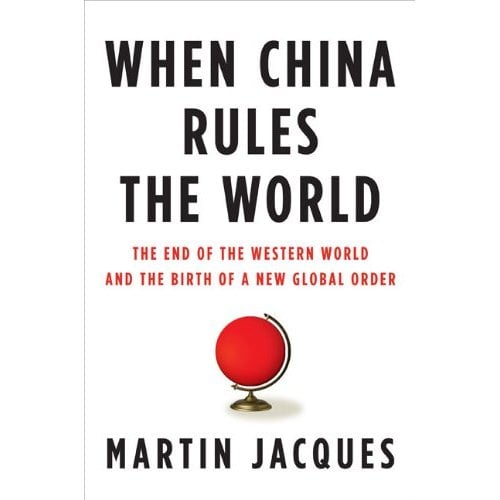
The recent BBC article by Martin Jacques, entitled “A Point of view: is China more legitimate than the West?”, has provoked the ire of seasoned “China Watchers” everywhere. A few intelligent rebuttals have already been produced. I saw the article yesterday, and the reason I wasn’t surprised by its content is that I had already browsed through Jacques’s recent book, When China Rules the World.

The fact is that for anyone with a real knowledge of China, it is impossible to take Jacques too seriously. His triumphalism about the Chinese model masquerading as impartial analysis just does not fit in with the actual situation in China, and few Chinese would share it. His idea that the Chinese see the state as the head of their family, even some sort of “extension of themselves”, and that the government enjoys great authority and legitimacy, doesn’t coincide with what those who really know the Chinese will tell you. And as it has been remarked elsewhere, the surveys of satisfaction with the Chinese government which he quotes cannot be taken too seriously.

It is funny that in his article, Jacques mentions Italy as an example of a country where, in spite of constant elections, the government lacks popular legitimacy. This is supposed to be in opposition to China, where the government enjoys great legitimacy in spite of the lack of elections. In fact the Italians and the Chinese are actually rather similar in their attitudes: the only thing they take seriously is their circle of family and friends. Outside of that, nothing really matters. The state is seen as something which has to be put up with, and the corruption of those in power is met with cynical acceptance. 

Unsurprisingly Martin Jacques has little personal experience of China, and cannot speak Chinese. He apparently spent a short period as a visiting professor in Renmin University. Not enough time to really understand the country, but just enough time to be awed and overwhelmed, while not having to deal with any of the real problems of living here.

The tragedy is that the most basic arguments outlined in Jacques’s book are correct, or at least deserve a hearing. China is indeed going to become more important in the future, the West will no longer dominate the global order, China and other Asian countries are not going to become more Western as they become more modern. China is the product of a different history, and we cannot hope to understand it by just applying Western concepts and prejudices in a different context. And yes, the Chinese state is quite efficient and effective in a number of ways, while managing to retain a certain amount of consensus (does that equate legitimacy?), even though none of the Confucian-style devotion he imagines.

All this is true and needs to be said, but it would take somebody who actually knows Chinese society to say it, someone who is aware of China’s problems and negative sides and does not just engage in blind sycophancy towards Beijing. We may need Sinophiles, but intelligent, informed and balanced ones.