The bus carries me through a majestic Tibetan landscape of vast, green, empty mountains and valleys, until we reach the prefectural capital, called Jiegu in Chinese or Gyegu in Tibetan, but generally just referred to as Yushu. The town is not particularly big, but it is still the biggest and most developed in the region, and has many of the trappings of any Chinese provincial town, including the inevitable Dicos fast food joints (it's too small to have an actual McDonalds). The town was flattened in the dreadful earthquake of 2010, but it has been completely rebuilt with typical Chinese speed. Many of the new buildings have been given Tibetan architectural elements and are painted in the traditional colours of red and white, giving the town a distinct feel.
Tibetan culture is celebrated everywhere in Yushu, at least on the surface. The huge main square has a large statue of Tibet's mythical king Gesar in its centre. On the sides of the mountains that overlook the town there are two large phrases written in huge white characters, clearly the work of the local government: one of them says "Long live the unity of the peoples (of China)" in Chinese and Tibetan. The phrase on the other mountain is only in Tibetan. I assume it to be more propaganda, but later on I am told it is actually the ancient Buddhist mantra "Om Mani Padme Hum", known throughout the Buddhist world.
 |
| Statue of king Gesar, with "long live the unity of (China's) ethnic groups" written in the background |
I have to walk five minutes from the bus stop to my hotel, some of it uphill. When I get there I am panting and out of breath, as if I had just ran all the way. I realise this is the effect of the altitude. I have in fact never experienced such a high elevation in my life. The hotel, run by a monastery, is one of the few that can take foreigners in town. The staff, all Tibetan, are a bit suspicious and ask me all sorts of questions. They will have to report my stay to the local police, and want to know all about my past and future itinerary and what I am doing in Yushu. They want evidence of a PCR test, and the one registered in my Beijing health code app is already a few months old, but between that and the Beijing and Qinghai green health codes, I manage to convince them to check me in.
Once I am in my room, I get a phone call from reception with more questions: "Can you confirm you are only here on holiday?" "So what did you say your next destination would be?" Clearly the police have asked them to double-check. This is the kind of suspicion I was expecting to encounter.
That evening I go out for a walk in town. Because of the altitude, the temperature is much cooler than Beijing, and it gets chilly after the sun sets. Most people look Tibetan, and many are wearing traditional clothing. Some are as curious about me as I am about them. I reach a square where 广场舞, or square dancing, is going on, as it does in every city in China. But while in most parts of China it is a pastime for elderly women alone, here it is engaged in by men and women of all ages, including children, and the style of dancing is Tibetan. I find myself thinking that in Beijing children of that age would be doing their homework at this time, not dancing in a square.
Out on the streets, the pandemic seems a world away. Few wear surgical masks, and nowhere requires you to scan a QR code to enter, in sharp contrast with Beijing. Qinghai barely had Covid-19 cases even at the start of the pandemic, and this remote corner of the province has probably not had a single case. That's how effective China's containment policies have been.
After having dinner in a Muslim restaurant, I agree to meet up with a young Tibetan woman who I had got to know on the bus from the airport, when she started chatting with me in fluent English. At the time she was travelling with her grandmother, an old lady dressed in traditional Tibetan attire. She is a local from Yushu, and is enrolled in a master's degree in a Western country, but returned home due to the pandemic and is now taking classes online. Both her features and her accent when she speaks English are distinctly different from those of the Han Chinese.
My new friend (I will call her Amala from now on) takes me for a walk around the town centre, and then to see a night market where traditional Tibetan goods and clothing are sold. It's all very interesting, with shops selling Buddhist religious objects, ornamental daggers like those many Tibetans carry, and Tibetan carpets made in Nepal. Men from the countryside with the long hair and red tassels typical of Khampa nomads sell traditional clothing and headgear.
Tibet is traditionally divided into three areas, U-Tsang, Kham and Amdo. Yushu belongs to the Kham area, which also covers what Chinese maps show as the Western part of Sichuan province. Kham means "frontier" in Tibetan, and in the past the area was long ruled by a patchwork of kingdoms independent from both Lhasa and Beijing. The men of Kham (known as the Khampa) have a reputation throughout the Tibetan world as fierce warriors, with imposing bulks, long flowing hair and red tassels known as "hero knots". This stereotype has even gained some notoriety among the Chinese public, with the expression 康巴汉子 (meaning something like the "Khampa stallion") entering Chinese and becoming a draw for Chinese tourists looking for exotic fantasies of dubious authenticity.
Most of the conversations on the streets of Yushu seem to take place in Tibetan, although I have no trouble communicating in Chinese. The Tibetan language is divided into regional varieties, and the local Khampa variety is more or less intelligible with the U-Tsang variety spoken in Lhasa, but much less so with the Amdo Tibetan spoken in the rest of Qinghai. Amdo Tibetan is more conservative, and closer to classical Tibetan. What is interesting, and little known, is that Amdo Tibetan doesn't have a tonal system, while the other varieties of Tibetan are tonal, the result of a later evolution.
 |
| A Khampa man selling ornaments |
 |
| A lady at the market wearing Turquoise ornaments in her hair. Tibetans believe turquoise has spiritual properties. |
As we sit down for a glass of tea on the banks of the river that runs through the town centre, Amala tells me more about herself. She is a native of the area, but after the earthquake struck in 2010, she was offered a place in a high school in Beijing as part of a program to help local youths. Since the eighties, there have been many government programs to send high-performing students from Tibetan areas to high schools in neidi, "inland", as people in Tibet often call China proper. The idea is to help foster "human talent" in Tibet, but also, sceptics say, to make these kids more culturally aligned to the rest of China. Families are often happy to get their offspring into these programs, as they promise better opportunities for the future.
In any case, Amala's time in neidi has only made her prouder of her Tibetan identity, and she is obviously delighted by my genuine interest in her culture. As we sit down for a glass of tea, she makes an unexpected proposal: would I like to join her and her family to visit a local monastery which is going to host a ceremony? They are leaving the next day, and plan to spend a few nights there.
I find the idea very appealing, but my immediate concern is what the local authorities will make of a foreigner attending a Tibetan religious ceremony and staying in a monastery on the strength of a private invitation; I don't want to cause myself or my new friend any trouble. But she insists it will be fine: the lama who runs the monastery is her cousin, and her family are from the area and have good local connections. Perhaps on the day of the ceremony itself I might need to keep a low profile, but essentially there should be no problems.
I am still slightly concerned, but I get the impression my new friend is smart and knows how things work, so I decide to take the risk. The following afternoon I check out of my hotel, one day early. I am worried they will ask me detailed questions about my plans, but they just ask me where I am headed, and I get away with a vague answer. After I leave my hotel, I am picked up by a car driven by Amala's father, with Amala in the back. We drive out of the town, and into the vast emptiness of Tibet. I feel a bit like an undercover agent, even though there is no law that forbids me from driving off with a Tibetan family. Then again, no law explicitly allows it either, and it feels almost subversive. As we drive through Yushu's suburbs I keep my mask on, hoping to conceal my foreign features as much as possible.
As we drive out into the countryside, we see families from Yushu camping by the side of the road, enjoying the summer sunshine in a land that is freezing cold for most of the year. After about an hour we park by the side of the road and go and sit in the grassland ourselves, basking in the sunlight. My friend's father can't stop offering me cigarettes, as small-town men of a certain age tend to do in China. He is a local government official, which is nothing surprising, since most officials in areas like this are ethnically Tibetan (However the CCP secretary for the Yushu Prefecture, the real power-holder, is a Han Chinese outsider who has been assigned there. This is a typical arrangement). A jovial man with a round, weather-beaten face, Amala's dad talks to me about how much life has improved since he was young, and how well China has done at controlling the pandemic. He also tells me that I can count on Tibetans to be hospitable and friendly, and I agree that people here are indeed very hospitable.
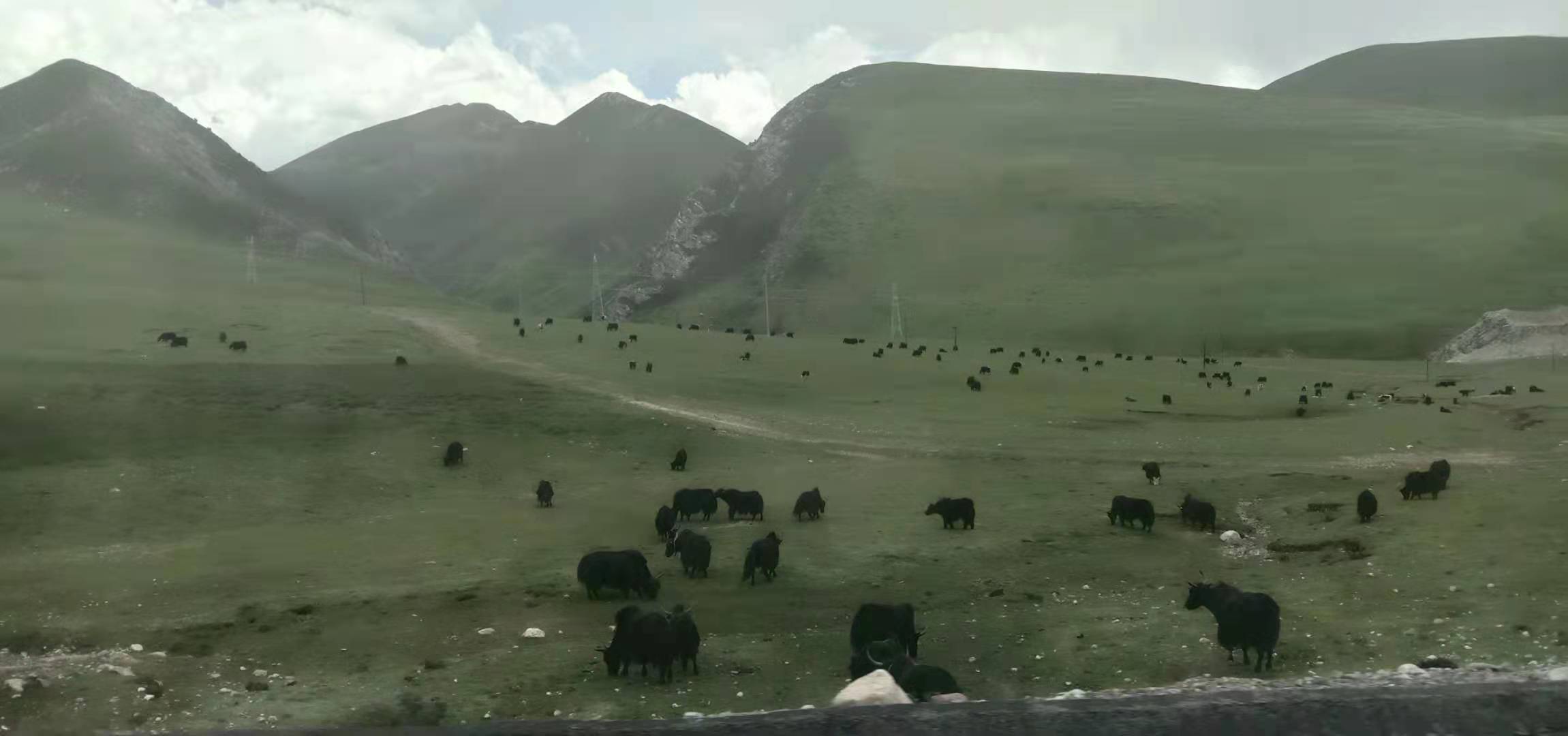
After the break we drive on. We pass through a few villages, but the landscape generally has far more yaks in it than people. At some point I see a big river snaking through the valley below, and I am told it is the Yangtze river. Then I see a large phrase engraved on the side of the mountain above the river, saying in typical Chinese style 万里长江第一湾 ("This is the first bend in the Yangtze River"). Clearly we must be close to the source of the great river, but it already looks very large.
On occasion I see bundles of Tibetan prayer flags strung together around a pole. Prayer flags are pieces of colourful rectangular cloth inscribed with mantras in Tibetan, a common sight on mountains across Western China. Obviously influenced by Chinese religious practices, I had supposed the prayer flags might be a way of asking for wealth and good health from the gods, but my friend tells me that their real purpose is to protect the mountain. Tibetans believe the flags' prayers and mantras are spread by the wind, bringing compassion and good will to the surrounding space.
After about four hours of driving we reach the county town of Qumarleb, where we stop to eat in a good Sichuanese restaurant. More of Amala's relatives join us, including her sister, who works in the local government in Yushu and is very friendly too. To my total lack of surprise, the county town is an unimpressive collection of one-storey buildings perched incongruously in the middle of the Tibetan plateau. Local culture is still celebrated, however, in the form of a statue of a yak and another one of the four harmonious animals, a common theme in Bhutanese and Tibetan Buddhist art.
 |
| A statue of the "four harmonious animals", Qumarleb |
By the time we finish eating the sky is dark, and we leave the town and drive on into the wilderness. The road has no lights, and outside the window everything is pitch black. We drive for around two hours in unbroken darkness, until suddenly I see a light flickering in the distance. It's the monastery. After another half hour driving up winding paths, we reach it. It feels like we've reached the end of the world. I can make out little in the dark, but I get out of the car and am shown into the monastery's guesthouse. Conditions are not exactly luxurious. There are two large rooms, one for men and one for women, and beds with thin mattresses of the kind you still find in rural China. There is no chance to shower, and the only running water is provided by an outdoor tap. The toilets are also outside, quite a distance away and very spartan.
That night I find it hard to sleep because of the altitude, which is over 4000 metres in this region. As soon as I start falling asleep, I have the uncomfortable feeling of not being able to breath and I wake up. This goes on for a while until exhaustion takes over and I finally sleep. The following morning I wake up early and go outside to take a look around. The monastery is perched on the side of a hill, overlooking a valley. The sky is a lovely blue you don't often see in Beijing, and the air is thin and clear.
 |
| The monastery guesthouse where I stayed |
 |
| A view of the whole area, with the monastery up above and the temporary campsite in the valley below |
The area is so high up and remote that mobile phones often have no signal (a rare event in China). There is a building where the monks and the lama live, a row of white chorten, and a new ceremonial hall whose official opening will be marked by the upcoming ceremony. There are also some Han Chinese labourers doing some building work for the monastery, and their living quarters. Down in the valley below, a few hundred metres away, is a big flat area where Tibetans who have come to attend the ceremony are sleeping in tents. Amala and her family have their own tent down in this area.
I go back to the guesthouse and a monk gives me a glass of butter tea (made from yak butter) and a bowl of tsampa mixed with more butter tea for breakfast. This is the staple Tibetan breakfast, and at first the tsampa seems so alien that I have no idea how to eat it, but a Tibetan man shows me how it's done. I have to drink the liquid first, and then use my hands to knead the tsampa powder into a dumpling-like form that's ready to eat. It doesn't taste bad, and it certainly fills me up and makes me feel good, as if it were made to be consumed at these altitudes.
After having breakfast, Amala takes me to meet the lama who heads the monastery. He is a man of around thirty who wears glasses, and projects an air of calm and intelligence which sets him apart from the somewhat rougher men around him. As far as I am given to understand, this man was identified as the reincarnation of a previous lama as a child, and trained in the Buddhist scriptures.
The lama takes me to see the inside of the new hall, which looks impressive, with statues of the Buddha. I am told that this monastery belongs to the Gelug school of Tibetan Buddhism. There are four major schools of Tibetan Buddhism, with different lineages and doctrinal focuses, but the Gelug school is the largest and the one the Dalai Lama belongs to. The different schools have a history of mutual suspicion and animosity, but nowadays this has mostly subsided, and all the different schools worship the current Dalai Lama and are acknowledged by him.
 |
| The monastery's new hall, about to be inaugurated |
 |
| The biggest statue of the Buddha inside the hall |
After leaving the lama, I walk down a little path on the side of the mountain and go down to the area where the Tibetan visitors have pitched their tents. There are nomads and villagers from the surrounding areas in traditional clothes, as well as townsfolk in modern clothing. Many of them have driven to the area in SUVs, which are common in Tibet due to the difficult terrain. The atmosphere is like a village fair. There is even a basketball pitch where a bunch of youngsters, including apprentice monks in red robes, are honing their skills. I am taken into a large tent where a group of women are cooking lunch for everyone. The tent is made of handwoven yak wool, and the meal includes plenty of yak meat. Every part of the yak is made use of in Tibet, including yak dung, which is used as fuel.
The consumption of yak meat may appear to be contradictory, since Tibetan Buddhists are generally loathe to take the life of any sentient being. This principle is still followed by ordinary Tibetans to a surprising extent. Fishing is unheard of, and many Tibetans will even refrain from swatting mosquitoes. I had always assumed that the scene in "Seven Years in Tibet" where the Tibetans drive the Austrian protagonist crazy by insisting that they cannot kill a single worm in the process of building a movie theatre was exaggerated, but Amala assures me that it is realistic.
This is one Tibetan attitude that is nice to witness when you come from the monotheistic traditions of the West, which have never given much importance to the rights and feelings of other species. In Tibetan Buddhism, a sentient being is a sentient being. And yet Tibetans are mostly not vegetarian, and yak meat has always been a fundamental part of their diet, alongside yak butter and milk. The historical justification for this is that growing vegetables in the Tibetan Plateau is extremely difficult. Tibetans will also point out that slaughtering one yak can feed a family for weeks, while if you eat smaller animals like fish you may have to take several lives just to have a single meal.
Something else I find striking, probably because I live in China, is that everything is free. The meals are cooked by volunteers, and the hundreds of people who have come for the ceremony are offered free meals and a place to plant their tent for as many days as they wish. My friend explains that many of these people support the monastery through donations, and that even today poor rural families may donate 20-30% of their earnings to the monks. She talks of this admiringly, as evidence of Tibetans' lack of materialism and of their giving and spiritual tendencies.
I am well aware that this is exactly the sort of thing that led Marxists to describe religion as the "opium of the people", and Chinese Maoists to depict Tibet as a feudal society where the monks exploited the gullible serfs. Outsiders have long tended to either romanticise or demonise Tibetan religion and society, but it strikes me that in the past this phenomenon may have been little different from farmers paying taxes to their local lord, except with a spiritual dimension. In any case, today such practices cannot be separated from the larger scenario of Tibetans being a small minority within a much larger country and struggling to retain their cultural identity, which like it or not is inseparable from their Buddhist faith.
In the afternoon I have a lazy picnic with my host family, while the children play in a stream nearby. I spend too long in the unforgiving high-altitude sunlight, which leaves me quite sunburnt the next day, in spite of the sun lotion I smear on my skin in abundance. Among Amala's relatives is a boy of about ten who is studying to become a monk. He lives in the monastery and wears the red robes of a monk. There are also two teenage girls who go to school in Xining, the provincial capital, and look and speak just like any urban Chinese teenagers. They speak to each other in Chinese, and feel more comfortable speaking Chinese than Tibetan. Most of the family's children seem to talk to each other in a mixture of Chinese and Tibetan, and are clearly far more comfortable speaking Chinese than their parents' generation.
My friend's family may not be typical, since they are clearly well-to-do and don't all live locally. Most of the chatter I hear throughout the campsite is in Tibetan. But it is clear that, just like everywhere in China where minorities reside, the Chinese language is gaining ground at the expense of the local tongue. People tell me that while there is still a choice between Tibetan-medium and Chinese-medium instruction for children at the primary level, it is made much more advantageous to learn in Chinese. Instruction at the higher levels of education has long been in Chinese.
Then again, Tibetans are a proud people, and their determination to make their culture survive has clearly never wavered. For instance, most young Tibetans in China use iPhones because they have a good function for writing in Tibetan, which Chinese-made phones generally lack. Tibetans also never adopt a separate Chinese name, as many people from ethnic minorities (and foreign residents) do in China. Their official Chinese name is almost always just a transliteration of their Tibetan one.
It is also quite noticeable that the Han Chinese, as a people, remain unpopular among Tibetans. Relations between Tibetans and Han tend to be polite at a superficial level, but if you broach the subject with Tibetans in a private setting, they will often be quite open about their dislike of their "Han compatriots", who they see as overbearing, greedy, materialistic and unfriendly. These feelings feed into a resentment of the state that has never died.
My experience is that the young are often most vocal about such "subversive" sentiments, and fluency in Chinese or time spent living in other parts of China does not change these perceptions. In fact, it often reinforces them. Experiences of casual discrimination, like arriving in a hotel or airbnb only to be denied a room because of having an ID that says "Tibetan" under ethnicity, serve to further alienate people. I will never forget sitting with a young Tibetan in her SUV under the driving rain, listening to her tell me how much she resents the government she works for, and how she is only telling me these things because so far up into the mountains our smartphones pick up no signal (so there is no chance we are being recorded).
 |
| Apprentice monks taking part in a basketball game |
That evening I am invited into a big tent, where alcohol is being offered to some important guests in the traditional Tibetan way. A woman presents three small glasses on a tray to the guest, while behind her some men play traditional Tibetan music. When the glass of liquor is offered, the guest must dip their third finger in the alcohol and flip it in the air three times, which indicates toasting towards heaven, earth and their ancestors, before emptying out the glass. To my embarrassment I am also offered alcohol in this way, but I only drink a sip with the handy excuse that I am suffering from high-altitude sickness.
Later in the evening it suddenly starts pouring with rain, and the temperature drops significantly. The lama himself gives me a lift back up to the monastery in his car. The following morning I wake up to find the monastery has become a hive of activity. This is the big day of the ceremony, and more people from all over the region have come to attend. Almost everyone is wearing their most impressive traditional clothes, including Amala and her sister, who normally dress in Western clothing. I am obviously conspicuous, and I think that it might be best to stay out of sight for the time being, since I'm still not entirely certain whether my presence may cause problems.
I retreat to my dorm in the guesthouse, but soon enough a group of people come into the dorm and sit in a circle on the beds (there are no chairs), including some of the local potentates/officials. I sit on my bed trying to look inconspicuous, but of course my presence attracts attention. Men chat with me in heavily accented Chinese, and offer me butter tea. At some point a group of police officers in uniform enter the room to pay their respects, and I get nervous and depart. I am still not sure whether I should try and keep out of the police's way, but later I understand that there is really no issue. The local police are Tibetans too, and Amala and her family know some of them personally, which makes everything easier. No one shows any sign of being bothered about my presence.
As the morning progresses, new lamas start to arrive at the monastery. I am told that over 30 lamas will be present for the event. This is a big deal. A lama is not simply equivalent to a monk, but is a revered figure, and you don't often get that many in one place. The genuine reverence that ordinary Tibetans feel for the lamas is in full display. Some people bow deep whenever a lama passes and remain bowing until they depart, while others rush to receive their blessing. There is one elderly lama dressed in civilian clothes who survived persecution during the Cultural Revolution, and is particularly respected in the area. Another lama, with sunglasses and a ponytail, is also known to be a yoga teacher.
It is clear that Amala and her family are in their element here. They are originally from this county, and they seem to know pretty much everyone. Her father, the official who speaks so glowingly of government policy, is also wearing traditional clothing on this day and is busy getting blessed by one lama after another.
Between the lamas and the crowds in traditional clothing, the feeling of being in a different culture is strong. While I am the only foreigner present, I am not the only outsider. There is a handful of Han Chinese who have come for the ceremony, including a lady from Xining and her teenage daughter who were invited by one of Amala's relatives because they were classmates at university, and another small group who must have been invited by someone else. They are dressed like typical Chinese backpackers and are busy taking photos with professional cameras. There is little doubt that, in this setting, these urban Chinese feel as much like outsiders as I do.
The ceremony for the opening of the new hall turns out to be more bureaucratic than religious in nature, and rather Chinese in style. There is a stage with two long tables where the lamas and local officials sit, with a large red banner behind it proclaiming the opening of the hall in Chinese and Tibetan. The crowd is all seated on little plastic stools of the kind you find at public events in rural China. A couple of the lamas take the stand and make speeches. As the elderly lama who survived the Cultural Revolution speaks, I catch a couple of Chinese words that he repeats several times during his speech in Tibetan: zhongguo gongchandang, or Chinese Communist Party, and Deng Xiaoping. At first I assume he is just repeating platitudes about the Party, but then I wonder why he would mention Deng rather than the current supreme leader. Later on, I learn that the lama was actually telling his people that they should thank Deng Xiaoping's reforms that they are now able to hold such ceremonies at all.
As the lamas speak a handful of policemen stand around and look on, while the crowd ignores them. I am told that in the Tibetan Autonomous Region it would not be possible to hold a ceremony of this nature with so little interference and supervision. Here in Yushu, however, the authorities are ready to keep one eye closed about many things. It is not strictly legal, in fact, for the children in red robes that I see running around to live in the monastery and study as monks, and yet they do. The laissez-faire attitude with which the Chinese state dealt with minorities 20 or 30 years ago still seems to be alive here.
This is not to say that the practice of Buddhism is conducted without interference. The impression I receive is one of monks and laypeople following their spiritual tradition in relative freedom, and this may well be true (although not every aspect of the situation is visible to an outsider), but there is an elephant in the room, and that is the old lama residing across the border in India. His name and image are banned. On the occasion when the topic comes up, Tibetans whisper the words "Dalai Lama" to me, since saying them out loud in public is best avoided. He is still the unquestioned leader of Tibetan Buddhism, and yet you will not see his photo in monasteries next to those of other important lamas.
All the same, people assure me that Tibetans continue to revere him in private, and many would like nothing more than to take a trip across the border to see him speak. This is a matter of great chagrin for the authorities, and it is why going to India has long been forbidden in practice for Chinese citizens of Tibetan ethnicity. A few years ago Nepal also became forbidden, as the authorities realised many Tibetans were getting into India illegally from there. Those who manage to make their way to India via a third country have to be very careful that this is not discovered, or they will be in for trouble when they return, including, in one case I have heard of, having their passport ripped up in front of them.
After about an hour of speeches, the ceremony ends. As the crowd disbands, a long line of people forms in front of the building where the monks and the lama live, carrying scriptures wrapped in red as a gift for the monastery's head lama. Amala takes me inside the building, into the lama's living quarters, where people are lining up to give him the gift and receive his blessing. There is no way I could intrude in this way without a respected member of the local community by my side. I can't help noticing that the building includes a modern bathroom, something that does not seem to exist anywhere else in the area.
Slowly everyone makes their way down to the campsite, where lunch is being served under a large tent. At some point a man who is clearly a powerful local official swaggers in. He is Tibetan, but looks just like such officials do all over China, with a large belly and a sense of self-importance about him. He makes his way to a table where a group of men are seated, and the men immediately stand up and toast him with great fanfare, offering him three cups of alcohol in the traditional way described earlier. The official then starts singing in Tibetan, and goes on for quite a long time. He sings ok, but he's no great tenor. The men all remain standing, and awkwardly clap along. I get the strong feeling that they are giving the man face because he is important, and that this is someone who no one dares to interrupt.
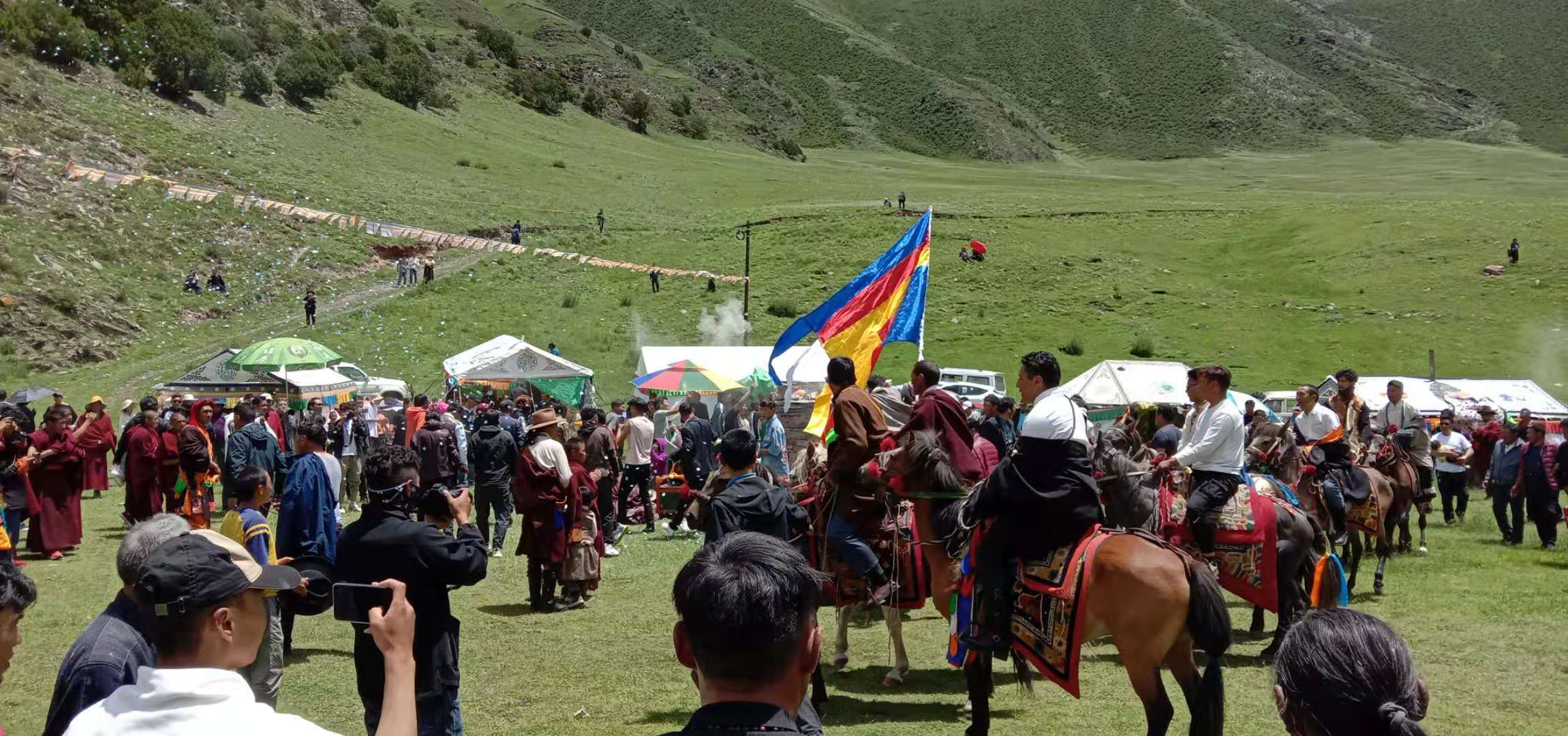
After lunch all the lamas gather together one last time to chant scriptures, under the eyes of the crowd. I am napping in the shade, but I hear their hypnotic chants. I wake up to excited cries, as a bunch of men in traditional Khampa costume ride on horseback around a stone altar spewing out smoke, one of them carrying the multi-coloured flag of Buddhism that dates back to the 19th century.
A rather more secular celebration takes place later in the afternoon. There is a show of traditional Tibetan dances, followed by local singers crooning in Tibetan. The show has two presenters, one speaking in Tibetan, and the other one repeating everything in Chinese. Three of the lamas are in the audience, and they are given the place of honour under a large umbrella, while everyone else stands or squats under the strong rays of the midday sun. The show goes on for hours. Just after it ends it starts pouring with rain again, and everyone repairs to their tents. I think how lucky it is that it didn't rain during the day, or the ceremony would have been ruined. Perhaps the gods were smiling on us. That evening we all drive back up to the monastery and sleep in the guesthouse, since the temperature has dropped and the tents don't offer as much warmth.

The next day, after breakfast, we leave the monastery. Just before we drive off, we see a monk blowing on a conch shell, a holy symbol in Tibetan Buddhism. Amala and her relatives all crowd round the monk and bow down deeply while the sound lasts. After he finishes blowing on the shell, the monk taps each one of us on the head with it, giving us his blessing. After witnessing this last bit of religious tradition, I get into the car as we set off on the six hour drive back to Yushu. The prefectural capital seemed like a sleepy two-street town when I flew in from Xining. Coming back from rural Tibet it seems like a metropolis, with lights, restaurants, consumer goods and, most importantly, showers.
The hotel I stayed in last time is full, so I book a room at another hotel that takes foreigners. This one is run by Han Chinese from outside the area, and when I check in they are suspicious. They want to know if I'm vaccinated against Covid-19, the first time I am asked this. Being vaccinated is not supposed to be a requirement to stay in hotels or travel. I tell them I am not, and after lecturing me about how I should get vaccinated the guy in charge lets me check in. This is a hotel that clearly tries to be fancy, and the room seems nice. I am really looking forward to my first hot shower in days, but am mightily disappointed when I find that the water in the shower is only lukewarm, not hot. For a 400 Yuan-a-night room this is not what I expected.
Over the rest of my time in Yushu I encounter exactly the same thing in all the other hotels I stay in: the showers don't really have hot water. In a cold climate like the Tibetan plateau this seems amazing, and these aren't cheap places either. Apparently the hot shower I had on my first night in town was a fluke. I have to say that I found the hotels in Yushu to be one of the worst aspects of travelling there. Usually in remote areas of China hotels are at least cheap if nothing else, but out here they are both overpriced and mediocre.
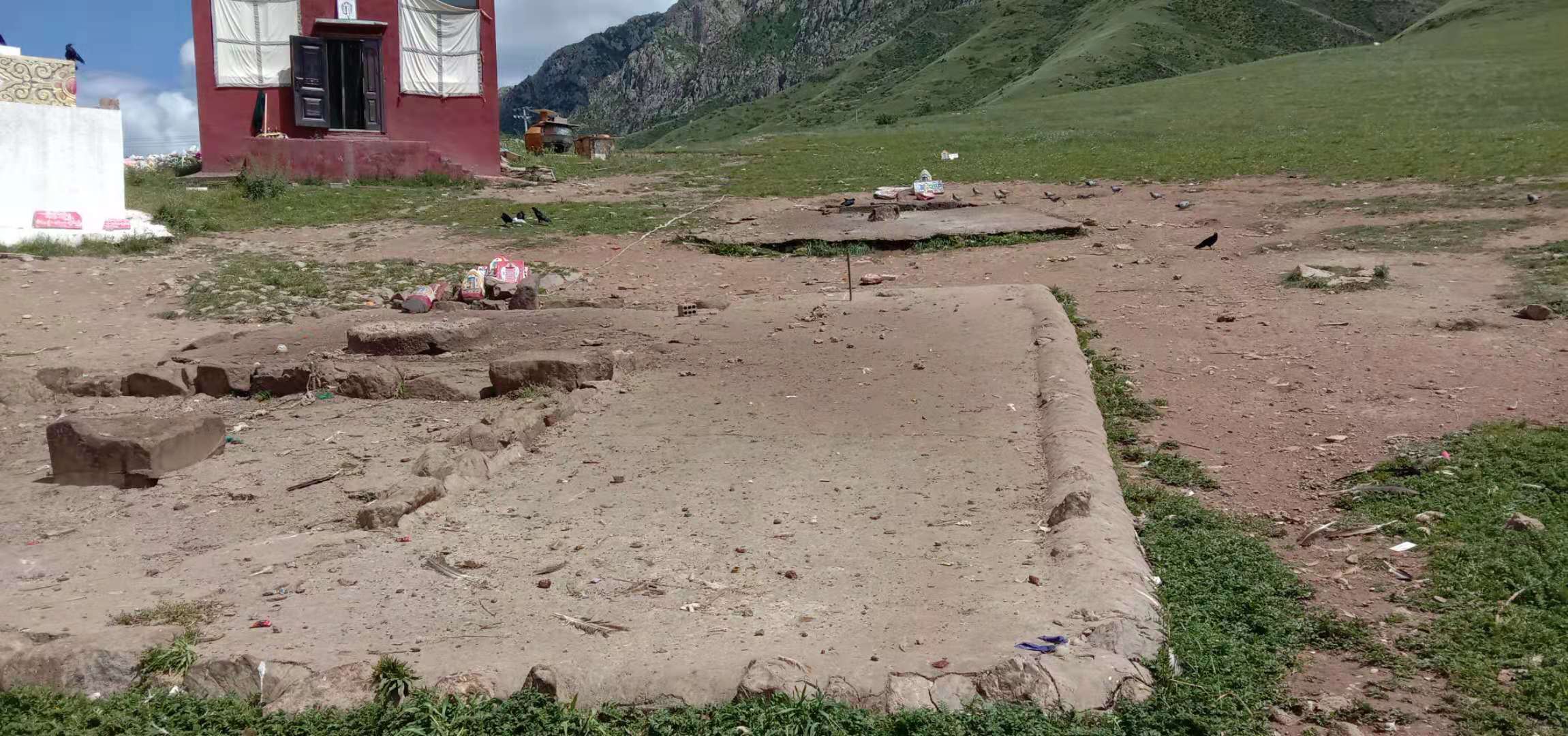
The next day I remain in Yushu, and Amala's sister is kind enough to drive me around town and show me all the local sites. Most interestingly, she takes me to the site where the locals conduct the ancient Tibetan tradition of the sky burial. It is located on a patch of flat ground next to a temple. There are a couple of stone platforms where the bodies are disposed of. We arrive a few hours after a funeral has been conducted. The remains have mostly been disposed of, but there are still crows chipping away at small bits of bone and flesh, and streaks of blood on the stone. The hammers used to break up the bones are also visible.
It's all rather gory, but Amala's sister assures me that Tibetans do not see it that way. In fact they do not fear death, precisely because they witness such ceremonies. Next to the burial ground is a small red building, with little statues connected to Tibetan astrology. Tibetans believe in the same progression of years as the Chinese, with years of the rat, ox, tiger etc... Amala's sister ask a monk where she can find the statue connected with my astrological sign, and he tells her. As we leave the monk says something in Tibetan in a strange tone. She translates it into Chinese for me. It turns out he said "Good job your friend is a foreigner. If he were Han, I wouldn't show him these things".
Later on I am taken to see the Song-ze Gyanak Mani wall, the biggest collection of mani stones in the world. Mani stones are rocks or stones of varying sizes with mantras inscribed or carved on their side in Tibetan. The most common mantra is always om mani padme hum, but there are other ones too. Creating and carving mani stones is a spiritual exercise, and they are placed along the roadside or rivers or stacked together to form mounds or walls.
The mani wall outside Yushu is said to have been founded in 1715. It was destroyed in the earthquake of 2010, but it has now been completely rebuilt. I did not feel that the fact the site was rebuilt took anything away from the experience of going there, since the age of the mani stones themselves is clearly not the point; the point is rather the meaning behind the whole thing and the devotion of the pilgrims.
The complex consists of two to three million mani stones, piled on top of each other across a square kilometre. There are always plenty of pilgrims, circumambulating the complex in a clockwise direction, as you should do in Tibetan Buddhism, because that is the direction in which the earth and the universe are believed to revolve. There is also an area where it is possible to buy a mani stone from a series of vendors, and then have it deposited onto the mound. This is what pilgrims generally do, and it is how the site keeps growing. The smaller stones sell for just a few dozen Yuan, while the larger ones can be quite expensive.
 |
| The stone platforms where dead corpses are broken up and fed to the birds. |
 |
Pictures of the Song-ze Gyanak Mani Wall
|
 |
| Pile of Mani stones on the side of the street in Nangchen |
That afternoon, we drive to see a memorial to the Yushu earthquake on the outskirts of town. Next to the memorial, a collapsed building has been kept in the state it was in immediately after the quake, with metal beams holding it up. It's terrifying to think of people being trapped in there. This is very literally the only building still in this state that I see anywhere in the entire prefecture. Both Amala and her sister have terrible tales of the quake's aftermath, of walking through streets reduced to rubble and seeing death and destruction. They both insist the official death toll of 2698 people is vastly underestimated.
 |
| A building preserved the way it was after 2010 earthquake |
The next day I set off for Nangchen (Nangqian in Chinese), Yushu's last county to the south before you reach the "forbidden" lands of the Tibetan Autonomous Region. Nangchen's main draw is the scenic Gar temple, located on the side of a mountain, that earns it a trickle of visitors. I go to Yushu's bus station to take a minibus to Nangchen, and there is drama when I try and board the bus. The guy at the ticket counter used his own name and ID number to buy me my ticket, because he did not know how to enter a foreign passport number into the system (nowadays you need ID just to buy inter-city bus tickets in China). When the minibus's driver sees a Chinese name on my ticket, he gets upset and says he will not take me, because that's clearly not my name and he doesn't want trouble with the police. He looks concerned, and adds "I don't dare take foreigners".
I have to go back out of the station to the ticket office, find the ticket seller, and ask him to re-print my ticket with my own name and passport number, and then come and speak to the driver and assure him it's all ok. The driver is still dubious, but after asking me whether I have been abroad recently (this would mark me out as a potential Covid-19 carrier), he relents. He is a Tibetan man, and not unfriendly, but he just doesn't want trouble.
In the minivan there is another tourist, an older Chinese man who turns out to be from Beijing too. He tells me that he comes to the Tibetan plateau every year and loves it. He sympathizes with me regarding the trouble foreigners have to go through to travel in the area. He seems like a genuinely nice guy, with a sincere passion for Tibet and its culture. He says that Amdo and U-Tsang have even better views than Kham, and snow all the year round.
We drive for about four hours, through more Tibetan scenery. I kill the time by listening to ANU, a Tibetan pop band to which I have just been introduced in Yushu. They come from Nangchen, the place I am going to, and their songs have become hits throughout the Tibetan-speaking world. Since they live in China they have to avoid political topics, but I find their music quite refreshing.
As our van approaches Nangchen's county capital, Sharda, we are stopped at a police checkpoint. The police ask everyone to get off, and unsurprisingly get very concerned when they notice me. They ask me all sorts of questions, and rummage through my backpack quite thoroughly. At first they say that after checking in to my hotel I should go to the local police station to register. This would be huge trouble, and invite further problems. It's especially unnecessary when you consider that my hotel will automatically register me with the PSB in any case. While remaining friendly, I give them a look that says "are you kidding me", and they relent. We agree they will call my hotel if they need any further information.
I take a taxi to my hotel, and the driver immediately starts haggling with me: I plan to go to Gar temple, don't I? He'll take me there and back for 500 yuan. He leaves me his number and dumps me at my hotel, which may well be the only one in the whole county currently accepting foreigners. It turns out to be a new, imposing building incongruously located in the middle of a wasteland in the town's unimpressive outskirts. As ever, the staff are suspicious and ask all sorts of questions. After I check in and go up to my room, a few members of staff come and knock on my door with yet more questions: where will I visit in Nangchen? When am I leaving? Where will I be heading?
That evening I take a stroll into town to find something to eat. The town is a similar size to Yushu, but it looks far less developed and prosperous. The dusty streets, unfinished buildings and numerous cows meandering about remind me strongly of India. The town centre is a little more lively, but still looks quite impoverished, and unsurprisingly everyone stares at me. Yushu may get the odd foreigner, but here you get none, especially nowadays. I find what looks like a reasonably big and reputable restaurant with the sort of menu you might find anywhere in China, and I have a large dinner. On the way back, the driver offers to take me to Gar Temple for less than what the other guy offered. We agree on 400 Yuan.
 |
| Flats in Nangchen, with the open-air balconies favoured by Tibetans |
 |
| The main square of Nangchen |
 |
| Village outside Nangchen |
The next morning, the same driver comes to pick me up and take me to the temple. Gar temple is a two hour drive south of the town, and the only way to visit it is to rent a taxi for the day. The driver and I try and chat, but he is Tibetan and his Chinese is so bad that going beyond the basics proves impossible. Half way to the temple, we stop at a checkpoint. As expected, I have to get out of the car and go inside the police station, where I have to register by filling in a form. I begin to realise how lucky I was that there were no police checkpoints when I went to the monastery with Amala's family. I have no idea how we would have explained what I was doing and where I was going to stay. I suppose checkpoints are more common when you travel towards Tibet proper, and here we are almost at the border.
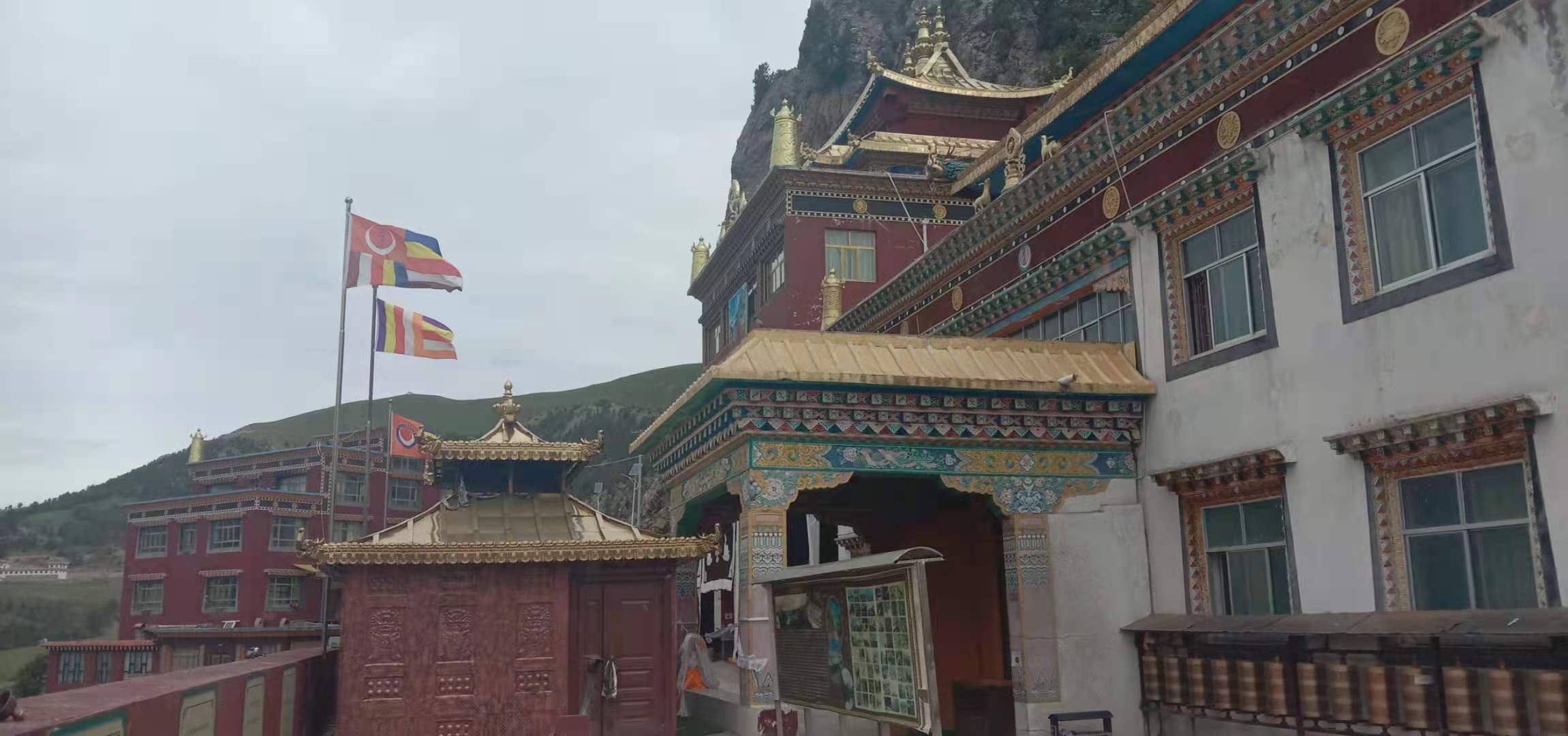
After another hour we reach the temple. It is indeed very scenic, perched on the side of a mountain that reminds me of the Alps. There are blue sheep milling about and Tibetan monks walking back and forth, and also a smattering of Han Chinese tourists taking photos. I walk up a staircase to the top of the temple for a better view, and my altitude sickness almost gets the better of me. Walking up 20 metres of stairs causes me to gasp for breath for a full minute. I wonder if my body could ever get used to living at these altitudes.
 |
| Gar monastery, with two flags of Buddhism fluttering at the front |
 |
| The whole monastery seen from a distance |
On the way back down to the valley below, we see three men sitting in a field picnicking. My driver stops and beckons me to get out. It turns out the men are his relatives, and we are going to join the picnic. They kindly offer me some of their food, and start chatting with me. One of the men speaks Chinese well enough to have a proper conversation. He asks me if I'm married, and when I say I am not, he says "You should marry one of our Tibetan girls. You'd have a great life. She would cook and wash your clothes for you, you could take things easy."
I make an attempt to explain that where I come from we believe in equality of the genders. He says "oh, there's nothing unequal about it, because in Tibet the men go out to 干活 (work, make a living), while the women do the housework, so it's fair". Amala had complained to me that Tibetan men tend to be sexist in this way, expecting their wives to do all of the housework for them. Later she tells me that men from Nangchen are well-known in the region for being particularly patriarchal.
The next day, I return to Yushu. This time I take a private taxi, because the driver offers me a great rate. Once again, his Chinese is bad enough that we have trouble communicating (it may not just be because his mother tongue is Tibetan, but also because of the influence of the local dialect of Chinese, which fails to distinguish between H and F among other things). We drive a few hours, and as we approach Yushu, we are stopped at the inevitable checkpoint.
This time the experience is especially drawn out. I am kept inside the police station at the side of the road for half an hour, and I begin to wonder if they are going to let me through at all. They ask me several times if I registered with the police when I was in Nangchen, and insist on calling the hotel I booked in Yushu to make sure it can take foreigners. To their credit, they are friendly and offer me tea. My driver has to wait inside with me, and he is understandably not pleased about wasting all this time. I wonder if he will be as ready to give a foreigner a lift in the future.
After we are finally allowed to proceed, my driver drops me off at the hotel I have booked. The staff at this hotel are the most suspicious yet, and after checking in I am asked to go to a store across the street to take a passport-style photo. Once I am in my room, I get a phone call from the local Centre for Disease Prevention and Control, asking where I have been over the past 14 days, and when I entered China. The friendly woman on the other side of the line seems to realise I'm not a threat, but she says that I may have to take a PCR test. Great, I think. Within half an hour I get a knock at the door. A woman is standing there with the full PPE suit, ready to swab me. She has a nice manner, but the nasal swab is like the ones you are given in quarantine after entering the country, long and thorough. Luckily my nose doesn't seem to be too sensitive to swabs, but it's still unpleasant.
The woman tells me that there is soon going to be a festival in town, and there are plenty of outsiders coming in, so they are requiring a negative PCR test from all arrivals. It is true that there is a horse-riding festival coming up in Yushu, and there is a new outbreak of the Delta variant in Nanjing which seems to be spreading to other parts of China, partly explaining the paranoia. I still think it is likely, however, that my foreignness is what caused them to spring into action so readily. In spite of the fact that no one can enter China without going through 14, and in most provinces 21, days of quarantine, and in spite of the fact that the vast majority of people entering the country from abroad (and in some cases bringing the virus with them) are themselves Chinese, the presence of a foreigner continues to inspire irrational fear in local authorities across China.
In any case, now that I am done with the PCR test, I still have a couple of full days left in Yushu. The town definitely has more going for it than meets the eye. I spend much time on my laptop in a large Western-style cafe' (or rather, Chinese-style Western cafe') overlooking the main square, which attracts all the local hipsters. My local friends take me to Yushu's bar street and to the town's weekly English corner, which is run by a Tibetan man who spent years in India. At the English corner I meet what seems to be the only other foreigner passing through Yushu, a Serbian man who works as an English teacher in Beijing and is travelling in Qinghai. When I meet him, he is supposed to fly back to Beijing the following morning. He is staying in my same hotel, and the staff have been calling him all day to ask him to go to the hospital and get a PCR test. He already has gone to the hospital, but perhaps due to a miscommunication (his Chinese is only basic), he was unable to get tested. The hotel is still calling him, but he has decided not to answer.
That evening, I later learn, the Serbian goes back to the hotel and finds that his room card has been deactivated. He goes to the reception, and is immediately dragged to the hospital. When he gets there, his temperature is taken and it is found to be over 37. He is promptly put in quarantine in an isolation unit until his PCR test's result comes out the following morning. He spends the night in pretty awful conditions, misses his flight and ends up extending his stay for another day and buying a new ticket. While this story is indicative of the authorities' unjustified paranoia, I think another lesson to draw from it is that not picking up the phone will not make a problem of this nature go away, and that travelling in such a remote area without speaking much Chinese is a foolhardy thing to do.
I am lucky to be in Yushu at this time, because it coincides with the annual horse-riding festival mentioned above. The festival has existed for centuries, and it attracts Tibetans from all over Kham. But this year celebrations are especially big, because it is also the 70th anniversary of the establishment of the Yushu Tibetan Autonomous Prefecture, in other words of Yushu's incorporation into the PRC, and a large show has been organized by the local government. A stage has been set up in the main square outside my hotel, and every evening Tibetan dancers rehearse until late. I will not be able to see the show itself, because tickets cannot be bought, only obtained through government channels; but I will be able to catch the full dress rehearsals, which will be open to the public and should be just as impressive.
On my last day in Yushu I go and see the rehearsals, which are being held in an impromptu outdoor stadium in the grasslands outside the town. This being China, the stadium is huge and the show is impressively choreographed. It consists of an interesting mix of Tibetan culture and communist iconography. There is plenty of horse riding, with long-haired nomads rushing around the stadium on their stallions waving swords. There are yaks, mountain goats and Tibetan dances. But there is also a parade of local students dressed like soldiers, with a large picture of Chairman Mao, and a huge hammer and sickle on the inner face of the stadium. There is a massive re-enactment of the Yushu earthquake, with hundreds of actors falling to the ground in a spasm, and then hundreds more rushing in dressed like soldiers and firemen to save them, many waving Chinese flags. Amala, who is there with me, comments that those who did the best job of rescuing people after the earthquake were Buddhist monks, but they get no mention. Indeed, at no point in the show do I see any reference to Tibetan religion, although it is at the core of local identity.


To be clear, the atmosphere is by no means one of coercion and fear. Half the town is here, and they are clearly excited and happy. People who are unable to enter the stands crowd around the entrance to catch a glimpse of the parade. The riders and dancers give every impression of being genuinely happy to show off their cherished culture. At the same time, I doubt all of them would accept that the events of 70 years ago are something to celebrate. From the 13th century, Yushu was the seat of a tribal confederation known as the Kingdom of Nangchen, essentially independent from both the Ming and Qing dinasties and the Tibetan government in Lhasa. In the 18th century the area nominally accepted the sovereignty of the Qing dynasty, as did most of Tibet, but this was only on paper. In 1951 the last king of Nangchen, Trashi Tsewang Dorje, accepted his kingdom's incorporation into the PRC. This is the anniversary that the parade is commemorating, although any open suggestion that Yushu was "not part of China" before 1951 would, of course, be completely taboo.
After a while I go back into town, and take a look at the local museum. It contains some pretty good quality material on the local flora, fauna, history and culture, religion included, but when it comes to modern history it unsurprisingly delves into some dubious propaganda. A portrait of Xi surrounded by adoring crowds in Tibetan costume also cannot help but catch my eye.
That evening I go to the night market for a bite to eat, and I am overwhelmed by the hospitality of the vendors. I buy some dumplings from a lady at one stall, and while I sit and wait for my food two other women working at different stalls separately bring me a glass of tea and some more dumplings for free, while they ask me where I am from and what brings me to their hometown. Tibetans really are a very hospitable people, no question about that. I don't normally get people throwing free food and drink at me like this when I travel.
The following morning I go to the airport, and fly back to Beijing via Xining and Xi'an. I am a bit sorry to leave the quiet of the Tibetan plateau, but the real world beckons me back. China is busy stamping out the new Delta variant outbreak that began in Nanjing, and I am vaguely worried about transferring in a city with Covid-19 cases, lest the authorities give me trouble when I get home. In the end the new outbreak will be contained, as always, but in the airports the change in mood is palpable. Fortunately I fly to Beijing and return to my apartment without incident. My first journey to Tibet is over. I hope one day, if things change, it will become easier to explore the whole of this fascinating land.