Sunday, July 14, 2013

Corruption and the death penalty in China

Last week China’s new anti-corruption campaign made an illustrious victim. Liu Zhijun, who used to be China’s Minister of Railways, received that strange Chinese form of sentencing which exists nowhere else in the world: the death penalty with a two year reprieve. When this happens, the sentence is usually commuted to life imprisonment after two years.

The court found that during the course of his career Liu Zhijun helped eleven people to receive promotions and contracts, and got a total of 64.6 million Yuan (about 10 million dollars) in bribes from them in return. As well as the death penalty with a two year reprieve, Liu was also given a 10 year prison sentence for abuse of power, and his personal property was confiscated.

In China corruption is punishable with the death penalty if the sums acquired illegally go beyond a certain threshold, which in this case was abundantly passed. However, in view of the fact that Liu readily confessed to all of his crimes including ones which were unknown to investigators, and that most of the stolen assets were recovered, it was decided to be “lenient” and hand down a suspended death sentence.

What I find rather unsettling is the reaction of many ordinary Chinese to the case, which I gathered both from my discussions with colleagues and acquaintances and from comments I have seen on Weibo (China’s Facebook). Basically, most people’s feeling seems to be that the guy should have gotten the death penalty without a reprieve, and been executed for real.

This was certainly the opinion of two of my Chinese colleagues with whom I discussed the issue on the bus yesterday. They claimed that corrupt officials who get a two year reprieve sentence end up being released after ten or fifteen years, after which they can take off abroad and enjoy their wealth. When I argued that his property had been confiscated, they claimed that he was bound to have more money which hadn’t been found, and had probably already bought a house in the US.

This is an argument which I have already heard before. Corrupt officials who are condemned to death with a two year reprieve are then released after “only” a decade or so, and can enjoy their ill-gotten gains. It’s almost as if they weren’t punished at all! When I told my two colleagues that in a European country the guy might have received no more than ten years in prison from the start, they were very surprised (even though one of them actually studied in France for some years).

When I said that I thought a decade in prison is a heavy enough punishment for corruption, they were disdainful. They pointed out that Liu Zhijun’s crimes might have been responsible for the terrible Wenzhou high speed railway crash in 2011, where people lost their lives. I argued that killing people indirectly is not the same as killing them directly, but this argument didn’t go very far with them. Other Chinese I have spoken with have expressed similar views.

Then on Weibo minor internet celebrity Yanhua Meimei, better known for the sexy photos of herself which she often releases online, posted a comment on the case. It reads: “In the end Liu Zhijun had his wish not to die fulfilled. The former Railway Minister Liu Zhijun was condemned in the fist instance to the death penalty with a two year reprieve, and not all his personal assets have been recovered. The death penalty with a reprieve is perhaps the form of death penalty which most deceives the ordinary people in the whole world.” Under her post there were dozens of comments, many (but not all) supporting her view that the guy should have gotten the actual death penalty.

It is common for ordinary Chinese people to feel annoyed if important corrupt officials who are caught don’t face the death penalty. This may seem extreme and cruel in European eyes, but it must be remembered that this is a country where a number of crimes are punishable with the death penalty, including serious cases of drug trafficking.

If powerful officials don’t get executed even though the amount they have stolen is big enough to warrant the death penalty, then people feel that they are getting off the hook just because they are government officials, in contrast to ordinary people and even corrupt businessmen.  After all when some poor sod with no connections gets caught trafficking drugs to make enough money for their father’s operation, they will get the death penalty with no reprieve. Why should it be different for important politicians, goes the reasoning?

This issue came to the fore again last Friday, when Zeng Chengjie, a pyramid schemer from Hunan province, was executed for his frauds. The execution took place without his family even being notified of the exact date or getting to see him for the last time, something which is no longer legal in theory. Zeng Chengjie's daughter opened a Weibo account to protest his sentence, and then dramatically announced on Friday that she had just found out that her father had been executed.

In the days before the execution, she had often protested that while Liu Zhijun got a suspended death sentence "because he is a government official", her poor father got an actual death sentence for being just a businessman. Her Weibo account has not been censored or deleted up to now, perhaps because of the fuss it generated.

Personally I am and remain opposed to the death penalty for any kind of crime. I don’t think it can be justified because “there are too many people in China, and we have to keep order”, like many Chinese would tell you. I realize that the death penalty is being implemented less and less in China, and that the way of implementing it has also become more civilized (although the way this Zeng Chengjie was put to death seems like a real step backwards). I am also quite aware that public hangings used to take place in my own country not that long ago.

All the same, the ease with which much of the Chinese public can demand the death penalty for people who haven’t even murdered anyone still unsettles me. I suppose this is the result of living in a country where it is a normal form of sentencing, and of anger at the unfairness when only non-influential people get executed. I hope that one day it dawns on the Chinese public that abolishing the death penalty all round is the real solution, and that it is neither a necessary nor a humane way of dealing with crime.

Wednesday, July 3, 2013

Student writes a biting denounciation of China's injustice in his Gaokao essay, and gets a zero.

A few weeks ago millions (literally millions) of Chinese teenagers took the Gaokao, the national university-entrance exam, and now their scores are in.

Every year, after the exams have been marked, essays which received either full marks or a zero are published or leaked to the public. This year a particular essay from a test-taker in Sichuan Province which received a zero has been doing the rounds on the internet, inspiring both amusement and admiration. The topic of the essay was supposed to be "Chinese style justice (or fairness)", 中国式平衡 in Chinese.

The young test-taker, obviously not even hoping to pass the exam, took the chance to write a denounciation of all the unfairness in Chinese society. Personally I think it is a scandal that the essay got a zero. It was on topic, and for that alone it should at least get some points by any standard. If it were me, I would have recommended this young man for one of China's top universities. What China needs is more of this kind of people.

The essay makes references to a lot of recently occured scandals in China. I have added links where possible. Here is an English translation of the essay:


Chinese Style Justice

According to the media, the last decade has seen the price of real estate increase twenty-fold. When all the young who have dreams cannot even lift their heads because they are crushed by the prices of apartments, where is justice? The common rabble’s monthly salary is enough to buy only half a square meter of real estate a month, while any one of “Brother Watch‘s” watches costs tens of thousands of kuai—and “Brother Watch” even says he has dozens of watches like these. Brother Watch even says he also has so many apartments in Beijing. Thus, my eyeballs almost popped out from their sockets [after reading this essay prompt].

Fortunately, then there came a “Sister House”, who with her actions told “Brother Watch”: You’re nothing, kiddo! After all, it was all over the news that “Sister House” has dozens of apartments in Beijing, plus four household registry booklets. Those booklets are real, and she even has four citizen identification numbers [four official valid identities]. This time my eyes actually fell out of their sockets, and it took me a while to put them back in their place. Apparently, the so-called “relevant authorities” had nothing to say about this seeming abnormality. No one was held responsible, and no one ran into trouble. Suddenly, I felt “justice.”
When the second-generation rich drive their sports cars, flowers in hand, into school campuses chasing after chicks, when the exhaust of the sports car roars and blows into my face, I think, why isn’t my dad Li Gang? This kind of cynicism spread through my body, and made me dispirited and downcast. But then, the feats of Guo Meimei reinvigorated me. When there isn’t a biological father to rely on, there’s always someone called a “godfather” ["sugar daddy"]. Unfortunately, godfathers don’t take on godsons.

When the Chinese Red Cross, the symbol of helping those in need, couldn’t explain all the discrepancies in their accounting books, when Guo Meimei flaunted her luxury accessories, when people began criticizing and blaming Guo Meimei, Meimei told them, “Sister [referring to herself] has 17.4 GB of video.” Suddenly, the leaders of the Red Cross quickly declared, “no one said anything at all!” Guo Meimei acted to protect her personal interests, displaying the noble qualities of a new generation of youth. With her snow-white thighs, she climbed again and again onto the highest award podiums of the Red Cross.

Justice? I’ve always wanted to live a just life; in a society where everyone’s equal, where the law reigns supreme, where the city management don’t beat the rabble, where school principals don’t check into hotel rooms with their students, where doctors focus on treating their patients. But I was born into this society, breathing highly polluted air, eating food that could kill you at any time, watching the director of some state tobacco bureau accumulating millions. I want to ask, do you see justice? Do you believe the Chinese Dream will ever be realized? It doesn’t matter if you believe it or not, either way I believe it.


When over ten thousand pigs collectively jumped into the Huangpu River, I realized that if I don’t believe in this “justice,” I’ll end up just like them. I’ve been waiting to live a “just” life, where the government officials are honest and do real work, where the businessmen run their businesses conscientiously, where the housing prices are not so ridiculously high, and where the people live in happiness and contentment.

There’s only a few minutes left before I have to turn in my test paper, and I already know my essay has pricked the test grader’s tiny little heart. Give me a zero then, my dear grader. I’m not scared, Sanlu milk powder didn’t kill me, so what more could a zero grade do? Don’t hesitate; scrawl down the grade, and then you can go play mahjong…
(Mahjong is China's most popular game, but it is often played for money, and thus the suggestion is that the examiner is going to go and gamble with his friends after marking the exam.)

If you can read Chinese, here is a link to the Chinese original.

The Gaokao is one of the toughest end of high school exams in the world, and only the students with the highest grades can get into university at all (although there is less pressure for students in Beijing or Shanghai, because of a system of regional differentiation widely seen as unfair). Students famously spend the year before the exam doing nothing but cramming for it.

As always, this year there have been a few cases of students committing suicide after (or before) hearing the results. Just the other day, after CCTV news reported on a suicide case, I saw the presenter inviting students not to think of their score in the exam as a life or death matter, and even quoting Lao Zi to reinforce the point. What a pity that Chinese society seems to give these young people exactly the opposite message much of the time.

Chinese students revising for the exam. On the blackboard it says "still 100 days left to the Gaokao"

Friday, June 21, 2013

How I was kicked out of the Dalai Lama's birthplace for being a foreigner

During my trip to Qinghai, one of the things I found most surprising was the open display of photographs of the current Dalai Lama in all the Tibetan temples I visited.

Altar to the Dalai Lama, Rongwu Temple, Qinghai


It is often reported that publically displaying images of the Dalai Lama is forbidden in Tibet, and can lead to dire consequences. It is a verifiable fact that the Tibet branch of the official association of Chinese Buddhist of the PRC does not acknowledge the 14th Dalai Lama's spiritual authority, and that Tibetan Buddhists are officially not supposed to worship him. The Chinese government and the media constantly denounce the “Dalai clique” as a bunch of splittists and criminals. 


An image of the Dalai Lama in front of a statue

All the same, every one of the Tibetan temples I visited had images of the 14th Dalai Lama in prominent display in front of their altars, next to photos of the Panchen Lama and of other important Lamas. When I had the chance to witness a large group of monks chanting sutras in Rongwu temple, like I describe in this previous entry, there was a large picture of the Dalai Lama hanging on the wall above them. I have heard that such photos are taken down if there is an official inspection of the monastery, but I obviously had no way of witnessing this.

The issue clearly remains sensitive however. In Rongwu temple I once asked a friendly Tibetan monk if one of the photos of the Dalai Lama was indeed the Dalai Lama, just to see what his reaction would be. He said it was, but he was visibly put out and uneasy about my question. The monks clearly have nothing to fear from Han Chinese visitors, however, since the vast majority of them are unable to recognize the Dalai Lama, and in any case probably wouldn’t understand what the issue was. Even my Chinese co-traveler, who considers herself to be a serious believer in Tibetan Buddhism, was unable to recognize a photo of the Dalai Lama when I pointed one out to her.

While in Qinghai I had the chance to visit the village where the current Dalai Lama was born, which is called Taktser and is situated near Xining. It is an unremarkable Tibetan village perched on the very edges of the Tibetan plateau. Then again, the Dalai Lama came from an ordinary farming family, and had an ordinary childhood until he was recognized as the reincarnation of the previous Dalai Lama. It is odd that the Dalai Lama’s reincarnations have always been male and Tibetan, but then the current Dalai Lama has hinted that the next one may be a woman and non-Tibetan. Although this is a great step forward, to me it just highlights the improbability of the whole belief in reincarnation to begin with.

The Dalai Lama's place of birth, Taktser, as it appeared on our arrival

To get to the village we took a taxi from the nearby town of Ping’an. The taxi wove down winding mountain roads until it reached Taktser. When we arrived, the driver pointed out a house with an impressive entrance, which he informed us is the house where the Dalai was born. Surprisingly the house has been restructured, and it has an exhibition inside which is open to visitors. However, my guidebook warns that during periods of tension in Tibet foreigners may not be allowed in. I soon found out that this was one of those times.

My friend and I entered the home, since there was nobody to stop us, and reached a small courtyard with a large Tibetan prayer mast which I had the time to photograph. As soon as I had done so, a group of men on the second floor saw me and gestured brusquely for me to leave. One of them was in uniform, and they were clearly responsible for security. I wasted no time in leaving and going back to the taxi.

In the meantime, my friend attempted to argue that as a Chinese she should be allowed in, but they told her that she couldn’t because she was accompanying a foreigner. If she came back on her own the next day, they would let her in. To top it, they told my driver not to bring any more foreigners to the village. We then noticed that there were cameras placed at the house’s entrance.

Although I didn’t get the chance to see the exhibition inside the house, I suspect that it downplays the whole dispute there is between the Chinese government and the Dalai Lama, or even completely ignores it. As we left I reflected on how surprising it is that the authorities should have opened up the Dalai Lama’s ancestral home to visitors, and how sadly predictable it is that they should have this sort of reaction when a foreigner comes to have a look.

Here I am about to enter the house where the Dalai Lama was born


The courtyard of the house where the Dalai Lama was born. A moment after this photo was taken, I was brusquely told to get out. If the photo is enlarged, one of the officials about to tell me to leave is visible, staring at me out of the second floor window.

Beware of fake Tibetan monks!

While in Tongren me and my friend also visited Wutun temple, which is famous for being a major center for the production of Thangkas. A Thangka is a traditional form of Tibetan painting, usually depicting a religious scene. Thangkas are used both for educational purposes and as a tool for meditation. While visiting Wutun temple, me and my friend were accosted by what we later realized must have been a fake Tibetan monk.


Example of a Tibetan Thangka, c. 1758, depicting the Chinese emperor Qianlong
It started like this: it was a sunny afternoon, and the temple grounds were quite empty, with hardly a visitor or a monk in site. Perhaps the monks were having a nap. We wondered around the deserted temple taking photos and chatting. At one point we arrived at a large stupa, and walked up to the top. At the top of the stupa we found a lone monk, with the red clothes and the shaven head of all Tibetan monks. My friend started asking him questions about various aspects of Tibetan Buddhism, and he answered all her queries at great length. He seemed friendly and helpful, while maintaining the calm composure typical of a Buddhist monk. In all he chatted with us for at least half an hour.

He didn’t look very Tibetan and his Chinese was impeccable, so at one point I actually asked him if he was Tibetan. He replied that he was a Han from Gansu, but that in those parts many Han also follow Tibetan Buddhism, and some even become monks. This is in fact true, so we thought nothing of it. After saying goodbye to the monk, we went and explored another temple complex further down the road.

Once we had finished our visit and were waiting for the bus back to Tongren, we saw the same monk walking in our direction. We assumed this to be chance, but later realized that he must have followed us. He started chatting with us again, telling us that he was in Wutun temple on an “exchange”, and inviting us to visit his own temple in Gansu province. We ended up leaving him our phone numbers and names.

Over the next few days, the supposed monk started sending my friend a lot of text messages about Buddhism and the meaning of life. She would reply politely, and he would just keep sending her more and more. After a while it started to feel positively weird, but we didn’t know what to make of it. After our return to Beijing the text messages went on increasing, becoming quite irritating.

And then a few days later the “monk” finally revealed his true colours: he said he needed a pair of Nike shoes, and asked my friend to send him her bank card details so he could buy them, promising to pay her back later. At this point she told him not to contact her anymore, but he is currently still sending her text messages claiming that he was just trying to test her, while asking if she couldn't actually send him the money by any chance.
We met the fake monk in the room at the top of this beautiful stupa.

We had been warned that fake Tibetan monks exist, and try to scam tourists. However, it initially didn’t cross our minds that this guy might be a fake, partly because he was inside the temple, and partly because he seemed so knowledgeable about Buddhism. Looking back the temple was almost empty, which would have made it easier for him. Furthermore I don’t suppose the monks all recognize each other, and his disguise was impeccable.

I must say that the fake monk was very clever on the day we met him, giving long answers to all of my friend’s questions about the nature of the Buddha, and not asking us for money immediately. On the other hand, his later attempt to scam her was quite clumsy. At least he could have asked for money to buy a new prayer wheel or to help Tibetan orphans, rather than a pair of Nike shoes!
The lesson is to beware of fake monks if you visit Tibet. Tibetan temples are full of genuine monks who can be chatty and friendly. However, be suspicious of ones who are overfriendly and seem to follow you around, or who ask for you phone numbers. If they are obviously Han rather than Tibetan, this may be a further reason for suspicion.

The "monk" in question

Travels in the Tibetan plateau

Our trip began with a 20 hour train ride from Beijing to Xining, the capital of Qinghai. The province’s ethnic diversity immediately made itself obvious in the train, where there was a Hui Muslim with a white cap and beard sitting next to me. The young man actually performed his five daily prayers on his bunk during the train ride. He was reading a book about Islam in Chinese, and I saw that one of the chapters had the word 达尔文 (Darwin) in the title. Since he was quite friendly, I asked him whether he accepted the truth of Darwin's theory of evolution, to which he replied “of course not; we Muslims don’t believe in such stuff.” Sigh.

Xining's Great Mosque
Xining itself feels like a typical Chinese provincial capital, with few Tibetans living in it. Some of those who do have by now lost much of their identity, like a former classmate of my Chinese travelmate who we met in our last day in the city. He is an ethnic Tibetan, but although his parents spoke Tibetan they didn't pass it on to him, and he now speaks only Chinese. Xining however has an extremely atmospheric Hui Muslim neighbourhood, where most of the women are veiled, and most of the men wear white caps and sport beards. The neighbourhood is dominated by a huge mosque, which you can see in the picture above.

On the second day of our stay we went to see the Youning Temple, a sprawling 17th century monastery near Xining which belongs to the Gelugpa Buddist order. The temple has become the major religious center for the Tu people, a small ethnic minority who live in the area around it. The Tu (also known as the Monguor) are originally a Mongolian people who speak an isolated Mongolic language, and just like most Mongolians they follow Tibetan-style Buddhism. 

All the monks in the monastery were Tu. Although the temple is well known throughout the Tibetan world, it receives few tourists, and there was no entrance ticket or touts. Some of the monks were quite friendly, and spoke to us in their accented Chinese. One of them asked me with endearing naiveness whether Britain is a Buddhist country! The monastery is perched on a hillside, and we found walking up the hill extremly tiring, probably because of the relatively high altitude to which we had yet to acclimatize.

The Youning Temple's golden roofs
The next step of the journey was Tongren (Repkong in Tibetan), a small town further to the south which is mostly Tibetan. I soon found out that getting around Qinghai province is no simple business. The only railway line is the one which goes through Xining to Lhasa. Due to the small population and great mountain ranges, it was never worth building any others. The only way to get around is by taking long distance buses through winding mountain roads for extremely long journeys. What’s more different places often don’t have direct roads connecting them, and it is necessary to go through Xining. It occurs to me that this sort of isolation is what has helped preserve Tibet's unusual culture.

The four hour bus ride from Xining to Tongren took us through some beautiful mountain scenery, which gradually felt less and less like China proper, and more and more like Tibet. Villages and houses started getting scarcer, and the mountains higher and greener. One of the things which really differentiates Tibetan scenery from the scenery of the Chinese heartland is the scarceness of houses and people. What villages there were had typical Tibetan masts with prayer flags fluttering in the wind.

The county of Tongren is notable for having been the seat of the 2010 Tibetan language protests. Education in the area is bilingual, but on October 19, 2010 there were protests by Tibetan high school students against a proposed government plan for most subjects to be taught in Chinese. It is unclear what the result was, but there was no violent repression, and the local authorities may have backed down on their plan. For sure, the Tibetan language is in no danger of extinction in the area. Official signs are all bilingual, and there is at least as much Tibetan as Chinese writing around. Tibetan is commonly heard on the streets, and I once saw children on the pavement doing their homework in Tibetan.

Tongren country has also been the sight of many of the self-immolations of Tibetans protesting against the government which have been taking place recently. In a village near Tongren, we saw one of those big red posters with government slogans on them which you can find all over China. The slogan, written in both Chinese and Tibetan, said “self-immolation is criminal behaviour against religion, against society and against humanity”.

Government banner in a village in Tongren county, saying in both Chinese and Tibetan: “self-immolation is criminal behaviour against religion, against society and against humanity”.

Rongwu Temple Complex
Tongren is the seat of the important Rongwu temple, and many Tibetan monks in red clothing and shaved heads can be seen walking the streets, as well as women in traditional Tibetan attire. The buildings however look the same as in any drab Chinese provincial town, in spite of an effort to build them with a hint of Tibetan style. Virtually all the restaurants are owned by Hui Muslims and serve the typical Chinese Muslim fare of noodles and chuar. This seems to be typical throughout the area. We did manage to find one Tibetan restaurant after much searching, and proceeded to eat yak meat and drink butter tea, which has a flavour I can only describe as weird.

Tibetan woman turning prayer wheels
The Rongwu temple was interesting and relatively devoid of tourists, while there were lots of Tibetan pilgrims. Many buildings had Tibetans walking around them clockwise while chanting prayers, as is the Tibetan custom. The profound devoutness of most Tibetans is one of the things which sets them apart from the Han, few of whom have much interest in religion. This is not just a result of the Maoist period, which affected Tibet as much as anywhere in China. The centrality of Buddhism in Tibetan culture has no equivalent in traditional China, where no single religion ever took on such an important social role.

At one point, we came across an interesting scene. Inside a temple, hundreds of monks were sitting and chanting rhythmically in Tibetan, while some of them beat gongs. Most of them were very young trainee monks, and this was basically their morning class in chanting the sutras. The monks were chanting behind a red curtain, and lay people like us could only kneel at the entrance and peep through the curtains. Apart from us there were various Tibetans listening to the chanting, with some joining in. At one point the monks took a break and came outside for some fresh air, and the younger ones behaved just like school children in recess.

A Gelugpa monk in Youning Temple, who seems to want to express his appreciation of heavy metal music for us. 

The sprawling Youning Monastery seen from above

An elderly Tibetan woman

Child monks on the street of Tongren

       An image of two skeletons having sex, Rongwu Temple


Monk dwellings inside the Rongwu Temple.

Background of my trip to the Tibetan plateau

Tibet is one of those places which many people fantasize about, many others have strong opinions about, but few have actually visited or understand.

The whole of the Tibetan plateau is a vast region, which covers an area practically the size of Western Europe, but the harsh climate and conditions ensure that it remains scarcely populated. The scarce population, limited economy and unwelcoming geography means that few people actually have the need or possibility to go there, while its unusual religious traditions and inaccessibility have fueled a tendency to romanticize this remote place and its people. This is not just a Western thing: even the modern Chinese have a certain tendency to view Tibet as a romantic land of mystery and legend, although they may not extend this attitude towards Tibetans they actually meet in real life.

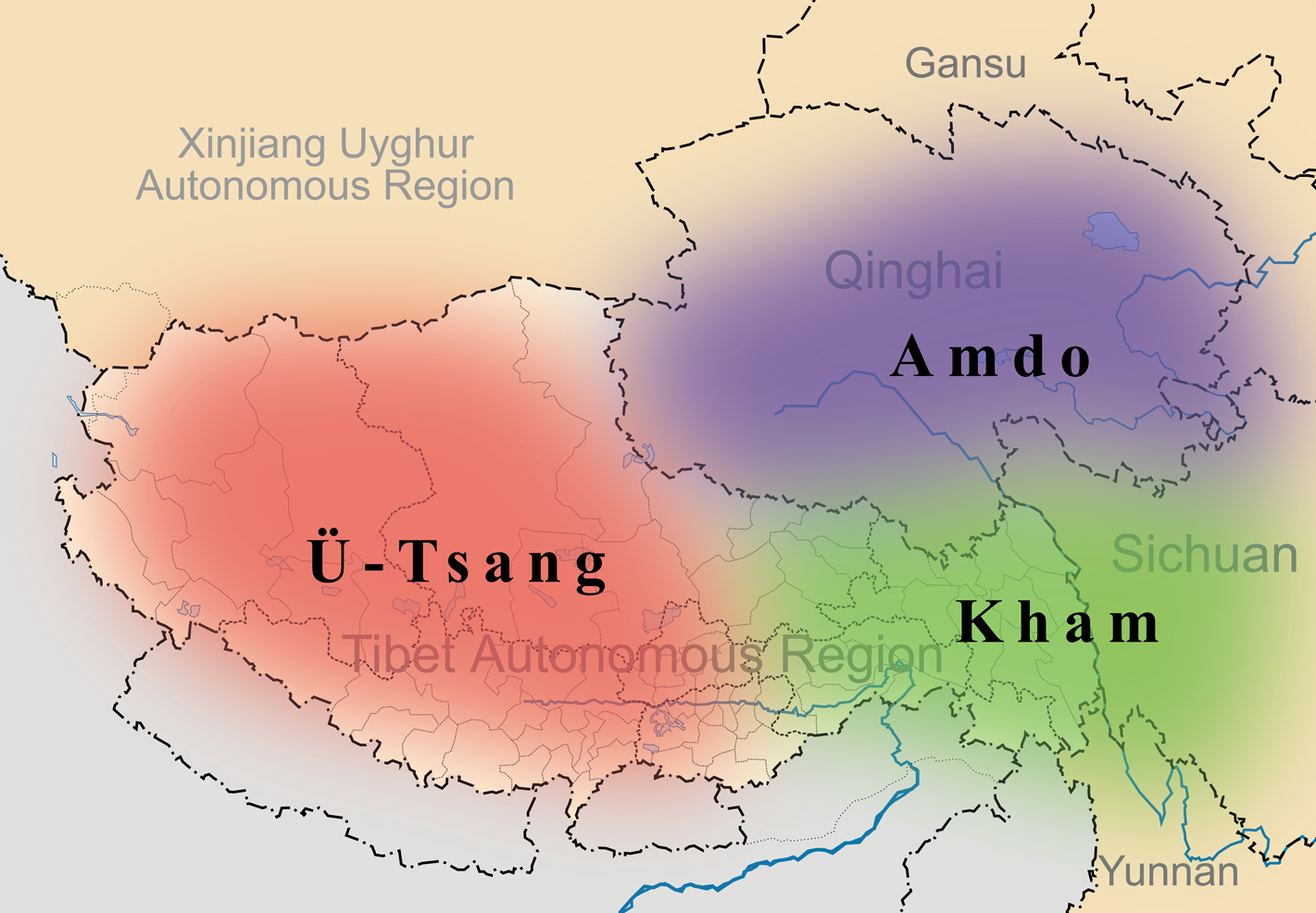
Since moving to China I had always wanted to go and see Tibet, but had never had the chance. Then recently I finally saw the opportunity to take a week off work and go and explore the region. There is only one problem: The Tibet Autonomous Region (TAR), the official province of Tibet on Chinese maps, is closed off to individual travel by foreigners. You are only allowed to go there by joining a tour or hiring a guide, which is expensive and limits your freedom. The TAR, however, does not comprise the whole of historical Tibet. The nearby province of Qinghai and the West of Sichuan province also lie in the Tibetan plateau, and are culturally part of the Tibetan world.

Because of the impossibility of going to the TAR alone, I opted for Qinghai instead. This province is itself bigger than any European country, but it only holds five million residents. It corresponds roughly with the old Tibetan province of Amdo. Currently only 21% of the population is actually Tibetan, while 54% are Han Chinese and the rest are mostly Hui Muslims or belong to other minorities.

Having said that, most of the Han and the other minorities live in the capital Xining and in the surrounding Eastern tip of the province. The vast Western and Southern expanses of Qinghai are inhabited mostly by Tibetans, and form very much a part of the Tibetan world. This is officially recognized too, since five of the province’s eight prefectures are designated as “Tibetan autonomous prefectures” and one as a mixed “Tibetan and Mongol autonomous prefecture”, following the Chinese system of autonomy for minorities.

It must be pointed out that the Tibetans in Qinghai have not really been ruled from Lhasa since the break up of the great Tibetan empire of the 7th-9th century. This empire spread all the way to what is now Bangladesh and at one point actually occupied the Chinese capital of Chang’An, as amazing as it may seem nowadays.

Since that empire broke up, Amdo was ruled mostly by local chieftains who sometimes pledged allegiance to the Chinese empire or to Lhasa, but enjoyed basic autonomy. The Tibetans who live there now speak a dialect of Tibetan which is not mutually intelligible with the dialect spoken in Lhasa and Tibet proper, and are relatively more integrated into mainstream Chinese culture. 

 A map showing the three traditional regions of Tibet, and how they fit into the modern Chinese provinces of Tibet, Qinghai and Sichuan.


How do I feel about the political dispute over Tibet? The Chinese claim that Tibet is historically part of China seems to me not exactly unassailable: it is based on the fact that Tibet was ruled by the Chinese Yuan and Qing dynasties, while for the rest of history it was basically independent, although of course it always had strong links to the Chinese world. Even during periods of Chinese rule Tibet had a lot of autonomy in practice, and the Chinese presence was not very heavy. Even so, the Chinese seem to base their territorial claims on the shape China had during its last dynasty, the Qing dynasty which was broken up by European invaders. In that period, Tibet was indeed under Beijing's rule.

For what the Chinese are concerned, it was the European invaders who took Tibet away from them, and they were just taking back what was theirs in 1951. They view Western support for Tibetan separatists as a way of undermining China’s rise, and extremely few Chinese are at all open to the idea that their might be anything legitimate to the Tibetans’ national aspirations. Educated to think of China as a multiethnic country with 56 different peoples forming one nation, they cannot see how the Tibetans might not feel that they fit into that picture.

The Chinese also assert that they have brought great improvement to the lives of ordinary Tibetans, and that the social system which existed in Tibet under the Dalai Lama was backward, theocratic and inhumane. There is certainly substance to these claims, and I don’t doubt that an independent Tibet would hardly be a prosperous country. Neighbouring Nepal is quite a lot poorer after all. The Chinese have built significant infrastructure and brought much modernization. 

Pre-1951 Tibet was certainly a backward theocracy in great need of reform (although not the hellhole which the Chinese government portrays it to have been). At the same time I can see how Tibetans might have rather had reform without the full scale attack on their culture carried out under the Cultural Revolution, the repression of any expression of their grievances, and what they see as another people ruling over them even today.

The Chinese claim that the Tibetans, just like other minorities, are allowed certain privileges under Chinese policy, and that Tibetan areas have already been granted autonomy. It is true that the Tibetans don’t have to follow the one child policy, and have special places reserved in university. It is also true that their language does enjoy a certain degree of official recognition and protection, as I saw for myself in Qinghai.

On the other hand, Tibet’s autonomy in government seems to be quite symbolical, and while the governor of the TAR is always Tibetan, the far more powerful Party Chief of the province is always a Han Chinese. While claims by the exiled opposition and their Western supporters about a full scale attempt to destroy Tibet’s culture by flooding the region with Chinese migrants are rather exaggerated (only 8% of the TAR’s population is non-Tibetan right now), there is clearly much genuine and legitimate resentment against Beijing rule amongst Tibetans.

Saturday, June 1, 2013

Anniversary of the Day when Nothing Happened in Tiananmen Square approaching


It has been reported that the last person still detained in China for taking part in the 1989 protests in Beijing has been recently released. Meanwhile the 24th anniversary of that bloody Beijing night is coming up this Tuesday. And like every year, this fact will be completely ignored by the Chinese media.

Nowadays there are few topics which remain completely unmentionable in the Chinese public sphere. It is quite possible to talk and write about the Cultural Revolution, Tibetan and Uighur separatism, democracy or human rights. The Chinese media often mentions these issues, although of course it has to tow the government line.

The repression of '89, however, remains entirely taboo. You will virtually never see a direct reference to it in the Chinese media or in any kind of public forum. The closest thing I have seen is oblique references to the "political disturbances of the late eighties" buried within articles on recent Chinese history.

There has been one exception to the rule: in 2009, on the day of the Tiananmen incident's 20th anniversary, the English edition of the Global Times amazingly ran a front page story on the legacy of the event. Although the article correctly described how sensitive the topic is in Mainland China, and how it is never openly discussed, it then went on to toe the party line, stating that the government was correct in putting down the protests, and that this decision has given China twenty years of growth and prosperity. Perhaps unsurprisingly, this article no longer appears on the newspaper's website. Even so it is amazing that it was published at all, and I am sure that it would never have got past the censors had it been written in Chinese.

In China it is quite possible to bring up the topic of the '89 protests in private conversation, although not everyone feels comfortable with it. I remember once asking a chatty Beijing taxi driver if he remembered the tragic events of that year. When he understood what I was asking, he said "this topic shouldn't not be spoken about" and went silent for a while.

It is untrue, as it is sometimes claimed, that most younger Chinese have no idea what happened in 1989. In fact a basic knowledge of the events seems to be pretty widespread, at least amongst people with a decent education. If you just mention the 六四事件, or the "six-four incident" as it is known in Chinese, most people will know what you are talking about. What is true is that most Chinese, at least those too young to remember that time, have probably never seen photos or videos of the demonstrations and of the subsequent bloodshed. The famous photo of the man with his arms stretched out in front of a tank is not at all well known within Mainland China.

On the Chinese internet all search-terms related to the events of '89 are carefully censored, as are the Wikipedia articles on them in all languages. Any entry mentioning the topic will most likely get removed pretty quickly from any forum based in China. That is not to say that if you live in Mainland China it is impossible to find material on this issue through the web, even without using a VPN, but you would probably need to know a foreign language to do so, and in any case most Chinese do not seem to be hell-bent on finding out more about the topic.

As always, the one place in China where the unhappy events of 1989 will be publically commemorated is Hong Kong, where a huge vigil is held every year to commemorate the massacre. Attendance for this vigil has risen dramatically in the last three years, but this is probably connected with Hong Kongers' increasing frustration towards the central government in Beijing, and tells us nothing about the attitudes of people in the Mainland.