Wednesday, March 29, 2023

A Vipassana retreat in Chiang Mai

I recently went on a six-day Vipassana retreat in a Buddhist monastery in Northern Thailand.

The experience was a good one, if rather different from what I was expecting. Vipassana retreats have a reputation for being extremely strict environments, where you wake up at the crack of dawn, meditate for hours a day and aren't allowed to speak, read or use digital devices. 

The particular monastery I went to, Wat Sopharam, takes a far more relaxed approach. The monastery and temple have existed for 250 years, but the "International Vipassana Meditation Centre" was only established in 2018. Outsiders can come and stay for as long as they wish, as long as they ask in advance and there are rooms available. The stay is free, as is the case with most Vipassana retreats in Thai monasteries. You can leave a donation, but there is no pressure to do so. 

The monastery is located in a rural area on the outskirts of Chiang Mai. I took a taxi there from the city, which took about an hour. The taxi dropped me off next to the monastery's living quarters, at the bottom of a hill. On my arrival, a young man who seemed to be in charge of the logistics came and greeted me. He showed me to my room, which was fairly basic, including just a bed with a thin mattress, a plastic chair and a mat for meditation. It was, however, equipped with an air conditioning unit. There appeared to be no concern about leaving the room unlocked, although I eventually requested and received a key.

After leaving my things in the room, I was taken to meet a monk in saffron robes. The monk didn't look at all Thai, and he turned out to be Russian. The monastery houses at least two foreign monks, this Russian and an Iranian, as well as dozens of Thai monks. It is apparently possible for foreigners who choose so to stay and become monks without too much difficulty. The Russian monk led me up the hill, on the two-minute walk from the dorms to the monastery proper. The area at the top of the hill contained a temple, a chedi (the Thai word for a stupa) and a pavilion where monks gather to chant and perform ceremonies. 

I was taken to the room used to teach the "international meditators", as foreign guests are called. I noticed that the room had a DIY air purifier, the only one I saw anywhere in Chiang Mai. This was welcome, because the air quality was quite poor the whole time I was there. Unfortunately January to April is the "burning season" in Northern Thailand, when farmers burn their crops, and it is also the dry season so there is no precipitation to clean up the air. The AQI on most days hovered close to 200, like a polluted day in Beijing.

The monk then gave me an initial introduction to Vipassana meditation, during which he told me about the distinction between Samatha and Vipassana. While Vipassana is an ancient concept, the modern Vipassana movement started among Buddhists in Burma in the 19th century as an attempt to modernise Buddhism. In Vipassana retreats you generally practice two forms of meditation, one walking and one sitting, during which you respectively focus on your steps and on your breath. The walking meditation also ensures that people get some form of exercise, rather than sitting still all day. The monk lead me through five minutes of each kind of meditation.


While most Vipassana retreats include hours of group meditation a day, in this particular monastery everything is quite lax. There is normally group meditation at 4 pm, but the person who leads it was not around while I was there, so it did not take place. The only scheduled activity while I was there was a class on meditation at 10.30 am every day, which usually started around 15-20 minutes late. The first day I missed the class, because I arrived exactly on time and found no one there, so I supposed it had been cancelled. 

The monastery was very Thai in this way: things tended to start late, and everything was unpredictable and subject to unannounced changes. The Russian monk had warned me of this on the first day. He said visitors from certain nationalities find it hard to get used to the chaos, but eventually people learn to live with the uncertainty and go with the flow.

The classes were all given in English by the monastery's abbot, a youthful man of about 40. While his English was not incredibly fluent, he always managed to get his point across. Given that the international meditators kept coming and going, there was always a mix of new students and ones who had already sat through many of the abbot's classes. Somehow the abbot managed to give a different class every day, covering exactly the same content but from a different angle each time.  

I could see why the man was the abbot; he was witty, personable, and exuded an air of authority. He appeared to be highly revered by everyone at the monastery. He encouraged us to seek him and ask him any questions we had at any time. I approached him one day during lunch, telling him that I still had some trouble understanding the principles of Vipassana meditation. He beckoned me to sit at his table, and did his best to answer my questions while the other monks listened.

Unlike what you might expect at a Vipassana retreat, there was no prohibition on talking at the monastery. We had badges in our rooms saying "silent" in English and Thai, which we could wear if we wanted to let people know that we didn't want to be spoken to, but I only ever saw one person wear one. The orientation guide encouraged us not to enter each other's rooms and reminded us that we weren't here to socialise, but there were no strictly enforced prohibitions.

In practice, I only really talked to people at mealtimes. In the canteen, the "international meditators" all sat at one table. The food was not vegetarian, as those who have spent time in temples in India might assume. It was simple Thai food, nutritious and appetising enough. The monks only ate at breakfast and lunch, since they follow the Buddhist injunction not to eat from noon until dawn of the next day. The rest of us ate in the evenings too. Some tables were reserved for the monks, and some of the best food was also set aside for them. The rest went to us and to the monastery's children, who often come from troubled families and have been sent there to study as monks. Only some of them actually go on to become monks, apparently, while many return to the lay world when they get older.


The other international meditators were an interesting bunch. They came and went, some only staying a handful of days and some staying for weeks or longer. Among others, I met an older French man who's spent ten years in Thailand and speaks good Thai, an American girl who was volunteering at the monastery teaching English to the kids, a slightly neurotic Ukrainian young man, a friendly Australian hippy who believed Covid to be a conspiracy and told me that the hardest thing about being in the monastery was not being able to smoke hash, and a guy from Novosibirsk who had heard about the monastery from the Russian monk and spoke virtually no English or Thai. There were travellers from Brazil, Israel and Europe spending short spells at the monastery while they took a break from their globetrotting. There were also a few Thais retreating there.

Outside of mealtimes, there was little to do but meditate, read and go to class in the mornings. I tried to increase the amount of time I meditated by the day, but as a beginner I could not manage more than a couple of hours without break. I did go for a few walks in the local area, but the presence of unfriendly dogs made this seem rather risky. Electronic devices were not prohibited, like they are in stricter Vipassana retreats; in fact the monastery had wi-fi, although it did not reach my room. But in any case I did not open my laptop or read the news while I was there, which I found quite liberating. I did use my phone, but I made a rule of not initiating conversations with anyone and only replying to messages in the morning after waking up, and I generally stuck to it. 


Photos of the living quarters

Life in the monastery was fairly spartan, but not uncomfortable once you got used to it. The bathrooms were in outdoor sheds, and there was no hot water in the showers (in Thailand this is considered a luxury), but I found that taking cold showers in the heat of the afternoon was quite bearable.

At night I went to bed no later than 10, since there was nothing to do, and getting up in time for breakfast at 7.30 was never a problem. The monastery's bells ring at 4.45 am every morning, and the monks meet at 5 to chant, but fortunately we were not expected to join. At 6.30 the monks go on their morning alms round, walking around the local area and receiving donations of food from the residents. On my first day at the monastery I joined them, beckoned by the friendly Iranian monk.

The alms round I joined worked like this: three monks walked around with little metallic bowls to collect the donations. In front of them walked a layperson, in this case a child, banging a drum to alert people that the monks are coming. At the back there walked another layperson, in this case me, wheeling a big basket in which the monks place their donations when their bowls fill up. 

We walked around for about an hour, and by the end my basket had become pretty heavy. At every house we stopped, the residents gave the monks their donations and then got on their knees and placed their hands in prayer as the monks chanted their blessings. Not knowing Thai and not being a Buddhist I did not join in the chants, but I tried to stand respectfully at the back.

The monastery is clearly a focal point of community life in the area. On one of the days I was there I had the chance to see a ceremony for the full moon, an important part of Thai and Buddhist culture. A lot of local people came to the monastery to join in the evening chants, and then seek the abbot's blessing. After the chanting was over there was a dance performance held by local women in front of the monastery's chedi, as a Buddhist stupa is known in Thailand.

After the performance everyone, monks and lay people alike, circled the chedi clockwise, holding lanterns and chanting. Finally, dozens of Thailand's characteristic sky lanterns were released into the night sky, quite a sight to behold. The lanterns floated up until you could barely see them anymore. Apparently there is a concern in Thailand that they could be dangerous for airplanes, although no sky lantern has yet brought down a plane.


I had to leave the monastery after only six days, due to work-related obligations. On my final morning I left a donation. No one pressured me to do so, or even mentioned it. I asked the kitchen staff what I should do, and they gave me an envelope and said I could simply slip it into the donations box in the canteen with some money inside. No one knew how much I donated, or seemed to care. I then went and said goodbye to the abbot and the other meditators. 

While I am not a Buddhist or a follower of any organised religion, I found the willingness of the monks to allow people from all over the world to stay in their monastery for little apparent material reward, simply for the sake of spreading the Dharma as they see it, rather admirable. I have certainly never spent such a lot of time meditating, or alone with my thoughts, as I did in the six days I spent in Wat Sopharam. It was refreshing, and the effect lasted long after I had left the monastery and Chiang Mai for bustling Bangkok. 

A road in the surroundings of the temple

Monday, January 23, 2023

A trip to Wuhan

Last weekend I took a trip to Wuhan.

I had never been before, but Wuhan is in fact one of China's most important cities, both currently and historically. It has become the commercial and educational hub of Central China; it is also the city with the largest number of university students in the world, with over a million students spread out over its dozens of universities. 

The high-speed train network has made it much more convenient to take short city breaks across China. The fastest line now does the Beijing-Wuhan route in just four hours, amazingly little time given the huge distance involved. There is just one stop on the way, in Zhengzhou. The price, around 600 Yuan for a ticket, is not particularly cheap but still cheaper than flying. 

Unfortunately, I and the friend I was travelling with set off on a day when much of China was blanketed in thick air pollution. It was heavily polluted all the way from Beijing to Wuhan, to the extent that you could barely see anything out of the train windows. Air pollution is common in China, but it rarely covers such a huge swathe of the country in one go.


The view from my hotel window on the first day I arrived (above), and two days later (below)
     
The hotel where we stayed was excellently located next to the Hankou Bund, China's best-preserved colonial-era Bund (or waterfront) after the Shanghai Bund. Wuhan is traversed by the Yangtze River, and in the 19th century it became one of the so-called "treaty ports" that were forcibly opened up to foreign trade by the European powers. At the time it was made up of three cities, Wuchang, Hankou and Hanyang, which were later merged to form Wuhan. Five foreign concessions, run by the UK, France, Germany, Russia and Japan and not subjected to Chinese laws, were established next to the Yangtze in Hankou, to the great displeasure of the Qing Dynasty's rulers who could do nothing about it.

The Bund has now become Wuhan's trendiest area, with cafes and nightclubs nestled among the 19th century European buildings and churches that are in many cases still intact. The German and Japanese concessions have mostly been built over, but the British, French and Russian areas are quite well preserved. Although Wuhan has a history that predates the European concessions by centuries and centuries, the European buildings remain the oldest architecture you are likely to see in the city. 

A street in the former German concession

After unpacking we went for a walk in the area, in spite of the pollution, and ate some 热干面 (hot dry noodles), the local specialty, at a hole-in-the-wall restaurant. It tasted excellent. In the evening we headed across town to Wuhan Prison, a well-known bar where punk bands sometimes play live music. When we got there a DJ was performing. The bar is tiny, and it has the sort of grungy atmosphere that you rarely find nowadays in Beijing, with young foreigners and Chinese hanging out together. 

We barely saw any other foreign faces in Wuhan except for the ones in that bar, by the way. The city used to have quite a lot of foreign students, but most were evacuated or left after Covid began, and few have returned.

In the bar I got chatting to a young Moroccan man doing postgraduate studies in one of Wuhan's universities. He was one of those who didn't leave when Covid started. A sociable and multilingual young man, he told me how he had been lucky during the Zero Covid years because he lived off campus. Foreign students living on campuses throughout China were notoriously badly treated over that time, often entirely forbidden from leaving their campuses even when cities were not in lockdown.

He said that his university had long tried to push him to move to a dorm on campus, so they could control his movements, but he had found ways to refuse. When they summoned him to the campus, he would claim that he was in lockdown and had been told not to leave his house. On one occasion he left Wuhan, and got a call from the university telling him that he wasn't allowed to leave the city and should return at once. He told them that if they bought him a return ticket with their money, he would go back. They then relented.

The view from the top of the Yellow Crane Tower

The following day strong winds arrived and blew away the pollution, but the weather suddenly turned very cold, almost as cold as Beijing. Luckily our hotel room was well heated, but central heating isn't common in southern Chinese cities like Wuhan, and restaurants and other indoor environments could often be quite chilly.

After having lunch we decided to cross the 武汉长江大桥, the city's largest bridge over the Yangtze, on foot. The Yangtze is an enormous river, and it took about fifteen minutes to cross the bridge, which turned out to be quite painful in the Arctic winds. Wuhan's skyline seen from the middle of the Yangtze could rival Manhattan's, with skyscraper after skyscraper jostling for space. 

Once across the river we walked on to the Yellow Crane Tower, one of Wuhan's landmarks, made famous by being immortalised in the verses of various poets, including the celebrated Li Bai. The tower has existed since the second century CE in one form or another but, typically for China, the current tower was rebuilt recently, in 1981. It had plenty of visitors, and the view of the city from the top was quite impressive.

That evening it snowed, and the following morning the city was covered in snow. We decided to visit the museum of the Wuchang Uprising. The uprising, which as the name suggests started in Wuchang, one of the three cities that went on to make up Wuhan, marked the beginning of the Xinhai Revolution of 1911, which overthrew the Qing Dynasty and established the Republic of China. 

The museum is housed in a big modernist building, in front of a large square with a monument to the revolution. Between the snowy weather, the "socialist realist" style of the building and the huge empty square with the revolutionary monument, for a moment I felt like I was in Russia. 


On the other side of the square there is an old, European-style building built in 1909 to house Hubei's provincial assembly. After the revolution, the new government used it as its headquarters. It's now been turned into a sort of second museum, with displays on the revolution and what Wuhan was like at the time. Entry to both the building and the museum was free. 

The building that housed the revolutionary government, built in 1909

Some of the exhibits were quite interesting, and gave you a good picture of Wuhan in the dying days of the Qing Dynasty and the early days of the Republic. Political propaganda was never completely absent, of course, with the revolution often described as being a milestone on the path towards the "great rejuvenation of the Chinese nation", a slogan used a lot in recent years.

The Communist Party's official historiography considers the Xinhai Revolution to have been a positive event, the first step towards the real Revolution of 1949, even though it was led by its arch-rival KMT. Sun Yat-Sen, who led the revolution and founded the KMT, is still lionised in official propaganda, and in fact there was a statue of him outside the museum. This is in contrast to Chiang Kai-Shek, his successor as KMT leader who fought against Mao and then fled to Taiwan, who is reviled. 

The flag on the left was the official flag of the Wuchang Uprising. The 18 yellow dots symbolised China's 18 provinces, and the red and black symbolised blood and steel. The flag on the right, much better known, was the first national flag of the Republic of China. The five colours symbolised the country's five peoples (Han, Manchu, Tibetans, Hui and Mongols) 

The following morning, the weather had gotten warmer and sunnier. We were in Wuhan for four days, and the weather was quite different on each of them. I guess this proves the truth in the city's slogan (武汉,每天不一样, or "every day is different in Wuhan").

We still had a few hours to kill before taking the train back to Beijing, so we decided to go and take a look at the Huanan Seafood Market, the one where the Covid pandemic may have begun. We took a taxi to the neighbourhood, which is actually quite central and only took 20 minutes to reach from our hotel. 

The market turned out to be a nondescript two-storey building next to an intersection, dwarfed by the high-rises around it. Until January 2020, the ground floor of the building contained the seafood and wildlife market which was the epicentre of the world's first Covid outbreak; the second floor housed an eyeglasses market.

It turned out, unsurprisingly, that the seafood and wildlife market on the ground floor is now closed, probably for good. A blue metal barrier has been erected around it, so you can't see inside. There is, of course, no sign or reminder of any kind that this is the place where a pandemic that changed the world forever may have begun. The market is now just an anonymous building in an anonymous suburb with a metal barrier around it. 

On the second floor of the building, however, the eyeglasses market is still open and running. The building has a side entrance sitting next to a row of little shopts, through which you can reach the second floor. We decided to go in. There was a security guard at the entrance, but he didn't stop us. The second floor looked just like any cheap market anywhere in China, with dozens of little shops and stalls selling eyeglasses and competing for customers. It wasn't particularly busy. We walked around a bit, but at some point two security guards started following us. I became rather concerned at this point, and we decided to walk straight back out. 

I am certain that, in spite of the appearance of normality, the site is still considered sensitive, and the security guards have been warned to follow any foreigners who walk in. After all we might have been foreign journalists, there to report from "the place where Covid started". I was concerned enough that I insisted we walk away from the market and round a corner before calling a taxi, rather than hanging around in front of it.

The Huanan Seafood Market is the two-storey building in the centre of the photo

The Chinese authorities indicated the Huanan Seafood Market as the origin of the first cluster of Covid cases in January 2020. A few months later, however, they decided that no one knew where the Covid pandemic had begun, and actually it probably didn't even start in China. Unsurprisingly, the idea that the virus might have arisen at that market is no longer heard much in China today.

The entry on the Huanan Seafood Market in 百度百科, an attempt by Baidu to produce a Chinese Wikipedia, claims that researchers from the Chinese Academy of Sciences found in February 2020 that Covid did not originate at the market, but was brought there from elsewhere. It then claims that in March 2021, the WHO's report on the origins of Covid found that the market was not the point of origin of the virus, and that it is unclear how the virus got there. The entry then goes on to repeat the theory, often heard in China but not generally taken seriously anywhere else, that the virus could have first been brought to Wuhan from abroad on the packaging of a frozen product, and it reminds us that the Huanan market's supply chain included frozen and animal products from 20 countries.

The truth is that, regardless of what Baidu may claim, the WHO report never said that the market was definitely not Covid's point of origin. In fact, the report (which can easily be downloaded) states in its introduction that it is impossible to say: "No firm conclusion therefore about the role of the Huanan market in the origin of the outbreak, or how the infection was introduced into the market, can currently be drawn". The report, it bears mentioning, was based partly on a visit to Wuhan by a team of WHO experts who were not allowed to go anywhere on their own.

In reality, outside of China the theory that Covid originated in the Huanan Seafood Market remains the most popular one with serious researchers. In July last year, two peer-reviewed papers by an international team of scientists offered strong evidence suggesting that the virus was, indeed, first transmitted to humans from one of the wild animals at the market.

This theory should be far less politically controversial than the most popular alternative, in other words that Covid originated from a lab leak. Even so, the Chinese authorities do not want to hear of it. That's why it wasn't surprising to see that the Huanan Seafood Market remains standing, with nothing to suggest anything particular ever took place there; the seafood and wildlife market shut down as an embarrassment, but the eyeglasses market on the second floor still functioning as normal. 

After leaving the market we went back to our hotel, picked up our stuff and headed to the train station to take the high-speed train back to Beijing. Wuhan had definitely been worth the visit. 

Wednesday, December 28, 2022

The end of an era

I remember the exact moment when I realised it was over. It was the 6th of December 2022. After four days stuck at home due to a flu (which I now think may well have been Covid), I left my flat and walked to the shopping mall near my home in Beijing's Chaoyang district. I wanted to get some fresh air, and also buy some supplies at the mall's supermarket. 

When I entered the mall I had to scan a QR code with my Beijing Health Kit app, just like every other time for the past three years. My last PCR test had been taken 5 days ago, as my app clearly displayed, and I was by no means certain they would let me in. In fact, I pretty much expected to be turned away. The last time I had been out of my home, public places all required a negative result from a test taken within the last 48 hours.

To my surprise, the security guard happily waved me through. Once I got in, I saw that there were customers sitting down in some of the restaurants. The last time I had been out, restaurants were only doing deliveries and dining in was forbidden. I had heard that some places had started reopening in outlying districts of Beijing, but I barely believed it, and I thought that in my area everything was still closed. 

According to the official statistics (which, as I now know, were already becoming unreliable), there had been thousands of Covid cases in Beijing over the previous day, of which hundreds had been found "in society" (among people not subjected to any form of preventive quarantine). 

The fact itself that restaurants might reopen wasn't strange. They have been open for most of the past three years, after all. But the idea that the government might allow them to open up again while the city was clearly in the midsts of an uncontrolled Covid outbreak would have seemed outlandish just a few days earlier. 

At that moment, I knew that the Chinese government's attitude towards Covid had changed, drastically and probably for good. When you live in China you develop a feel for what way the political wind is blowing (and Covid-control policies are inherently political). Official government announcements are opaque and ambiguous, but you learn to read the room. Beijing, as the capital, is always particularly well protected, and if they were ready to let Covid spread in Beijing, this meant they were determined to transition towards "living with Covid" all over China.

So that was it. The three year-long gargantuan effort to prevent an infectious aerial-born disease from spreading in China was being abandoned. All of the measures that had defined the rhythm of our lives over the past three years, and especially the past year (mass PCR tests, sudden lockdowns, closed borders), were all going to be consigned to the dustbin in no time. Also, we were all going to get Covid. 

The next day, China's national health authority officially announced that people with Covid would be allowed to quarantine at home, something that would have been unthinkable just a week earlier. Following that, public places stopped asking people to scan QR codes with their tracing apps, and it became possible to travel anywhere in China without taking a PCR test or getting quarantined. Then they retired the 行程吗, the app that shows all the cities and counties where you've been over the last 7 days. In a matter of days, China felt like a different country.

An empty shopping mall in Beijing, December 14

I had been saying China should open up since at least March this year, when Omicron started to spread and Shanghai and other cities were put under brutal lockdowns. And yet when it happened it felt disconcerting. Deep down I had never really believed the Chinese government was going to give up on containing Covid. I don't think most Chinese did either. 

And then, from one day to the next, it happened. Official government WeChat accounts, which for years had been keeping people updated on the latest quarantine policies and lockdowns, were suddenly publishing articles with titles like "what to do if you are at home with Covid" and "how long after getting Covid is it ok to go back to work".

Somewhat naively, I had imagined that if Zero Covid ended everyone would be rushing to travel, go out and have fun. The reality has of course been somewhat different. The moment China abandoned its total elimination approach, Covid spread like wildfire throughout the country. In Beijing it happened particularly fast, since the virus was already spreading significantly before they lifted all the restrictions (in fact, as I mentioned earlier, I may have caught it just before the containment measures ended). 

The Covid pandemic didn't stop being a source of worry, but the things people had to worry about changed suddenly. Instead of worrying about waking up and finding your building had been locked down, or getting a phone call telling you that you had been in the same place as someone positive and had to be taken to a quarantine centre, suddenly everyone was worrying about where to get hold of home testing kits, ibuprofen and cough medicine, or how to protect elderly relatives from infection. 

The first time I heard of a friend getting Covid in Beijing was on the 5th of December. He had tested positive with a home antigen test. At the time people still assumed they might get sent to a quarantine camp, so he decided to stay home and not tell anyone. By the 10th of December, only five days later, it felt like half the city had been infected, and people were openly sharing news of their infections on social media.

Over the following week or two, most of my friends came down with the virus. Restaurants that had just opened up had to close again because all of their staff was sick. I know Omicron spreads quickly, but the speed of the contagion still shocked me. We've probably never seen the virus encounter such an immunologically naive population before, since just a month ago almost no one in China had contracted Covid.

Within days of the restrictions ending, the streets of Beijing became emptier than they had been during the peak of the lockdowns. Everyone was either infected, or afraid of becoming infected. The few people you saw were wearing an N95 mask, rather than the blue surgical masks that used to be the norm. Government messaging may have changed all of a sudden, but you don't go telling people that Covid is the plague for three years, and then turn around and tell them it's no worse than a flu and expect them to lose their fear.

Crowds in central Beijing on Christmas Eve

It's now been about three weeks since China opened up, and in Beijing people are starting to go out again. Restaurants and gyms are filling up. Most people have either had Covid, or are fed up with being careful. The public will only be cautious for so long, as much of the world found out in 2020. On Christmas Eve there were large crowds in Sanlitun's shopping and bar district, although almost everyone was still wearing a mask.

Of course things may be back to normal on the streets, but they aren't in the hospitals. Official statistics on the number of Covid deaths are so low as to be meaningless, but there is no question that people are dying and that hospitals in Beijing are overwhelmed by all the serious cases. And one can only imagine what it's like in the poorer parts of China. 

Essentially China is now going through what most other countries experienced in 2020, except with a milder but more contagious Covid variant and with vaccines (although quite a few Chinese aren't vaccinated, in what can only be described as a serious policy failure). The young and healthy are learning to live with the risk of Covid, while the elderly and frail continue being careful or risk ending up in hospital. Soon it will come to seem normal here too. 

Tuesday, November 8, 2022

"We only take guests from the Mainland"

The Covid pandemic (or rather, the government response to the pandemic) has changed life in China in all sorts of ways, and travelling within the country has become far more difficult. One thing on which not many have commented, probably because it only affects the few foreigners still left here, is how hard it has become to find hotels that will accept foreign guests.

To be clear, it has long been the case that not all hotels in China accept foreigners. This did not start with the pandemic. In fact, it has probably been true since Maoist times. In his classic memoir River Town, Peter Hessler recounts being rejected by hotels in Western China for being a foreigner back in the late nineties. 

Personally, I have experienced hotels turn me away for as long as I've been in China. For instance, in 2013 I once travelled to Shijiazhuang, the capital of Hebei province, 300 kms south of Beijing. Before going I booked a room in a 如家酒店 (Home Inn), a chain of hotels with branches all over the country. I arrived at 11 pm, only for a smiling young clerk to tell me apologetically that unfortunately they could not accept foreign guests. Never mind that when I called the chain's national service line to book, I had specified that I was a foreign citizen. After making some phone calls, a (more expensive) hotel that could take foreigners was located nearby, and a taxi was called to take me there (at my own expense of course). 

This sort of annoyance isn't limited to remote parts of the country. It happens in cities like Beijing and Shanghai as well. On one occasion in 2017 I booked a room in a cheap hotel in Shanghai, only to arrive late at night and be told that they were unable to take foreigners. I had booked with an app on my phone, and it did specify somewhere amongst the reams of writing (in Chinese) that the hotel does not accept foreign guests, but I hadn't even thought to check. Luckily another chain hotel down the road was able to take me. 


In my experience, finding Chinese hotels that welcomed foreigners had been getting harder for years even before the Covid pandemic struck. I don't think the regulations changed; quite simply, enforcement got stricter. In the past, some hotels were happy enough to bend the rules. If a foreigner travelled alongside locals, they would simply register the Chinese guests with their ID and ignore the foreigner. If they travelled alone, the hotel might let them stay without registering them and take their cash. 

After the change in China's leadership in 2012, laws and regulations started to be enforced more strictly in all fields of life, including this one, and finding hotels that would acquiesce to foreigners staying illegally became harder. In 2019, I once spent hours wondering around the centre of Kunming late at night, trying to find a hotel that would take me in. Place after place rejected me, saying they could not accept foreign citizens. In desperation I looked in an app and found a 5-star hotel in the suburbs that purported to take foreigners. After calling to make sure, I took a taxi there and checked in. I ended up spending far more money than I had intended. 

It is true that the hotels that reject foreigners tend to be the cheaper ones. But it is not true, as people sometimes claim, that foreigners are only prevented from staying in grotty places that are unhygienic or unsafe, and that these rules are there to "protect" foreigners or to make sure they come away with a good impression of China. During my time in China I have been rejected by numerous hotels that were perfectly decent, and accepted by others that were horrible.

Unlike many believe, it does not in fact appear to be true that hotels in China need a special permit to accept foreigners. At least, there is no national regulation that states this. There used to be, but it was abolished in 2003. Quite simply, article 39 of the Foreigners Entry and Exit Management Law states that hotels must register foreign guests according to "applied regulations" and report the registration to the local police authority. 

Foreign citizens in China are supposed to register with the police within 24 hours of arriving in a locality. If you are staying in a hotel, they are responsible for registering you. While the hotels should be able to register foreigners automatically in their computer system, some of them may have to go to the police station to do this in person because their system does not accept foreign passport numbers (or it does, but they are unaware of how to use it).

It's always hard to get to the bottom of these things, but it seems that many of the hotels that refuse foreigners would be legally able to accept them, but want to avoid the hassle (or perhaps the scrutiny) that comes with registering them. It is also entirely possible that local authorities in various parts of China formally or informally prohibit or discourage hotels from taking foreigners, especially ones that are cheaper or not part of an international chain. Apart from anything else, this ensures the foreign guests spend more money.

Much probably depends on the attitude of local authorities and the police, which may explain the seemingly random way in which hotels in some areas are much more relaxed about having foreign guests than in other areas. When I travelled in western Hunan in 2018 pretty much every hotel seemed to accept foreigners, even in quite remote places, while in a relatively cosmopolitan city like Kunming finding a place to stay was a struggle. 

It is even possible to argue that the widespread practice of hotels rejecting foreign guests is actually illegal under China's Consumer Protection Law. Some claim that if you call the hotel and threaten legal action, they will take you in. I've never tried this, but I find it unlikely it would work in all cases, especially when local authorities have exerted pressure in the other direction. In any case, this is hardly how you want to spend your time when you travel. 

It must also be added that it is not only foreign citizens who get rejected in Chinese hotels. Certain Chinese minorities, particularly the ones native to the two regions that the government considers "restive", are also regularly (and shockingly) refused accommodation. The motivation is quite possibly the same: too much hassle from the police and local authorities, which puts hotels off from accepting them. 

Essentially, the issue appears to be that if you belong to a group seen as a potential national security issue, or more recently a public health threat in the case of foreigners, your movements need to be monitored and controlled. This makes you a source of hassle and potential trouble. It may be nothing personal, but hotels don't want you (or have been told not to take you). Perhaps uniquely in the world, hotels rejecting guests has become one of the most overt forms of discrimination in China. 

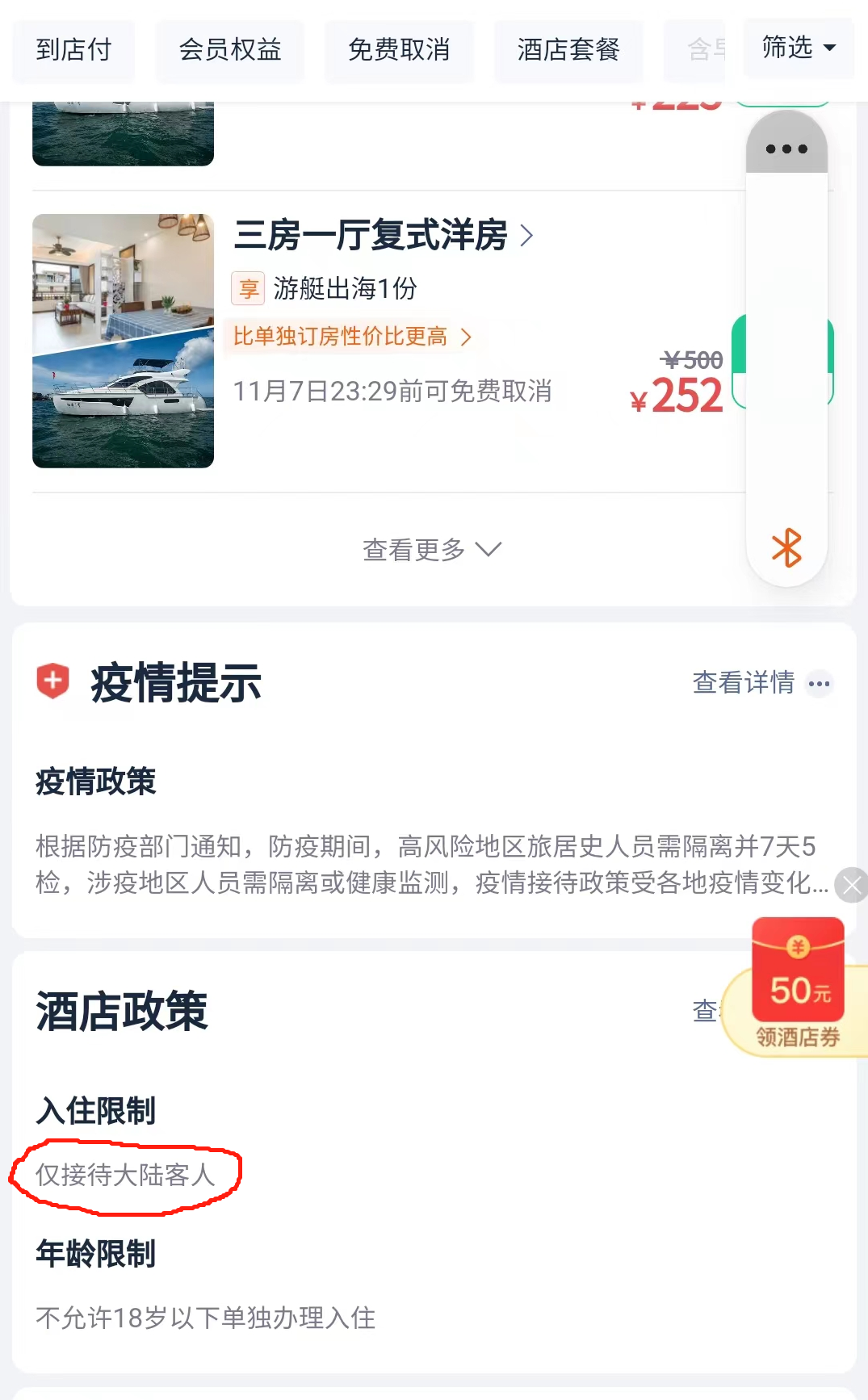
The booking page for a hotel in Sanya on a phone app. The encircled line says "we only accept guests from Mainland China".

Since the pandemic hit, finding hotels that will let foreigners stay has become much, much harder than it used to be, probably due to the general paranoia about us bringing Covid in from the virus-infested outside world. It used to be pretty much guaranteed that, no matter where you went in China, you would still find plenty of hotels that would accept foreigners too. This is no longer true today. 

In vast swathes of China, especially in the North and West, upwards of 90% of hotels no longer give rooms to "international friends" at all. The few that do are often the most high-end ones (4 stars and above), making travel within the country much more expensive and inconvenient. 

When I travel in China, I usually book hotels through the Tongcheng Travel (同程旅行) mini-program which I access through WeChat. I have learnt to always read carefully through the hotel's "policies" to see if I can spot the little phrase 仅接待大陆客人 (we only take guests from Mainland China), which appears depressingly often. In some instances they will say 仅接待大陆及港澳台客人 (we only take guests from Mainland China, Hong Kong, Macau and Taiwan), which is slightly more generous but still of no use to me (also take a second to reflect on how crazy it is that, 25 years after the handover, plenty of hotels in the Mainland won't even take Hong Kongers). Some of the places that carry this warning may turn out to take foreigners anyway, and some that don't still won't take you. It's all quite unpredictable.

It must be said that the situation still varies by the province. Last year I found it much easier to find accommodation in Hainan and Guangdong, both provinces that tend to be much more open to the outside world. A couple of hotels in Hainan did cancel my booking once they realised I was a foreigner, one of them a fancy resort in Sanya, but the second place I tried was always happy to take me.

Once you get away from touristy areas in the South, however, finding accommodation as a foreigner has become a struggle. Even in the outskirts of Beijing only 4/5-star hotels seem to accept foreign citizens at the moment, at prices that start from 6-700 Yuan a night. It used to be possible for foreigners to stay in 农家院 (rural homestays) in the mountains around Beijing with no questions asked. But on a recent trip of mine to such an area the local homestays (which double as restaurants) were wary of even letting me eat there, because they'd been told to report any foreigners they received.

If you travel somewhere and the handful of places that take foreigners are fully booked, then you're out of luck. Last year when I travelled to Yushu, I found that out of the dozens of hotels in the prefectural capital only three accepted foreigners. All three hotels were already sold out for the dates of an annual horse-riding fair, when people pour in from the rest of the county. I was going back to Beijing around that time anyway, but I ended up leaving a day early because of this. 

The fact that more and more hotels around China won't let foreigners stay is an unwelcome development but not a surprising one, at least for me. It's part of a general trend towards closing off which started well before the pandemic, but has been heavily intensified because of it. There is much speculation about when China will give up on its policy of  "dynamic clearance" of Covid and move towards some sort of coexistence with the virus. I have no idea when this might happen, but when and if the policy is abandoned it may take years before some of its unfortunate side-effects are rolled back, including this one. 

Even if one day China's borders open up again, I think foreign travellers who come here are going to find a country vastly less easy to travel in than the one they remember.

Sunday, June 26, 2022

Antisemitism with Chinese characteristics

Many bad ideas have made their way from the West to China since the two civilisations collided in the 19th century, but until recently antisemitism wasn't one of them. 

Unfortunately, it looks like this may be changing. The number of Chinese academics and media personalities recently espousing antisemitic rhetoric has become impossible to ignore. The latest example is professor Zhang Wenmu, from the prestigious Center for Strategic Studies of Beihang University, Beijing. He is a well-known political scientist and naval strategist, and also a "leftist" in the Chinese sense, in other words a conservative nationalist and statist.

In a weird bit of online commentary, translated by the excellent Israeli analyst Tuvia Gering, Prof. Zhang offered this astonishing take on events in Ukraine: "Why has Ukraine become Judaised, and why has Israel put up with it? It's because Wall Street wanted to plant a quasi-Israel in this problematic European region. Israel, like the US and UK, is a tool of Wall Street or, to put it another way, a moneymaking subsidiary of a corporation masquerading as a state. So what is the reason for Ukraine's Nazification? It was designed to sow the seeds of a world war in Europe. In the previous one, the Jews did not anticipate Hitler, whom they had helped to power, to turn on them. However Jews as people, as well as the great bulk of humanity, are merely tools for Wall Street's profits."

Zhang Wenmu is clearly no stranger to antisemitism: in August last year he wrote a rambling article which mixed conspiracies about George Soros, Covid-19 as an American biological weapon, and the Jews as a "people of usurers" who dominate the US. He even managed to throw in a few quotes from Marx's tract "on the Jewish Question", which many consider highly antisemitic.

If this sort of rhetoric were limited to Professor Zhang alone, it could be ignored as the work of a lone crank. Unfortunately, it is not. Examples abound. What is most concerning is that some of China's infamous nationalist influencers have decided to jump on the antisemitic bandwagon. The most striking example is Lu Kewen, a former factory worker whose rants have over the last few years amassed millions of followers across various Chinese social media platforms. 

In May last year, Lu Kewen published an article on his WeChat account entitled "What should we make of the Jews?". The "we" in question is of course the Chinese nation. The article is pretty much a rehashing of all the world's worst antisemitic conspiracy theories, but it also claims the Jews are "enemies of China". Predictably the Jews are charged with controlling the US and its "anti-China media", but they are also held responsible for the Opium Wars, with Kewen peddling the idea that most of the opium was actually sold by Jewish merchants. It is hard to imagine a more inflammatory charge in China, and misinformation like this could do real damage if it spreads. The article, which ends with an exhortation to guard against "Jewish infiltration" of Chinese media and finance, got dozens of thousands of likes, and at least a hundred thousand clicks, possibly far more (WeChat does not allow you to see figures over a hundred thousand).

Chinese vice-premier Wang Qishan on a visit to the Wailing Wall

Until very recently, this kind of anti-Jewish rhetoric was virtually unheard of in China. What seems to have marked a turning point is the latest conflict between Israel and Hamas, which took place in May last year. During previous rounds of fighting in the Middle East, Chinese diplomats and spokespeople stuck to bland and neutral-sounding statements, deploring the violence and urging restraint on both sides. This is hardly surprising when you consider that the Chinese leadership walks a fine line in the region, trying to remain friends with everyone, from Iran to Saudi Arabia, from Israel to Qatar, usually with remarkable success. In fact Israel and China enjoy blooming commercial ties, much to the annoyance of several US administrations.

Last year, however, China's "wolf-warrior" diplomats took Israel's bombing of Gaza as another opportunity to publicly blast the US. The main public faces of Chinese diplomacy turned to Twitter, now the world's primary arena for this sort of "undiplomatic" diplomacy, with Hua Chunying tweeting about how America "turns a blind eye to the suffering of the Palestinians" even though it "claims to care" about the "human rights of Muslims", while Zhao Lijian tweeted a picture of an American eagle dropping a bomb on Gaza.

This shift in tone seems to have little to do with Israel or the Palestinians themselves, and everything to do with a wish to get back at the US for daring to complain about China's treatment of its Muslim citizens in Xinjiang, with American criticism now painted as hypocrisy. Attacking the US for its one-sided support of Israel is an easy card to play, and will win you a lot of sympathy in much of the world. The temptation must have been too much to resist for the champions of China's new assertive diplomacy, in spite of the risk of throwing relations with Israel under a bus.

China's English-language state-media duly followed suit, with the Global Times publishing one of its infamous editorials on how the US held "undeniable responsibility" for the Israel-Hamas conflict. The rhetoric was mainly directed at America, rather than Israel, but at one point the editorial quotes a Chinese analyst as saying that US policy in the Middle East has "long been kidnapped by its Jewish community that serves the interests of Israel".

CGTN, China's main outward-facing propaganda channel, then published a short video entitled "Why does the US act as a diplomatic shield for Israel?" During the video, the presenter says "some believe that US pro-Israel policy is traceable to the influence of wealthy Jews and the Jewish lobby". He goes on to explain, in a pedagogical fashion, that there are, indeed, many rich Jews in the US, and that "Jews dominate finance, media and internet sectors". He adds "So do they have powerful lobbies like some say? Possible." But he then explains that the real reason for US support of Israel is not the power of American Jewry, but rather the fact that Israel serves the US's geopolitical interests as its main "beachhead" in the Middle East.

In spite of this conclusion, the video presents American Jews' control of the economy as a fact. It is likely that the people who made it simply did not realise how inflammatory it can be to talk about Jews "dominating finance". After the Israeli embassy in Beijing issued a strong complaint, the video was removed from CGTN's website.

The antisemitic tone of this sort of commentary may be unintentional, but it probably helped deliver the message to nationalist academics and bloggers like Lu and Zhang that the Jews are now fair game for their vitriol. It is no coincidence that Lu Kewen's rant came out in late May 2021, just after Israel's war with Hamas was over. 

What the synagogue in Kaifeng used to look like before it was destroyed in the 19th century.

All of this is all particularly unfortunate because China often used to seem strangely impervious to antisemitism, especially when compared to other forms of racist discourse from abroad. 

There is no native Chinese tradition of antisemitism, unsurprisingly for a culture so far removed from the monotheistic world-view. China's one and only "native" Jewish community, based in Kaifeng, was historically left alone until it assimilated of its own accord. European Jews who found refuge in Shanghai in the 1930s are said to have got along well with the locals, and Republic of China diplomat Ho Feng-Shan was later recognised for saving thousands of Austrian Jews from the Holocaust by issuing them humanitarian visas for Shanghai. Jews have never seen China as a hostile country, and with good reason.

In fact, over the past century China has developed an odd kind of "philosemitism". Many of the reformers and intellectuals of the early twentieth century, for instance Liang Qichao, admired the Jews as a resourceful people who had done well for themselves in spite of lacking a homeland and being persecuted. Many of them seemed to have believed exaggerated tales of Jewish wealth and influence that they heard from Europeans, but this did not cause them to resent the Jews. Instead, they wondered what the Chinese might learn from them. Sun Yatsen himself admired the Jews and sympathised with the Zionist movement.

This Chinese philosemitism is still alive today. On the (rare) occasions when I have brought up my Jewish roots in conversation with local people in China, I have often been told something along the lines that Jews are known to be "very intelligent". The Jews' presumed superior intelligence and education seems, in fact, to be the single most well-known "fact" about them in China. The stereotype of Jews being good at business also survives, but it is not seen as something negative, just as further proof of their smartness. These attitudes have given rise to an entire cottage industry of cheesy self-help books purporting to uncover the secrets of how Jews do business or how they educate their children to be so successful.

In spite of the Mao-era support for the Arabs, Israel has also sometimes attracted admiration in China. The Israelis are seen as a tough bunch who take no nonsense from anyone, look after their own and create first-rate technology, qualities highly prized by Chinese nationalists. There is no tradition of opposition to Zionism, a term that is not particularly well-known in China, either in English or in its Chinese translation (犹太复国主义, or "ideology of recreating the Jewish nation"). 

Of course, a philosemitism which is not based on any genuine understanding can easily turn into something darker, especially once you throw in the eternal stereotype of the Jew as a shrewd businessman. One only needs to see the CGTN video linked above, or the way that Fudan University historian Wen Yang, another egregious nationalist, responded to David P. Goldman's arguments on China's potential global economic hegemony: apparently Goldman (who is a secular American Jew) was "revealing his Jewish mindset that everything is commercial", and projecting the Jews' "parasitic business model" onto China.

The bottom line is that relations between China and the US are at their lowest ebb since the death of Mao, and the Chinese leadership has abandoned its long-held attitude of being guarded and non-confrontational in international affairs. Israel is obviously a strong US ally (although it manages to maintain decent ties with Russia and China), and sooner or later this was bound to be reflected in Chinese attitudes towards it and towards Jews in general, especially when it comes to the anti-Western nationalists who have the upper hand in public discourse. Unless there is a general improvement in China's relationship with the US and with the West, we may well see more of this "antisemitism with Chinese characteristics" in the future. 

Sunday, April 24, 2022

Shanghai's lockdown: the beginning of the end, or the end of the beginning?

Over the last couple of years, I have got used to a sense of the surreal permeating my daily life. All kind of things have happened which I would have dismissed as impossible back in 2019, and I have mostly adapted. 

I can now add another surreal experience to the collection: the feeling of living my normal life in Beijing, going to the office, eating out and taking yoga classes by the Liangma River, while people I know down in Shanghai are imprisoned in their flats and literally going hungry. 

A couple of weeks ago a German analyst I have worked with in the past, who resides in Shanghai with his wife and small child, wrote the following message in a WeChat group of which I am part: "People are seriously short of basic food, not having been able to order anything for days (same for us, my colleagues and friends). When asked what you do if you don't have basic food, he replied: "At this time it depends on your neighbourhood - and there are stories of people starving (already for weeks, as some districts have been on full lockdown for four weeks). There are stories of poisoning where people tried to eat old food, or even tried to eat non-food items. Water is another basic problem.

If I happened to be living in Shanghai, instead of Beijing, this could have been me. Never in a million years would I have imagined I would see China's most prosperous and orderly city suffer widespread hunger as a result of government policies to stamp out a virus, and yet here we are. 

Here in Beijing, life is still relatively normal. People have been hoarding food after seeing the events unfolding in Shanghai, but for now there seems to be no real need. Offices are open, cafés are full and streets are bustling. The odd new Covid case leads to a building or a neighbourhood getting locked down, but this has been happening on and off for two years, and everyone's used to it. As long as it isn't your own neighbourhood that's affected, you don't even think about it. I have not personally been required to do a PCR test since the last time I left Beijing in January (but this very much depends on your job and where you live).

Of course, travel into Beijing from other provinces has been seriously curtailed. If you leave the city, you run a serious risk of not being allowed back in for a while. Even people who commute every day from Yanjiao, just across the border in Hebei, have been forced to work from home. During the recent national holidays for Tomb Sweeping Day, the furthest you could go was basically the mountains north and west of the city that still fall within the municipal boundaries. Crossing into a different province spells trouble. No one knows when this will change.

But more than that, it is the events in Shanghai that seem to have shaken many people around me out of their complacency. It is looking more and more like China's Zero-Covid policy has no endgame. This could mean more years ahead of never knowing when you or your city might suddenly be placed in lockdown, not to mention travel within China being restricted and international travel almost impossible. These measures don't impact everyone equally, but in one way or another they affect most of society. 

For foreign residents like me, the big question is whether to remain in China or not. Many of the foreigners still here are definitely considering packing up and leaving. This may not matter much to Chinese society, but it certainly matters to me. In Shanghai some of the foreign residents have already left the country if they could, with no plans to return. I have heard stories of foreigners walking or cycling for hours through empty streets to get to Pudong airport and take a flight out, since taxis and public transport are suspended. There will probably be quite an exodus once the lockdown is lifted.

The mood amongst foreigners in Beijing is also rather sombre. In many ways the last two years have not been a bad time to be in China, since you were safe from the virus and daily life was mostly normal. But now there is a general feeling that a turning point has been reached, with China doubling down on its anti-Covid crusade while the rest of the world moves on.

Even more than the prospect of Shanghai-style lockdowns, it is the near-impossibility of going back home and seeing their families that is pushing foreigners here to call it quits, especially since there really seems to be no prospect of this situation changing. Foreigners still in China are probably the ones most committed to their lives and careers here, but even they are starting to falter. I have heard more than one person say they are now making exit plans. 

When the dust finally settles, the air of cosmopolitanism that parts of Shanghai and Beijing had acquired will be all but gone, with just a few diplomats, journalists, shills and people with Chinese family still hanging around. Probably just a side-show in a drama affecting 1.4 billion people, but still one worth commenting on, with ramifications that go beyond the disruption to individual lives.

Witnessing the mess going on in Shanghai has been particularly shocking to many, because it is a city that often feels like a bubble of internationalism and good governance, worlds apart from the rest of China. In fact, over the past year, Shanghai had often been upheld as an example of a more humane approach to achieving "Zero Covid": the city avoided the most extreme excesses of other regions, quarantining those infected and their close contacts but not entire neighbourhoods, and doing its best not to disrupt people's lives with unnecessary measures taken "just to be on the safe side". 

And yet, over the last month all the most inflexible and inhumane of China's "pandemic-control" measures have been on full display in China's showcase metropolis. Covid-infected toddlers have been quarantined without their parents in dubious conditions (after a huge public outcry, they announced this would change). More and more people with medical conditions other than Covid are finding they can't receive treatment, and in some cases are dying (it seems nothing has been learnt from January's sad events in Xi'an). The pets of the infected have been brutally killed, or left to starve in empty flats. Outsiders unlucky enough to get stuck in the city have had to sleep in the open.

Those infected have been carted off to empty factories and hangars re-purposed as quarantine centres, where they are given nothing but a bed with a thin mattress and a blanket in a room shared with hundreds of others. Showering is impossible, getting some sleep amid the noise is a challenge and the food is unappetising. In extreme cases, those quarantined have been filmed fighting over food.

The real shocker is the system's inability to deliver enough food to the population, especially since this was never an issue in Wuhan or anywhere else. Reports claim the problem is not a lack of food, just that many of the workers who would normally deliver it are in lockdown, and suppliers outside the city have trouble getting permits for drivers to enter and leave Shanghai. Things are now getting better, but securing enough food remains a struggle. I would have assumed that the authorities would rather end the lockdown than let people go hungry, but it seems that as long as actual mass starvation can be avoided, fighting the pandemic comes first. 

It is clear that in Shanghai there is real anger about what's going on. People placed in unsanitary and crowded quarantine centres have been on the verge of rioting. Plenty of videos show crowds protesting the lockdown of their neighbourhoods, breaking through quarantine barriers in mass and fighting with the police and health workers. Rappers stuck in their homes record songs where they rail against the system. The faceless "health workers" with their bodies covered in white are often on the receiving end of people's fury, although they may just be poor migrants going from city to city looking for jobs in this booming new sector.

People have been dragged kicking and screaming into quarantine, and arrested for refusing to get tested. Other videos show individuals going on rants against the government or flatly refusing to wear a mask and stay home. Such videos get censored quickly on WeChat and Weibo, but not before someone has uploaded them to Twitter, preserving them for posterity.

The most surreal video of all has to be the one of people chanting from their balconies to protest the lack of supplies. A drone then comes down from the sky, and intones in a robotic voice "Please comply with Covid restrictions. Control your soul's desire for freedom." The word "dystopian" gets used a lot in relation to China, not always fairly, but sometimes they really are asking for it.

The discontent isn't limited to Shanghai either. All over the country, cities and neighbourhoods in lockdown have been the scene of protests, unrest and arguments between ordinary people and the health workers in white suits. People like this guy are at the end of their tether. The poor can no longer stand the impact on their earnings: in this video of a protest last month in Langfang, Hebei Province, people can be heard yelling 解封!老百姓活不了!(End the lockdown! We laobaixing can't survive!) 

So what's the big picture? China's "Dynamic Zero Covid" policy has clearly reached a turning point. There are at least three cities (Shanghai, Changchun and Jilin) where the virus has spread widely in the community, leading to dozens of thousands of cases. This hadn't happened since February 2020 in Wuhan. The infectious nature of Omicron makes it far harder to nip every new outbreak in the bud and carry on as normal, as China has been doing for two years. 

When cases started sky-rocketing, many thought the authorities would finally have to abandon their commitment to a Covid-free China. I was sceptical they would, and I am being proven right. The reality is that, while there are Omicron outbreaks all over China, they have been or are being put down almost everywhere. Cases in Changchun and Jilin have already decreased sharply. It is only Shanghai that is still recording massive numbers, and even there we seem to be past the peak.  

We know that Omicron outbreaks spread fast and peak within a month or two, even without the sort of draconian measures China takes, and the authorities clearly intend to keep Shanghai insulated from the rest of China until the outbreak has died out or been stamped out. As long as they can deliver enough food to prevent actual starvation, I don't see a general anti-lockdown rebellion taking place, just isolated acts of disobedience and unrest. The fact that even respected scientists who advocate for a different approach get censored doesn't bode well for those hoping for change.

The real question is, why are the men who run China still so hell-bent on stopping Covid from spreading? The virus just isn't as dangerous as it used to be, and most of those infected have mild or no symptoms. Officially nearly a hundred people have died in the current outbreak in Shanghai (most were unvaccinated or had other serious conditions). There are good reasons to assume the true death toll is higher, given how deaths from Covid are recorded in China, but we are not talking about massive numbers. In Shanghai people seem to be more worried about getting stuck in a horrible quarantine facility than about the actual virus.

I happen to think that the "Zero Covid" approach was justified in 2020 and most of 2021, when the virus was more virulent and people weren't vaccinated. Implementation was unnecessarily draconian and could leave you feeling trapped in a Kafkaesque bureaucratic dystopia, but there's no denying that a few million lives were saved. This approach was also genuinely popular with the public, and in fact it provided China's authoritarian one-party system with added legitimacy in the eyes of its people. Now it feels like part of that legitimacy is being squandered, because the guys in charge just don't know when it's time to change course.

There is a popular take going around internationally, according to which China's real problem is that they vaccinated their population with "ineffective" Chinese vaccines, and that if they only used the Western MRNA vaccines they could then open up. The thing is, though, that it's just not true the local vaccines are no use. Data from Hong Kong suggests they are almost equally effective as Pfeizer after a booster, while a study from Singapore found a bigger gap, but it seems clear that they also offer decent protection against severe symptoms and death. The reality is that China would probably be following the same policies even if they had been using the Pfizer vaccine all along.

Behind the continuing lockdowns there seems to be a conviction that if the virus is allowed to spread there will be countless deaths and hospitals will be overwhelmed. It is interesting to read this article by "Chairman Rabbit", a well-known nationalist blogger who is also the grandson of an important Communist Party politician. He is not a government official himself, but his post is a good example of the kind of thinking that lies behind the continued support for Zero-Covid in China. 

The article engages in some questionable maths to claim that, based on Hong Kong's experience, hundreds of thousands, millions "or even more" deaths could occur throughout China if restrictions are lifted. It claims that "It is politically and culturally impossible for the Chinese government and civil society to allow lifting restrictions at the cost of massive human lives". 

In the end, it manages to wax lyrical about China's approach to the pandemic, claiming: "China's ultimate goal is to become the only country in human society that truly avoids massive loss of human lives due to COVID-19. The digital governance, grid-based grassroots governance, and a community-wide public health model that China is exploring, will not only be used to deal with COVID-19, but also with the more horrific viruses and superbugs that humanity may encounter in the future. If China can blaze such a path, it will be a success for the country as well as a contribution to human civilization".

I find the argument that it is "culturally" impossible for China to lift the restrictions to be quite disingenuous, in a culture that often takes pride in sacrificing the individual for the needs of the collective. At this point, it feels like the collective is being asked to make sacrifices for the sake of the minority of individuals who would die or be left disabled by Covid. The part that's probably true, however, is that lifting the restrictions is politically impossible. 

The simple truth is that the ruling party has staked too much credibility on its ability to stop China being overwhelmed by this virus, and it cannot easily change course. Especially after telling everyone who would listen about how much better China's response was than America's, and how this proves the superiority of the Chinese system, they can't allow ugly scenes of death and overwhelmed hospitals to play out all over the country. Also, they come from a political culture where sacrificing the comfort, dignity, and even life of individual citizens in pursuit of greater national goals is the right and proper thing to do.

It may well be true, of course, that China would see a lot of deaths if Covid were allowed to run rampant. After all, even major European countries are still seeing a few hundred deaths a day due to the pandemic, something which the public has become inured to. One of China's major issues is that the elderly have low vaccination rates. The authorities are now trying to push them to get their shots, but apparently don't feel comfortable mandating vaccinations (on the other hand, they do feel comfortable forcing 25 million people to stay at home for weeks without enough food). 

Ironically, and maddeningly, there is much less pressure on people to get vaccinated in China than in most of the world. Proof of vaccination is not required for most work or travel within the country, and getting inoculated remains a personal choice. Vaccines don't do the heavy lifting in China, lockdowns and PCR tests do. 

Personally, I see no justification for the continuation of the Zero-Covid approach. At this point, avoiding the potential deaths Covid might cause just cannot justify the disruption to millions of lives, or the damage to people's physical and mental health and, yes, to the economy (in the imperfect world we live in, real people suffer when the economy tanks). 

Of course, it's not surprising that I might feel this way. After all I come from a Western country, so I must be "overly attached to personal freedom", as I have sometimes been told here in China over the past two years. The real question is how many Chinese are starting to agree with me.

No doubt there is serious public discontent about what is going on in Shanghai. People in other cities are not thrilled at the idea that something similar might happen to them next. I personally know many Chinese, mostly young and well-educated, who understand that Covid is not the threat it used to be and think that it is time to move towards living with the virus. I often hear people around me express exasperation about the strictness of the anti-pandemic measures, in a way they didn't a year or six months ago. 

Yesterday's sudden wave of subversion on WeChat is a signal of the frustration and anger felt by parts of the population. The only other times I remember seeing such a lot of subversive sentiment openly expressed on my WeChat feed by normally apolitical people was in early February 2020, after Dr. Li Wenliang died in Wuhan, and in February 2018, after the presidential term limits were abolished.

All this doesn't alter the fact that there is still a large base of public support for keeping China Covid-free. There are plenty of people who are happy for extreme measures to be taken to keep Covid out, at least as long as they themselves don't get hit with the consequences. The idea that Covid is highly dangerous and should not be accepted as a normal part of life has been deeply implanted in people's minds. It is also not clear if older and less online members of the public realise how bad things have got in Shanghai, since the Chinese media don't really report on the food shortages, the horrible quarantine centres and the widespread anger. 

Conveniently and predictably, much of the blame for the problems in Shanghai is being placed on the local government, in the same way that much of the initial anger about the cover ups in Wuhan was directed at the local authorities. When it can't be denied that things have gone awry, blaming incompetence and corruption at the local level is always the easiest safety-valve. 

What's more, Shanghai's government is being blamed not only for mishandling the distribution of food, but also for being too lax about "pandemic-control" in the beginning, allowing the number of cases to spiral out of control. The only lesson the authorities may learn from all this is that Shanghai's more relaxed and less arbitrary measures (what they call "precise" prevention and control) were the problem, because they simply could not contain Omicron. From their point of view, they are right. If you want to contain a virus this infectious you have to use a sledgehammer, not a chisel. Quarantine entire neighbourhoods indefinitely for a single case, lock away anyone who's been anywhere near a positive case, don't even care if their pets are left to die, and then you might actually succeed.

Right now, it looks like what the future holds for China is ever stricter measures to make sure Omicron doesn't spread to begin with. Shanghai will be locked down for as long as it takes for the outbreak to end. A few lives will be lost, either to hunger or lack of medical care, but apparently this is considered a price worth paying. More cities will be locked down when new cases appear. Travel between provinces will become much harder than it was even in 2020-21. Most importantly to me personally, travelling to China from abroad will get even more difficult, or in any case no easier. It may not go back to normal for years.

There are those who predict things may loosen up after the big Party Congress to be held in the Autumn, when Xi will be reconfirmed for his third term in power. Now others are starting to say that they'll wait until the Two Sessions in March 2023. I've been hearing such predictions for a long time. A year ago, people were saying that China would have to open up before the Winter Olympics. Then it became after the Olympics. The reality is that this guessing game is futile, because no one knows. It is probably true that once Xi has been reconfirmed in power, the government will start to study a way out of this impasse, but even then it will not be a quick transition. 

Meanwhile, the rest of us can do nothing but sit back and watch the spectacle of the largest battle ever fought between human beings and a virus play out in real time. If nothing else we will find out what it really takes to contain this virus, and also what happens when a modern country seals its borders almost entirely for a number of years. There might be some lessons in there for the rest of us.