Showing posts with label internet censorship. Show all posts

Thursday, August 27, 2015

No comment


This news item was published yesterday on 网易 (Netease), one of China's most popular web portals. The comic effect was clearly intentional, and it looks like the website has already been forced to take it down, but before they did it had the time to make the rounds on Wechat.

Here's what it says:

Burma (Myanmar) unblocks Facebook. Only four countries now blocking it.

Burma recently announced that it was lifting the ban on Facebook, the world's most popular social networking site. There are at present only four countries in the world which still block Facebook, including North Korea, Cuba, Iran and others.

Wonder who the others might be?

Monday, January 26, 2015

A few thoughts on China and the internet

The last few weeks have seen an intensification of the Chinese state's attempts to control which parts of the internet its people should be able to access.

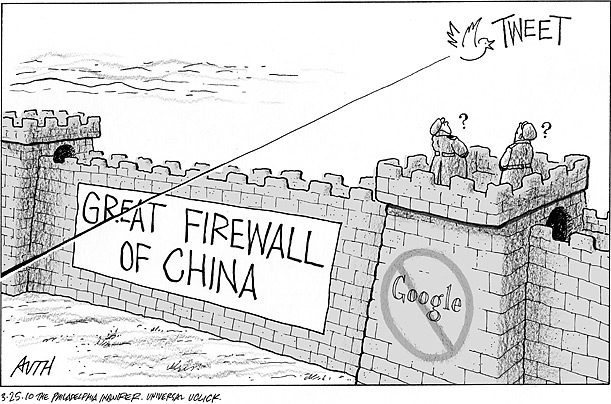
After having blocked nearly all major foreign websites (Facebook, Youtube, Twitter, Gmail, Google...), the authorities are now cracking down on VPNs, the softwares which people use to get around the "great firewall". Over the last month some popular VPNs have been blocked. Anecdotal evidence suggests that all VPNs are becoming increasingly unstable and hard to use. Although I am still managing to use my own one (otherwise I would be unable to access this blog), I have also found that it frequently stops working and needs to be restarted.

I doubt the authorities would go so far as to completely block all VPNs even if they were able to, since that would be a real headache for multinational businesses operating in the country. I must say that a part of me almost hopes they did, since it might finally precipitate a public debate on the issue. In any case,it will now become even harder for the less determined to view censored websites.

This crackdown on VPNs would seem to be part of a more general tightening of the screws on all kinds of dissent which has taken place since the new leadership came to power in 2012. Over the last couple of years, liberal and independent thinkers of all kinds have found themselves increasingly attacked and marginalized.

I think there are some general conclusions to be drawn from all of this. It used to be a common trope that as time goes by and the economy develops, China would "naturally" progress towards being more free and democratic. In my view it is high time to put that old chestnut to rest.

The truth is that a lot of progress was made towards allowing the Chinese greater social freedoms and freedom of expression during the eighties and nineties. Then again, when the baseline was the Maoist years it would have been hard not to improve in these respects. By the start of the 21st century however, China had stabilized at a certain level of freedom (or un-freedom).

While the economy has continued growing at great speed since then, and the infrastructure has continued improving, there has been no great progress in terms of granting citizens genuine freedom of speech and other basic political rights. Further progress would probably necessitate profound reforms of the political system which would ensure a separation of powers and subject the state's actions to constraints and oversight, but the people who run the country are just not willing to undertake such reforms, as much as they may pay lip service to concepts like the "rule of law".

Another thing to realize is that the government still enjoys much support and legitimacy in the eyes of the middle and upper classes of urban China, exactly the people who would have the ability to affect change (the peasant workers who man the country's construction sites may view things differently, but they have little possibility to act upon their feelings). Free thinkers and dissidents like Ai Wei Wei do not represent the mainstream, and never have done.

This holds true for a variety of reasons: partly because of how the state is seen as ensuring economic growth and providing new infrastructure (Beijing has just opened three new subway lines), partly because there is a good degree of social freedom (like the freedom to work where you want, dress how you like and spend your free time how you like), partly because people buy into the line that stability is what matters most and democracy would make China descend into chaos, and partly because they truly believe (or have been convinced) that the current government is what defends the nation from foreign intrusion and restores its honour after the "century of humiliation".

What's more, most of the Chinese public remains only vaguely aware of things like the current crackdown on the internet and on dissent, and has little interest in finding out more. As long this situation continues, the government is on solid ground. This doesn't mean that outside observers have to ignore the obvious negative sides of China's system, or refrain from criticizing these policies. At the same time, there is no use in kidding ourselves: China's internet isn't opening up any time soon. And what's more, most Chinese couldn't really care less.

Thursday, July 31, 2014

A Censorship Diary: how China cut itself off from the World Wide Web


It is relatively well known throughout the world that the Chinese government censors the internet to its pleasure, and that a number of important foreign websites are blocked in China. What is perhaps not so widely realized is that the censorship of foreign websites has got considerably worse over the last five to six years, the time during which I have lived in China. 

When I first got to China, in September 2008, the Beijing Olympics had just ended. To make a good impression with all the foreign journalists and visitors who descended on the Chinese capital for the games, important foreign websites had all been made accessible. It seems amazing now, but Facebook, You Tube and Twitter were all freely navigable from anywhere in China. At the time I wondered what all the fuss over China's "Great Firewall" was about.

Then in March 2009, the Chinese authorities decided to block You Tube. It was reported at the time that the site was blocked because someone had uploaded a "fake" video of a Chinese policeman killing Tibetan protesters. It's not like they just blocked that particular video. The whole of You Tube was made inaccessible from anywhere in Mainland China. I quickly learned how to download and use a VPN proxy server to get around the censorship, something which I had never done before. 

Shortly afterwards, Blogspot was also blocked in China, meaning that I had to switch on my VPN every time I wanted to update this blog. That summer I went back home on holiday, and when I returned to China in August, I found that Facebook had been blocked as well. Apparently this decision was taken following the unrest in Xinjiang that July. Quite unsurprisingly, groups in support of Xinjiang's independence had sprung up on Facebook, just as you would expect for any conflict anywhere in the world. 

Even less surprisingly, the folks at China's Ministry of the Interior, or wherever else these decisions are taken, reacted with all the subtlety and sophistication they are known for, and simply blocked access to the whole of the world's most popular social networking site. They also blocked access to the whole of the internet for almost a year over the entire territory of Xinjiang, a province as big as Western Europe.

Twitter was also blocked in China around this time, but not being a Twitter user I never really noticed. The situation stayed more or less the same for a few years, with Facebook, You Tube and Blogspot the only major sites I visit regularly to be blocked. Google's exit from the Chinese market in 2010 didn't really make much difference, as searches for google.cn were now simply re-routed to google.com.hk.

Then in January this year they decided to block the Guardian, my newspaper of choice. This was in response to them publishing a piece accusing relatives of Xi Jinping, Wen Jiabao and other top leaders of transferring money to offshore havens. As always, the Chinese government makes a big deal of its anti-corruption campaigns and openly admits that corruption is a huge problem (since denials would simply be considered laughable by its own people), but it draws a line at any accusations against its top leaders. 

At a briefing on this topic, a Foreign Ministry spokesman had this to say: "I am not aware of the specific circumstances. From the point of view of readers, the logic of some of the related articles is unconvincing, and it leads people to suspect the intentions behind it."(1) So now the Guardian has become part of the eternal conspiracy by the "foreign powers", who want to sow instability and prevent China's "peaceful rise".

In the meantime, access to Google was also becoming increasingly erratic. And then a couple of months ago, even Google and all of its related services (including gmail) were blocked for good. It is now almost impossible for me to do anything meaningful on the internet without using a VPN. My favourite newspaper, Google, my gmail adress, my blog, Facebook and You Tube are all inaccessible without one, hidden behind the great firewall. 

It may be noticed that the advent of the new Xi Jinping - Li Keqiang leadership in November 2012 has not been followed up by a relaxation of the censorship, but in fact quite the opposite. China has now become a country where the casual foreign visitor who doesn't have a VPN feels pretty much cut off from the World Wide Web, or at least the part of it which matters. For a country which wants to present itself as increasingly open and international, this is a huge paradox, and extremely self-defeating.

If nothing else, I hope that blocking Google will backfire. Facebook and You Tube were never really that widely used by Chinese people, who prefer their own social networking and video-sharing sites (which are of course controlled and censored). Most Chinese users also prefer Baidu to Google, but Google is still pretty much essential to search for anything foreign (Baidu's servers just aren't up to standard when it comes to foreign websites).  For many young people and companies, not being able to access Google will be a problem. The use of VPNs may shoot up as a result, at least among the young and educated, making the whole exercise self-defeating.


Monday, May 17, 2010

21 million people go without internet access for 10 months

How many of you often think that you should waste less time on the internet, chatting on MSN to people you haven't met in years (or ever), updating your profile on some social networking site or watching random videos on Youtube?
Well in the marvellous land of China, an entire province of 21.5 million people has been forced to let go of such time wasting habits for almost a year. In the province of Xinjiang, a huge expanse of land in China's North-Western frontier, the internet was entirely cut off across the province since the ethnic riots occured last July. The authorities, claiming that the Muslim separatists were using the internet to organize their activities, decided point blank to block any access to the internet in the entire province, which is around eight times bigger than Great Britain and has about a third of Britain's population. The move was justified with the need to "maintain social stability" and contrast activities harmful to it. This policy was only reversed two days ago, when the internet was finally unblocked in Xinjiang after ten months.
Although in China many rural areas still lack internet access in any case, in cities (including Xinjiang's cities) the internet is a part of people's lives almost as much as it is in the West. The situation in Xinjiang represents a unique sociological experiment, which no university researcher could ever hope to repeat: seeing how a relatively modern society copes without the internet for an extended period of time.
According to a report in yesterday's China Daily, the people who will be most unhappy about the return of the internet are the owners of cinemas, bars, KTV (karaoke) parlours and other entertainment venues. As a result of the lack of internet access, people had been going out to such places far more than usual. DVD sellers were also doing much better than usual, since no one could download films from the internet. The happiest about the return to normal will probably be businessmen, whose operations were obviously seriously disrupted by the ban. I would suppose that people who use the net to speak to relatives who work in other provinces will also find the return most welcome.
It was also reported that a street poll of 100 random people in Xinjiang's capital Urumqi found that only 10 declared themselves "severly affected" by the ban, while 70 declared they could cope comfortably with the situation, and 21 said they didn't miss the internet at all (yes I know, it makes 101 people, go figure). Some people even described the last ten months without the net as a kind of "mental detox". Take this example from the article:

"It was hell for the first couple of months without the Internet, which I think I've been addicted to since 1999," said Luo Liang, 29, an advertising planner in Urumqi. "I didn't know how to entertain myself. I felt so frustrated and helpless.
"But then I started to find alternatives to keep me occupied, such as watching movies and going to KTV with my friends. I later realized that my dependence on the cyber world is actually an addiction," she said.
Luo even started to learn Japanese, which she has always wanted to, by utilizing the time she normally used to surf the Internet.
"My attitude towards the Web has changed. I've learned that there is more to life than Internet," she added.
Sound familiar? If I were unable to access the net for ten months, I might well have similar things to say. Although the Internet is certainly an extremely useful tool, and I am not suggesting that we should get rid of it, I can't help feeling that perhaps there would be some positive sides to doing without it (yes, yes, I am using the internet to share these thoughts with you all, but so what?). The amount of time most young (and even less young) people seem to waste reading, watching and writing inanities on the net far surpasses the amount of time they spend doing anything useful with it, like doing research or communicating with people they actually need to communicate with. As a result, people also seem to me to be reading less novels and books, and perhaps spending less time with real people.
Anyway, it may be that humanity is only just starting to get used to the presence of the net, and as time goes by things will stabilize and people will learn to use it in a more balanced manner. Or maybe not.
(Below, a photo of the skyline of Urumqi, the capital of Xinjiang.)