Sunday, March 3, 2013

What do George Galloway and a Beijing restaurant manager have in common?

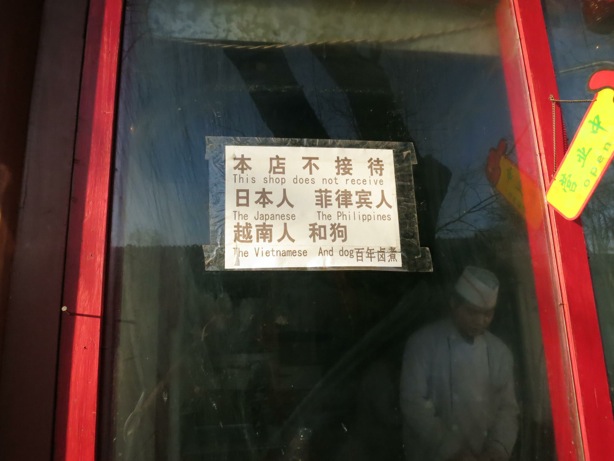
The idiot restaurant owner in Beijing who stuck the racist sign in the photo below outside his restaurant has now taken it down again, it transpires. The sign is bilingual, and the English (or rather the Chinglish) reads "This shop does not receive The Japanese The Phillippines The Vietnamese and dog."

The sign announces that people from the three countries currently involved in territorial disputes with China over uninhabited islands, and also dogs, will not be served. The reference is to the famous sign which supposedly once existed in Shanghai when it was occupied by foreign powers, forbidding "Chinese and dogs" from entering the premises.

The restaurant in question is located in Houhai, a touristy area of central Beijing which straddles a lake. The restaurant owner claims he has no regrets, but he was just getting too many phone calls about it. I'm glad to know somebody still cares. I hope there were many Chinese calling too.

Last week, British member of Parliament George Galloway walked out of a debate in Oxford University when he found out that the student he was debating against was Israeli. The motion of the debate was "Israel should withdraw from the West Bank immediately". After realizing that the other debater, who had an Israeli name, was indeed Israeli, Galloway got up and said "I don't recognize Israel and I don't debate with Israelis" as he walked out of the door. If not recognizing Israel can be considered legitimate, not debating with people because they were born in a certain country is just as bad as not serving them in your restaurant. 

Let's hope the principle that you should never discriminate against people on the basis of the country they were born in spreads wider and wider in the future, to include all Beijing restaurant owners and all British Members of Parliament.


Saturday, February 23, 2013

Why are foreign missionaries tolerated in China?

A report appeared yesterday in the Guardian about the activities of foreign Christian missionaries in Tibet.

Although I am well aware of the extent of missionary activity in China, even I was a bit surprised at the idea that Christianity might be making inroads into Tibet. After all the Tibetans, unlike the Han, have an extremely vital religion of their own which is intrinsically bound up with their ethnic identity, and it seems unlikely that they would easily give it up. The article claims that estimates of the number of Tibetans who have converted to Christianity range "from zero to thousands", so it would seem like the missionaries are fortunately (from my viewpoint) not having much success.

The Guardian suggests that the Chinese authorities tolerate foreign missionaries partly because they are seen as a counterforce to Tibetan Buddhism, which is highly bound up with Tibetan irredentism and identity. Personally I find this explanation rather unlikely. The article suggests that the main center of missionary activity is the city of Xining. For those of you not familiar with the region, Xining is the capital of Qinghai province, a Chinese province which geographically lies mostly within the Tibetan plateau.

Although this province is historically part of Tibet, only 20% of its population is now actually Tibetan, and it is administratively distinct from the Tibetan Autonomous Region (TAR), which is considered to be the proper Tibet. While foreigners need a special visa to visit the TAR, and can only do so in tour groups, in Qinghai there are no specific restrictions any more than there are in the rest of China. If foreign missionaries operated in Lhasa, the capital of Tibet proper, I would find that much more surprising, and necessitating a special explanation. However, that does not seem to be the case.


I would imagine that the reason why missionaries are tolerated in Qinghai province is the same reason that they basically seem to be tolerated throughout China.Western reporting on Christians in China often seems to focus on how the Chinese government represses or censors Christians. It is true that legally foreigners are not allowed to proselytize in China (whatever their religion). It is also true that officially all religious believers have to belong to one of the officially sanctioned religious organizations, which are under strict government control. It is true that the Chinese Catholic Patriotic Association is obliged to accept the bishops which the Chinese government appoints, rather than the ones the Vatican appoints, leading to the Vatican not recognizing the only official body of Chinese Catholics. It is also true that there have been cases of leaders of unregistered "house churches" being arrested and their followers being harassed.

The truth is, however, that beyond the well publicized cases of persecution (which may depend on the whims of local authorities, especially if they take place in rural areas) and beyond the seemingly restrictive legislation, if you live in China you do not get the feeling that the central government is exactly hell bent on stopping foreign missionaries, or on preventing Chinese people from being Christian. American evangelical missionaries seem to operate pretty freely, like the ones who go to Renmin University's famous English corner on Friday night and use the occasion to preach to dozens of impressionable Chinese students. Apparently one of them was once detained recently after a member of the public made a complaint. The police just questioned him and then let him go, and he was back at the English corner preaching the following week.

Foreign English teachers who use their position as a cover to proselytize among their students are also quite common, and no one seems to care or do anything about them. Chinese young people who consider themselves Christians seem to receive no trouble for it, even when they do not subscribe to one of the officially sanctioned churches. There is a rule that Communist party members are not allowed to follow a religion, but I doubt even that is taken too seriously.

I don't know the reason why the Chinese government is so reluctant to confront foreign missionaries and unregistered churches, but I can advance a hypothesis: since there are many questioning young people in China who aren't satisfied with just focusing on making money (China's current national obsession), perhaps the government would rather they joined nonsensical religious groups, fearing that otherwise they will end up in movements with a more political bent. After all, having read Marx when they were young, some of China's leaders perhaps remember the phrase on religion being the "people's opium", and have decided that they could use some of this opium in China too.

Wednesday, January 30, 2013

Terrible pollution in Beijing for the second time this month.


Beijing is once again blanketed in a thick coat of pollution today. Although the city’s air quality has always been atrocious, this last month has been particularly bad. The Chinese press reported today that during the whole of January Beijing has only enjoyed five days free of what they call 雾霾 (wùmái), which literally means “fog and haze”, but is understood to refer to smog caused by pollution.

A few weeks ago, on the weekend of the 12-13th of January, air pollution indexes in Beijing (and many other regions of China) reached unheard of new heights, pushing the authorities to suggest that children and the elderly stay indoors. It was so bad that I actually developed a slight sore throat, which I think was a result of the pollution. Many others had similar complaints. Visibility was low, and quite a few people claimed there was a kind of burning smell in the air, although I must admit that I didn’t notice it myself. (Below, the view from my window on the 13th of January).


A few days later some welcome snow seemed to have improved matters by washing away some of the foul air, but since yesterday air pollution levels have skyrocketed again. The main impact this has on my life is that I have to walk to work instead of cycling, so as to avoid breathing in more of the polluted air than necessary. More people than usual are wearing little surgical masks on the street, but I don’t as I am aware that they are fairly useless in keeping the pollutants out of your lungs.

Fortunately I will be leaving Beijing on Friday and going home for a two week holiday. That is, as long as my flight isn’t cancelled because of the low visibility, something which happened to sixty flights yesterday. Meanwhile, I can take comfort from the knowledge that British cities used to be just as bad during the Industrial revolution, as the Chinese government's ideologues love reminding you.

The Chinese press claimed today that the Beijing authorities are taking drastic temporary measures to lessen the pollution, including suspending the activities of 103 polluting factories around the city and of construction sites which produce dust. It is clear however that structural economic changes would be needed to address the underlying issue, and it is dubious that there is the political will to implement them.

Below is a photo of a “performance art” show put on by a group of artists in the city of Hefei, which has also been affected by the abnormal air pollution. The title of the show translates as “Resist the toxic smog. Make low carbon trips. Give me a clean world back.” Of course both the title of the show and the placards held up by the performers were sufficiently innocuous not to incur in the wrath of the authorities, neither blaming the government nor addressing it directly. 


(the slogans say "protect the world" and "resist the toxic smog, give me a clean world back")

Wednesday, January 9, 2013

Han Han's blog post on censorship and the Southern Weekly affaire

A few days ago an almost unprecedented event took place in China: a demonstration in favour of freedom of the press. Hundreds of people gathered in Guangzhou in front of the headquarters of the Southern Weekly newspaper, to express support for its struggle against censorship.

Southern Weekly is well known to be China’s most open and independent newspaper, and it has often been on the receiving end of government pressure in the past. Last week, the newspaper’s employees wrote an open letter to the provincial propaganda department of Guangdong, demanding the resignation of one of its highest ranking officials. They accuse him of surreptitiously revising one of the newspaper’s editorials, and having it published without their consent. (Note that the “propaganda department” is called 宣传 or xuānchuánbù in Chinese. The word xuānchuán, although it can mean propaganda, doesn’t have the negative ring of the English term. It simply means disseminating information).

The editorial was originally entitled “China’s dream: the dream of constitutionalism”, and urged the government to respect the country’s constitution of 1982. After its revision, the title was changed to “We are closer than even before to our dreams”. The editorial’s original position had been altered to make it appear heavily pro-government, and the revised edition also contained various factual and typographical errors.

The newspaper's staff are now on strike, and the situation has quickly snowballed, with various intellectuals coming out in support of Southern Weekly all over China. Chinese internet sites have blocked related search-terms, and the Chinese media is of course mostly keeping quiet on the issue. The English edition of Global Times, which always tends to tackle sensitive topics from a pro-government angle, has come out with an editorial entitled “Freedom of the Press must serve society”. Characteristically, while remaining vague and avoiding the actual issue, it basically takes the line that freedom of the press “cannot go too far” and has to proceed at the same speed as “social transformation”.

The Chinese edition of the Global Times, on the other hand, has produced another editorial in which it claims that the entire story of the Southern Weekly article being altered is a fabrication, and defends the current censorship arrangements. Other newspapers have been forced to republish this editorial, although many have attempted to resist the order, and the Beijing newspaper Xinjing Bao’s publisher resigned in protest.

The anti-censorship demonstration in Guangzhou was confronted by a small group of counter-demonstrators who called the newspaper “a tool of US imperialism” and waved Chinese flags and banners of Chairman Mao. From the only photo I can find of them, they look like a rag-tag band of people who might well have been paid by the local authorities to stage their “counter-demonstration”.    

 What this whole story tells us, I think, is that in the world of Chinese media some people are fed up with the current level of censorship, and they are not afraid to say so out loud.


China’s most famous blogger, Hán Hán (韩寒), published a post on the issue on his Weibo page two days ago. You can find my translation below. The title is a reference to a well-known Southern Weekly headline, “there is always a power which makes us weep”. I was a bit unsure of the meaning in a few places, but I did my best to produce an accurate translation.


There is Always a Power.
     

Since my two Weibo posts have both been deleted, what am I to write?

When I was still a teenager, the Southern Weekly influenced me deeply, and it accompanied me throughout my youth. Later on I wrote a lot of articles, I also edited a magazine, and I came to really understand the meaning of “there is always a power which makes us weep”, and I understood that there is also a power which leaves us unsure of what to do. That power interferes with what you say, what you write, and what you do. Writers and reporters are all constrained by this power, and we can’t even see who holds it, let alone communicate with them, until you understand that what it does is cover you mouth and tell everyone you are happy.

You can have so-called freedoms, but only because they will punish you for it. No matter whether you’re engaged in literature, news or cinema, you have to expend a lot of energy in getting their authorization. If you want to discuss the regulations, they don’t even tell you clearly what the regulations are, so that every person is breaking the “regulations” at least to some extent. If you want to conform with their rules, you have to become them. We are always being careful of ourselves and each other, being fearful, and trying to find ways around it. They tear your clothes, throttle your throat, and at the same time they also convey the message that if you run faster or sing better, you are gaining glory for them in the world.  

We hardly have any world-class authors, film-directors, newspapers, magazines, films…. Of course, you could say that it is us, the professionals in these fields, who aren’t up to standard and are trying to shift responsibility; you could say that what is national is also global; you could ask why we have to go and cater to other people’s tastes; you could say Iran is much stricter than us, and also produces XXX; you could even say that our pandas are loved by children worldwide. Perhaps I’m not good enough, but at least I don’t accept that there are people who can wantonly delete me, change me and bind me. So this expression of public support isn’t just for the sake of a newspaper I love and of journalists who deserve respect, but its also for the sake of the other media and journalists who’ve found themselves in even worse circumstances with even more miserable results, and of course it is also for myself.

As a reader, the Southern Weekly has given me a lot. It empowers the powerless, and helps those less fortunate to move forwards, so now that it is itself powerless and unfortunate, let’s try and give it a bit of power, and accompany it as it continues moving ahead.


The post has not been deleted by Weibo, perhaps because of Han Han's popularity, and it has already received thousands of comments. When such a popular figure comes out so strongly against censorship on China's most popular blog, which has an audience of millions, it makes you think.

(In the picture, celebrity blogger Han Han)

Sunday, January 6, 2013

Five good Chinese songs

In this post I am going to share some of my favourite Chinese songs with you.

I am doing this partly because I am aware of how few Westerners listen to any Chinese music, even ones who understand Chinese and live in China. To be fair, I can understand why this is. Much of modern Chinese music, especially the most popular stuff, consists of extremely commercial and sugary pop songs, lacking in personality, style and depth.
There is, however, some decent and meaningful Chinese music out there too. And I am not talking about ancient music or Chinese opera, which is very much an acquired taste. I am talking about modern rock and pop music. Below are five Chinese songs which I actually listen to regularly because I enjoy them.

1)  One night in 北京 (One night in Beijing) by 信乐团 (Xin Yue Tuan)

This is my favourite song by Xin Yue Tuan (also known as Shin in English), which has to be my favourite Chinese rock band. The band is in fact Taiwanese, and it distinguishes itself from the rest of the Chinese music scene because it plays loud, expressive and emotional rock music. The real soul of the band was the lead singer Su Jian Xin, whose powerful and wide ranging voice is a rarity in Chinese music. He unfortunately left the group in 2007.

This song, which is sung entirely in Chinese except for the “One night in Beijing” line, is actually a cover of a song by Taiwanese singer Bobby Chen. The cover version has now become more famous than the original, and it is extremely well known throughout China. The lyrics are actually quite mysterious, and it is not immediately clear what the song is supposed to mean. Although it is a modern rock song, the chorus is sung in a falsetto voice which parodies Beijing opera. You can find the lyrics and an English translation here.


2) 一无所有 (Nothing to my name) by 崔健 (Cui Jian)

This is the trademark song by Cui Jian, the only real rock star Mainland China has ever known. A Beijinger of Korean ancestry, Cui Jian became famous towards the end of the eighties. He was probably one of the first Chinese professional rock musicians. Like all good rock stars, he was also a rebel and an anti-establishment figure. It’s a pity that China’s music scene seems unable to produce such figures nowadays. Interestingly, his first band included a Hungarian and a Madagascan who worked in foreign embassies in Beijing.

Cui Jian songs were often covertly political, and sometimes parodied old government slogans. He became one of the icons of the protesting students in ’89, and appeared at the protests before they were broken up. After the crackdown he went into hiding for a while, but he was soon able to return to Beijing. His first tour was however stopped short by the authorities after he started performing his political song “a Piece of Red Cloth” with a red blindfold across his eyes. From then on he was prevented from playing in big venues for many years. State radio and television also wouldn’t broadcast his songs for quite a while. Although his music is now played without any fuss, one of his songs, called “the Last Bullet”, is so openly political that it is still banned nowadays.

The song I am introducing here is by far Cui Jian’s most well-known piece, which propelled him to stardom in 1986. The title is difficult to translate, but it is a chéngyǔ (a Chinese saying which usually consists of four characters) which basically means “not to have a penny to one’s name”. The lyrics seem to be addressed to a girl who is scorning the singer because he has no possessions. Many have seen it as actually addressing the Chinese government or Chinese society in the name of the restless youth of the time. Although most of Cui Jian’s music has aged rather badly in my view, this song really rocks. The video below is of a famous live version. For the original, click here. For the lyrics and their English translation, click here.


3) 睡在我上铺的兄弟 (Brother who slept on the bunk above me) by 老狼 Lao Lang, or Old Wolf

An old hit from 1994 by Beijing singer Lao Lang (meaning “Old Wolf”). The song is a nostalgic recollection of the singer’s university days, addressed to his old roommate (the “brother who slept in the bunk above”). It is particularly poignant in China, where for many people being an undergraduate student is their only moment of relaxation and freedom, which comes after they have spent their school days cramming like mad to pass the Gao Kao (end of high school examination), and before they graduate and have to face the pressure of working and fulfilling their family’s huge expectations.


4) 龙的传人 (descendants of the dragon) by 力宏 (Wang Leehom)

This piece by Chinese-American singer Wang Leehom is actually a cover version of the famous 1978 Taiwanese song written by Hou Dejian, and first sung by Li Jianfu. The original version is a patriotic ode to China, which expresses the singer's yearning for the Yangtze and Yellow Rivers, even though he may never see them (something especially relevant in Taiwan). It also makes reference to China's defeat during the Opium Wars, and ends with an exhortation for the mighty dragon which is China to "open its eyes".

Wang Leehom's version dates from the year 2000. It turns the original ballad into a rap song, and modifies the content. Some English rap verses are added in the middle, where the singer talks about how his parents emigrated from Taiwan to the US. The final verses are also changed, and talk about the yearning of Chinese emigrants in other countries for the motherland. Curiously, Leehom is the second cousin of Li Jianfu, the original singer. To see the lyrics and their English translation, click here.


5) 天路 (Sky Road) by 韩红 (Hán Hóng)

This song talks about the historic railroad which the Chinese have built from Beijing to Lhasa, Tibet. It's sung by Hán Hóng, a famous Chinese singer with a Tibetan mother and a Han father, who was born in Tibet. It is certainly a beautiful song, and very well known in China. At the same time, it is of course unashamedly patriotic and aims to glorify the Chinese authorities' efforts to develop Tibet. It also presents Tibet as the romantic land of mystery which the Chinese imagine it to be.


Tuesday, December 25, 2012

The Chinese media's excessive coverage of the Connecticut school shooting incident

Over the last few days, a curious phenomenon has been commented on in various Chinese websites and forums: the Chinese media’s constant focusing on the tragic Connecticut shooting incident, and on the debate on gun control in the US which has come in its aftermath.


I had already noticed myself that the CCTV evening news kept having coverage of the shooting in Connecticut and of how Americans are apparently rushing out to buy guns because they fear imminent legislation restricting their “right” to gun ownership. When I really got suspicious was when I found that even last Sunday’s edition of 新京报 (a daily Beijing newspaper) dedicated an entire six page special insert to the issue of gun control in the US, a full nine days after the shooting.


The quantity and the duration of the coverage certainly seems exaggerated, especially when compared to how little attention other international events often get in the Chinese press. It becomes even more striking when you consider that very little coverage was devoted to the attack in a primary school in Henan province, where a madman with a knife injured 22 children. This attack happened exactly on the same day as the one in the US (some have justified the lack of coverage as an attempt not to encourage copycat attacks).

Why this excessive focus on the attack in the US, and on the gun control debate? In most of the Chinese internet forums where the issue is discussed, people seem to believe this is due to two reasons: the fact that many high ranking Chinese officials and wealthy people have family and children in the US, so they want to know about what goes on there; and the fact that the Chinese media want to deflect attention from the problems in China, and give the people a negative idea of life in the US.

Personally I find the second explanation much more convincing. I can easily imagine some ordinary Chinese people seeing these reports, and saying “美国很乱. 还是中国好” (the US is such a mess; China’s still better in the end), or some such nonsense. Of course the fact that Americans can freely buy guns in shops is quite shocking for Chinese people, just like it should be for people anywhere (just think that if the attacker in Henan had had a gun handy, there would now be scores of dead children, rather than just injured ones). Focusing on the issue of gun control is thus an excellent way to make the US look unsafe and barbaric, and China good by comparison. On the other hand focusing on the lack of universal free healthcare in the US wouldn’t work, since the Chinese don’t really have that either.


With the NRA now going on the offensive, and claiming that the solution to school shootings is posting armed guards in every school, doubtlessly the Chinese media will have more easy chances to present the States in a negative light in the near future.

Saturday, December 8, 2012

Visit to the Shaolin Temple

A few weeks ago I had the chance to go on a trip to Henan province. I went there to attend a conference and then stayed on a couple of days to do some sight-seeing. One of the places I went to see was the Shaolin Temple, the place of origin of Shaolin Kung Fu.

Although I usually travel alone, this time I decided to join a tour group arranged by my hotel in Zhengzhou, Henan's capital city. I was the only foreigner in the group, and an object of curiosity for everyone else. The guide spoke incessantly into the microphone practically the whole way to the temple, going on and on about Henan’s history, having a happy trip, Zhengzhou’s traffic problem etc etc… The volume of her microphone was far too high and it gave me a headache. Of course none of my Chinese travelling companions were at all bothered. When you join Chinese tour groups, this is the sort of thing you can expect.
The Shaolin Temple's "pagoda forest"

The Shaolin temple is a Chan Buddhist temple (Chan Buddhism gave rise to Japanese Zen Buddhism, better known in the West. The character for Chan is pronounced Zen in Japanese). The temple is mainly famous as the place of birth of Shaolin Kungfu. The term Shaolin Kungfu is popularly used as a synonym for all of the Chinese external martial arts, as opposed to the internal arts. Not all Shaolin Kungfu styles are really connected to the Shaolin temple, but the temple is historically the most important center of Shaolin. It is supposed to have been founded in 495 CE, and its first abbot was an Indian master of Buddhist meditation known as Batuo.


Although Buddhism contains strong prohibitions against violence, Chinese martial arts were originally developed mainly by Buddhist monks like the ones who resided in the Shaolin temple. Since Buddhist monasteries were sometimes incredibly wealthy, and controlled large estates, they were important economic actors which might clash with the local authorities, and which needed protection against thieves and opponents. Martial arts were thus necessary for fighting and self-protection.


An interesting aside is the legend of Southern Shaolin, another Shaolin Temple which is supposed to have existed somewhere in Fujian province, or anyway somewhere in Southern China. It was supposedly razed by the Qing government in the eighteenth century when it became a base for people who wanted to reinstate the Ming dynasty. Popular legend has it that only five monks escaped, and they later established the Heaven and Earth Society (天地会), a secret society devoted to overthrowing the Qing regime.

After the overthrow of the Qing in 1911, this secret society (or some branches of it) allegedlly turned to crime and merged with the Chinese triads. While in Hong Kong it is still illegal, in the PRC the Heaven and Earth Society eventually turned into the Zhigong Party (致公党), one of the eight minor political parties which are allowed to function outside of the Communist Party (but "under its leadership"). The party is used by the government to strengthen ties with overseas Chinese and as a convenient intermediary with certain foreign governments, apparently.


The actual Shaolin Temples lies at the base of Mount Song, one of China’s five great mountains which have been worshipped throughout history. According to Chinese mythology, the five mountains originate from the body of Pangu, the first being who created the world. Mount Song was believed to have been formed out of Pangu’s belly, and thus to be the center of the world. It is holy in both Taoism and Chinese Buddhism.


Typically for China, the Shaolin temple was destroyed numerous times throughout its history, and the buildings you can see there now are mostly of recent reconstruction. A devastating recent bout of destruction came about in 1928, when the troops of Warlord Shi Yousan burnt the Temple for 40 days, destroying most of the building and manuscripts. During the Cultural Revolution more damage was done to the site, and the few remaining monks were victimized.


Shaolin Kungfu enjoyed a great revival of popularity in China in the eighties thanks to a 1982 Hong Kong film called “the Shaolin Temple”, starring Jet Li. After the film was released, thousands of youngsters apparently ran away from home to study Kung Fu at the Temple, and had to be sent back. At the time there was only one Kung Fu school which had recently opened in Dengfeng, the town next to the temple, and it was quickly overrun with applicants. Since then, numerous Kung Fu boarding schools have sprung up in the town. The students are usually children or young adolescents. As well as Kung Fu they are also supposed to learn other subjects. The best ones may one day join the Shaolin performance troupes that stage shows around the world. Others may end up in the military, the police or as Kung Fu teachers. My own San Da teacher in Beijing studied in one of these schools.


As my tour bus drove through the town, I saw courtyards full of young students practicing their Kung Fu moves in unison (on the right you can see a photo I took of practicing students).The actual Temple grounds did not look dissimilar from other collections of Chinese temples I have seen, and it was of course heavily commercialized and packed full with Chinese tour groups like the one I was part of (even though it was the low season). What gave the place a bit of authentic atmosphere were the hordes of students training all over the place, some of them wearing the grey robes of Shaolin monks. Our group was taken to see a Kung Fu show which was decent, although far from amazing. All the performers were young students, sometimes children. Some of them demonstrated their skills by braking thin slabs of metal using their heads.

An interesting site was the Pagoda forest, an area full of pagodas which each commemorate a different Shaolin monk of the past. The higher a pagoda, the more good deeds the monk performed in his lifetime. The Shaolin temple also includes a hall with a statue of the Buddha and a series of depressions on the stone floor, supposedly made by monks practising Kung Fu. I made friends with two rather nice girls in my group who were from Henan province themselves, but had never been to the temple before. When they knelt down and started prostating themselves to the Buddha in one of the temples, I knew that they were most likely not expressing any serious religiosity, but just doing it because it seemed amusing and fun, in the spirit of a tourist who tries to do something unusual while on holiday. I have even seen tour guides lead groups of Chinese tourists in "prayer" in Buddhist temples, telling them what to say and when to bow.