Friday, November 23, 2012

Intelligent Sinophiles


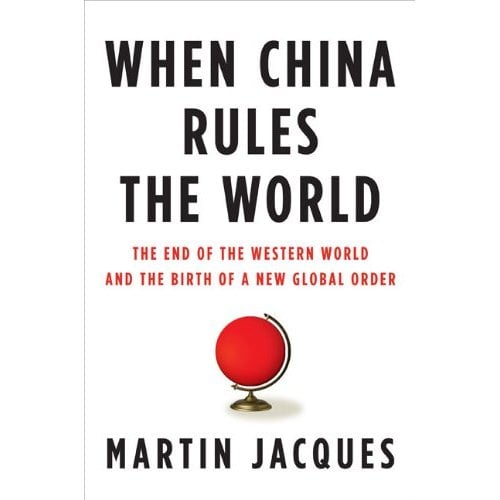
The recent BBC article by Martin Jacques, entitled “A Point of view: is China more legitimate than the West?”, has provoked the ire of seasoned “China Watchers” everywhere. A few intelligent rebuttals have already been produced. I saw the article yesterday, and the reason I wasn’t surprised by its content is that I had already browsed through Jacques’s recent book, When China Rules the World.

The fact is that for anyone with a real knowledge of China, it is impossible to take Jacques too seriously. His triumphalism about the Chinese model masquerading as impartial analysis just does not fit in with the actual situation in China, and few Chinese would share it. His idea that the Chinese see the state as the head of their family, even some sort of “extension of themselves”, and that the government enjoys great authority and legitimacy, doesn’t coincide with what those who really know the Chinese will tell you. And as it has been remarked elsewhere, the surveys of satisfaction with the Chinese government which he quotes cannot be taken too seriously.

It is funny that in his article, Jacques mentions Italy as an example of a country where, in spite of constant elections, the government lacks popular legitimacy. This is supposed to be in opposition to China, where the government enjoys great legitimacy in spite of the lack of elections. In fact the Italians and the Chinese are actually rather similar in their attitudes: the only thing they take seriously is their circle of family and friends. Outside of that, nothing really matters. The state is seen as something which has to be put up with, and the corruption of those in power is met with cynical acceptance. 

Unsurprisingly Martin Jacques has little personal experience of China, and cannot speak Chinese. He apparently spent a short period as a visiting professor in Renmin University. Not enough time to really understand the country, but just enough time to be awed and overwhelmed, while not having to deal with any of the real problems of living here.

The tragedy is that the most basic arguments outlined in Jacques’s book are correct, or at least deserve a hearing. China is indeed going to become more important in the future, the West will no longer dominate the global order, China and other Asian countries are not going to become more Western as they become more modern. China is the product of a different history, and we cannot hope to understand it by just applying Western concepts and prejudices in a different context. And yes, the Chinese state is quite efficient and effective in a number of ways, while managing to retain a certain amount of consensus (does that equate legitimacy?), even though none of the Confucian-style devotion he imagines.

All this is true and needs to be said, but it would take somebody who actually knows Chinese society to say it, someone who is aware of China’s problems and negative sides and does not just engage in blind sycophancy towards Beijing. We may need Sinophiles, but intelligent, informed and balanced ones.

Wednesday, November 7, 2012

On Japan and the Diaoyu islands


 (above, one of the many Chinese demonstrations against Japan's control of the Diaoyu islands)

China Daily reported last week that Kawahare Keiichiro, a 28 year old Japanese nurse and globe-trotter, is continuing to volunteer in the earthquake-hit areas of Yunnan Province in spite of the current animosity towards Japan within China. Kawahare first caught the Chinese media’s attention last February, when the expensive bicycle on which he planned to travel around the world was stolen in Wuhan, but then improbably returned after three days by the local police after he publically called for help on Weibo. This caught people’s eye mainly because bicycles are stolen the whole time in China, and usually nobody even bothers to report it. The idea of the police actually finding your bicycle again would normally be ludicrous.

Anyway, during the last few months the young Japanese idealist has apparently had to lie about his country of origin to protect his safety numerous times, had service refused in shops, and was even surrounded by a group of young men yelling at him in Guiyang after they identified him as Japanese. Even so, he is planning to carry on volunteering in China, and stated to China Daily: "I don't care about politics and the stupid islands thing, I care about victims of the earthquake. People are people, and governments are governments."

Here in Beijing people are still as fired up as ever over the Diaoyu islands issue. It has become quite common to see stickers on cars and shop windows with patriotic slogans on how the Diaoyus belong to China. The owners of Japanese-made cars will sometimes display a sticker on the back window saying things like “the car is Japanese, but the heart Chinese” in an attempt to dissuade hot-heads from damaging the car.

Practically all the Chinese I have spoken to are adamant that the islands belong to China and that China should, if necessary, use force to get them back (although one young man did tell me that they are “just some stupid islands where nobody lives”). When I suggested to my Chinese friends that the Chinese government was making a big deal of the issue to divert the people’s attention at this delicate time when the country’s leadership is about to be changed, their reply was along the lines of “yes, that’s probably true, but that’s the government’s thing, it’s nothing to do with us, the islands belong to China”.

Although China has territorial issues with other countries as well, it is a safe bet that emotions would not be running so high if the other country involved wasn’t Japan. Dislike of Japan runs deep in China, as anyone who has lived here will know. Most Chinese, although not all, strongly resent Japan’s occupation of China during the Second World War, and their perceived lack of contrition or recognition of their mistakes. The Chinese educational system and Chinese television, which features constant re-runs of old war films on the Japanese occupation, reinforce this resentment.

Western “China-watchers” tend to blame the Chinese government for encouraging generations of Chinese to hate Japan as a way to deflect the people’s anger on an external target and fan the flames of nationalism. I personally feel that it would be unfair to present Chinese resentment of Japan as being solely the result of manipulation and propaganda, although the government certainly has an interest in encouraging it. After all the South Koreans with their different government also resent Japan, perhaps even more strongly than the Chinese do. 

When the Chinese claim that “unlike Germany, Japan never apologized for the War”, they are technically incorrect. It is a fact that Japanese prime ministers have on various occasions apologized directly for what their country did to its neighbours, including China, during the War. Having said this, it is also a fact that Japanese society’s attitudes towards the Second World War are deeply different from German attitudes. While the mainstream of German society unreservedly condemns Nazism and is acutely aware of all the atrocities Germany committed, Japanese society seems to be far less aware of the darker side of its past, less willing to discuss it openly and more ambiguous in how it judges the war-time regime.

There are still constant cases of mainstream Japanese politicians either minimizing or outright denying the atrocities committed by Japanese troops during the war, and presenting the country’s war effort as a benign push to liberate the rest of Asia from Western imperialism. Most official Japanese apologies were made as a result of similar outbursts causing a scandal in the rest of Asia. It is still common to hear Japanese people voice the opinion that their country was pushed into war, and justifying its wartime actions.

It is hard to say what Europe would be like nowadays if Germany had maintained such an attitude. I wonder if the European Union would even exist. As it is resentment against Germany took decades to die down in the rest of the continent, in spite of the fact that the German state unreservedly apologized, paid reparations to some of its victims and taught its younger generations all about the Holocaust and the War.

Even nowadays the memory of Nazi occupation seems to be rekindled whenever there is a disagreement between Germany and another European country. Only recently Greek politicians raised the issue of the money Germany plundered from Greece during the war, money which was never repaid. In 2010 the Greek prime minister rather implausibly blamed the state of the country’s finances on this fact.

Across much of Europe, the image of a German chancellor trying to impose policies on local governments leaves an uncomfortable feeling. While memories of the War may not usually translate into resentment of modern day Germans, they often do so when relations with Germany sour. Given this fact, can Europeans really be surprised that the Japanese, who are far less repentant than the Germans, are still resented in China?

Having said this, it is undeniable that Chinese animosity against Japan can reach unenlightened and ridiculous extremes. It is sometimes possible to hear Chinese people claiming (only half-seriously I hope) that their country should one day attack Japan in revenge. Terms of abuse like 小日本鬼子 are constantly used when discussing Japan. The blanket dislike of all things Japanese expressed by Chinese youngsters whose parents were not even born during the war, and who probably grew up watching Japanese cartoons, feels like an induced reflex more than a result of genuine grievances.

Although not all Chinese share these attitudes, they remain widespread amongst the young as much as the old, and the islands dispute is now exacerbating people’s feelings. Although Japanese individuals don’t usually encounter actual violence in China, as long as the Diaoyu islands remain front page news Japanese people may well be wise not to advertise their origins too loudly. In the mean time it can only be hoped that people like the brave young Japanese nurse in Yunnan will continue working to build bridges, and that the Chinese media will continue reporting with honesty on such people.
Thursday, October 11, 2012

National Day Crowds


The week-long holiday for China’s National Day (which has just finished) has always been the busiest week for internal tourism within the country, with hordes of visitors jostling for space at all the country’s major and minor attractions. As more and more Chinese have the money to travel internally, the number of people moving within the country during the holidays is becoming increasingly unsustainable.

This year new peaks of overcrowding have been reached. The Forbidden City received 182.000 visitors on the 2nd of October, an all time record for a single day. According to an article in Xinhua, by the 3rd of October the 119 national tourist sites under monitoring (supposedly the most important ones) had received 609 million visitors! That would be half the population of China.

Many tourist sites were working at almost ten times their optimal capacity. In Dunhuang, Gansu Province, some camels died from overwork after carrying tourists back and forth for days. On Mount Hua, Shaanxi Province, thousands of visitors were stuck until midnight on the 2nd of October, because the cable cars were unable to cope with the crowds. There were chaotic scenes as visitors were refused entry, others demanded refunds, and a few fights broke out between visitors and staff.

Personally I had never traveled during the National Day holidays, but I had the brilliant idea to do so for the first time this year, thus joining this madness (and adding to it I suppose). What’s more I had the even better idea to go to Hangzhou, one of China’s most popular tourist destinations of all (well it wasn’t really my idea, a Chinese friend who was going there suggested I come along). 
Hangzhou is a big city just south of Shanghai. The main attraction is the West Lake, a large lake at the center of the city which is renowned throughout the country for its beauty and its historical relics. The Lake has influenced Chinese poets and artists throughout the ages, and it is associated with numerous important figures in the country’s history. As the Chinese saying goes, 上有天堂,下有苏杭 (above there is heaven, below there are Suzhou and Hangzhou).

As one might imagine, train tickets for the holiday period are extremely hard to come by, even if you start queuing on the morning of the first day when the tickets you need are on sale. Flights cost double the usual amount. Somehow my friend managed to get me a ticket for the Beijing-Hangzhou high speed railway for the first day of the holiday. It must be said that the new high speed trains connecting China’s major coastal cities really are very fast. This particular train takes only six and a half hours to get from Beijing to Hangzhou, a distance only slightly shorter than going from London to Nice.

Hotels also tend to be fully booked during the holidays, and I had to settle for an expensive and overpriced room in Home Inn. What has really stayed with me of Hangzhou’s West Lake is not the beauty of the Lake, but the size of the crowds swarming around it. The Lake is kilometers long in circumference, but there were so many tour groups on site that it was almost impossible to move. I tried renting a bike, but the road around the lake was so packed with people, cars and other tourists on rented bicycles that cycling was both difficult and potentially dangerous. Honestly I doubt that I would have found the Lake as beautiful as most Chinese visitors do even at the best of times, but I was so fed up with the constant mass of people surrounding me on all sides that I really couldn’t focus on its supposed beauty anyway.

My friend and I attempted to visit the famous Lei Feng Pagoda (no connection with the selfless soldier of Maoist propaganda; the second character is slightly different). There was such a mass of Chinese humanity swarming around it that I felt dizzy by the time I got near. Spotting my friend was utterly hopeless, and we had to go to the closest bus stop to find each other. By then we both agreed that we had no interest in visiting the pagoda anymore, especially since we would have had to queue for hours to get in.

My original plan was to continue traveling to Henan Province after going to Hangzhou, but after a few days I was so fed up that I just booked a flight back to Beijing on the 4th of October and spent the remainder of the holiday in my flat.

This year many Chinese holidaymakers have also complained that the size of the crowds at the places they visited affected their enjoyment of the vacation, in spite of the Chinese tolerance for overcrowded environments. It is clear that having hundreds of millions of people traveling through China at the same time and visiting the same places is becoming unfeasible, damaging for the tourist sites, uncomfortable and even dangerous (especially for the poor camels in Dunhuang). In any case, I know that I am not traveling anywhere in China for the National Day ever again. 


(Above: tourists turning Tiananmen Square into a campsite over the holidays)

Monday, September 17, 2012

On Mark Kitto's "Why I am leaving China"

Among China watchers and China expats, the latest stir has been caused by Mark Kitto’s article for Prospect magazine, entitled “You will never be Chinese: Why I am leaving the country I loved”. This outpouring of frustration and disillusionment has pushed other expats to go public with the reasons why they have left or are about to leave China, and prompted much debate.

The article in question is certainly heart-felt and well written. The author is a Brit who has spent 16 years in China, and founded the "That's Beijing" magazine. I can sympathize with some of his reasons for wanting to leave, and some of what he says about modern China is undeniably true. I will probably write more about this in another post. What I want to emphasize today is this: where I stop taking Kitto seriously is when he prophesizes the Chinese government’s violent downfall, or in any case an imminent violent upheaval in China.

According to Kitto, this will happen because of the property market bubble bursting, perhaps in conjunction with an “outburst of ethnic or labour discontent”. Outsiders have been making prophecies about the collapse of China’s government and system for a long time. In 2001 a book came out entitled “The coming collapse of China”. The writer was Gordon G. Chang, an author and lawyer who worked for years as a consultant in Shanghai, and is considered an "expert" on China. He argued in his book that many factors, but especially the hidden non-performing loans of China’s state banks, were going to bring the Chinese system to a crash and cause the Chinese government to lose its power. Chang even had the ill-fated idea of predicting exactly in which year the Chinese government would collapse: 2006. It is now 2012, and China is looking as confident and as growing as ever, with the same old people still in power.

Then it was the non-performing loans which were supposed to bring China down, now it is the housing bubble. Commentators seem to have a tendency to read too much into economic problems which are certainly real, but probably not as catastrophic as they are made out to be. The Chinese property bubble has by most measures begun to deflate in late 2011. Then again, this has led to declining economic growth in 2012, but we are really quite far from anything which could threaten the system as a whole. As for ethnic and labour unrest, well…ethnic unrest concerns only the minorities, who are less than 10% of the population, and it seems to be able to make the Han populace rally around its government like nothing else. As for labour unrest, it has existed for years, without seriously shaking the system.

It is impossible to predict the future of course, and I do not claim to know what it holds in store for China. I am however skeptical about any outsider who comes along and predicts the downfall of the Chinese government based on this, that or the other. The people who lead China may be many things, but stupid they are not. If they have been able to stay in power while China went from being a centrally planned economy to a free market one, they can probably survive quite a while longer. You may disapprove of their methods, but in some ways they clearly know what they are doing. Ridiculing them as hopelessly out of touch and unable to lead is tempting, but does it really hold much ground?

In the last decades the Chinese state’s management of the economy has clearly been wiser than that of many Western states, where we have seen some real bubbles burst in the last few years (Gordon G. Chang was obviously too busy looking at non-performing loans in China to notice the much more pressing problem of sub-prime mortgages back in the US). Of course allowing the people to vote for a new leader is an excellent way to assuage their discontent, something which for now is not available in China. It is likely that the Chinese system will have to change in the long run. How this will happen is anyone's guess, and I don't think Mark Kitto's catastrophic forecasts are really any more reliable than anyone else's.

Saturday, August 11, 2012

Why do the Vietnamese dislike China?


I have just got back from a two week trip to Vietnam. I had already visited the country for a few days in 2009, but this time my stay was longer and I feel that I got a deeper impression of the place. One thing that I came to realize about Vietnam during my recent stay there is the extent to which China and the Chinese are unpopular in the country.

On my first day in Hanoi, the receptionist at my hotel noticed that my phone had Chinese writing on it, and I told her that I live in Beijing. After asking me to write my Chinese name down, and showing me how she could write 你好 (ni hao) in a 5 year old's handwriting, the woman asked me why on earth I chose to live in China. She told me that Chinese people are "not good", that China occupies Vietnam's Spratly Islands, and that many of the Chinese tourists she has met are rude and speak too loudly.

During the following two weeks in the country, I had various other such experiences. Once I was in the lobby of one of Hanoi's fanciest hotels, and I was fooling about with a Vietnamese girl I know who speaks a bit of Chinese, trying to have a basic conversation with her in Mandarin. A smartly dressed young man sitting next to us interrupted, asking why we were speaking Chinese, since the Chinese are "bad people who think they can conquer everything".

My good Vietnamese friend Hien, who used to be my roommate when I studied in Beijing, confirmed that his fellow countrymen tend to dislike the Chinese on principle. In fact, he claimed that despite the wars with the Americans and the French, the only foreigners the Vietnamese dislike nowadays are the Chinese (he himself doesn't share these feelings, having had mostly good experiences in Beijing).

                       
        Above: Ho Chi Min's Mausoleum in Ba Dinh Square, Hanoi's own little Tiananmen Square

This widespread animosity towards China might seem puzzling at first, since Vietnam is clearly the most similar country to China on the face of the earth. Just like Korea and Japan, Vietnam has always belonged to the Chinese cultural sphere. As the Vietnamese like to remind people, they were ruled by China for a thousand years. As a result, they adopted the same mix of Confucianism, Mahayana Buddhism and Daoism as the Chinese, and took to writing their language in Chinese characters. Within South East Asia Vietnam represents an outpost of Chinese civilization, as opposed to its neighbours Laos, Cambodia and Thailand, whose culture is influenced mainly by India.

Vietnam's current political and social system is also very similar to China's, with a "Communist Party" presiding over a "Socialist-oriented market economy" in which the government does not exercise control over people's daily lives, but keeps a lid on political dissent. Vietnam's own "Reform and Opening Up", the "Doi Moi" Policy, was started in 1986. Ba Dinh Square in Hanoi even looks a bit like a small scale Tiananmen Square.

The lifestyle, food and mentality of the Vietnamese all bear a clear resemblance to China as well. Although Hanoi looks very different from a Chinese city, with narrow streets and old colonial buildings everywhere, the restaurants and shops look decidedly similar to the ones you might find in China. The people have a South-East Asian gentleness in their way which is unknown in China, and they thankfully don't share some of the Chinese bad habits which I referred to in my previous post, but otherwise their similarity to the Chinese is obvious. Even the Vietnamese language has borrowed about half its vocabulary from Chinese.

Why then this hostility towards China on the part of ordinary Vietnamese? The main reasons seem to lie in history and in the current dispute over the Spratly islands. The way the Vietnamese see it, their history has been one long struggle to rid themselves of Chinese domination. Most of Vietnam's national heroes are people who fought off the Chinese successfully. Then there was the 1979 war between China and Vietnam, started by China in retaliation for Vietnam's invasion of Cambodia, and ending with the war-hardend Vietnamese giving their Northern neighbours a good bashing.

The ancient Chinese were apparently baffled by these Southerners who enjoyed the benefits of Chinese civilization but held on to their separate identity so stubbornly, rather than just become Chinese themselves. I have never heard of modern Chinese laying any claim to Vietnam, unlike Mongolia, which most Chinese see as rightly belonging to China. I suppose China's domination of Vietnam came to an end too long ago for it to remain in the Chinese collectively memory. Even the war in 1979 is rarely remembered or discussed in China. The Vietnamese have forgotten nothing however, and there is currently a dispute between the two countries which serves to keep the old resentment burning.

The Spratly Islands are an archipelago of islands in the South China Sea (known as the "East Sea" in Vietnam) whose sovereignty is contended by China, Vietnam, the Philippines, Malaysia, Brunei and Taiwan. All of these countries except Brunei currently occupy some of the islands. The islands are uninhabited, but the real prize is the oil and gas reserves which the area contains. Although the islands are geographically closer to Vietnam and the Philippines, China claims that they have been part of Chinese territory for two thousand years, and that they are clearly marked as such on ancient Chinese maps. Archaeological findings of ancient Chinese pottery and coins on the islands is supposed to back this claim. Vietnam on the other hand contends that the islands were never part of China's territory, and that they have ruled over them since the 17th century, when they were not under the sovereignty of any state.

The dispute over the Spratly Islands is obviously very deeply felt in Vietnam, and contributes to the general ill will towards China. A British girl I met who lives in Saigon told me that in her opinion the Vietnamese media is also to blame, because it gives a distorted coverage of China. She said that various Vietnamese friends had told her that the Chinese eat babies after seeing stories to this effect in the media. She also pointed out that the Vietnamese have a rather selective memory, forgetting that Ho Chi Min received much help from the Chinese Communist Party. "Uncle Ho" actually spent years in China, married a Chinese woman and spoke fluent Chinese.

Thursday, June 14, 2012

Funny poem on Chinese regional differences

I have run into this amusing poem about Chinese regional stereotypes here. It's from the "Ich bin ein Berliner" blog of former Tang Dynasty guitarist Kaiser Kuo.

"In Dongbei, whence the Manchus came, the men do like their liquor.
While effusive with their friendship, with their enmity they’re quicker
Though they’re honest and straightforward, at the slightest provocation
They’ll show why they’ve been slandered as the Klingons of this nation.

The leggy Dongbei ladies for their beauty are renowned,
(I attest that in my travels, few more fetching have I found.)
But they suffer from one drawback, and it’s very sad to tell—
When they open up their mouths to speak, they break that magic spell.

The stalwart Shandong people grow as hearty as their scallions
On their noodle-heavy diet they’ve been bred as strong as stallions.
They’re known for dogged loyalty; they’re known as trusty folks,
But a bit slow on the uptake—thus, the butt of many jokes.

In Hunan and in Hubei in the country’s center-south
They say the people there can really run it at the mouth
In Hubei in particular, the saying is often heard
That a single Hubei codger can drown out a nine-head bird.

The Hunanese, in temperament, are piquant as their dishes,
Like duo jiao yu tou—capsicum with slow-braised heads of fishes.
Add to this mix the province’s infernal summer heat,
And you see why Hunan’s Xiang Jun had the Taiping rebels beat.

The teahouses of Chengdu represent the Sichuan Way:
The women toil in earnest while the men drink tea and play.
The Chuan hou plays at mahjong as the Chuan mei cleans and mends,
And like the Sichuan peppers do, she burns it at both ends.

The Pearl River Delta in the southlands of Guangzhou
Is home to China’s most industrious people, as you know:
They’re scrappy and they’re gritty and they’re free of all pretension,
And they’ll make a meal of any living beast you’d care to mention.

They say that Henan people are a sly and cunning lot.
But my ancestors are from there—proving some, at least, are not.
My co-provincials countrywide are blamed for every ill,
While provinces that suck as bad get let off easy still.

The Shanghainese are philistines, and this they’ll gladly own:
Commercial instincts permeate them to the very bone.
Their pride in Shanghai’s petit bourgeois ethos is immense
But what they lack in culture, they make up in common sense.

As you might well have expected, I have saved the best for last,
For my love for Beijing’s people is immovably steadfast.
From their gargling r-drenched accent to their dry sardonic wit,
The denizens of Jing Town are the dope, the bomb, the shit.

Beijingers love to gab, and though they’re lazy and they’re slow,
There’s nothing about politics that they aren’t apt to know.
They may complain a lot about the traffic and the air
But scratch beneath the cynicism and you’ll find they care.

So be grateful that you live here, and be clear on what it means.
Be grateful you don’t live among Klingons, or philistines.
Be grateful for the legacy of Yuan and Ming and Qing—
And most of all be grateful for the people of Beijing."

The part on the Henan people rings very true. Living in Beijing, the most common regional stereotype I have ran into is that the Henanese are basically not a very decent bunch. There is a widespread idea that a lot of them are untrustworthy, swindlers and people to be wary of.

For those of you China-illiterate, Henan is a huge province in north-central China, where Chinese civilization is supposed to have originated. It is the third most populous province in the country, with 94 million people living within its borders. If it were a country, it would be the twelfth most populous in the world. Despite its historical prominence, it is nowadays a relatively backward province which produces rather than attracts migrant workers, and not a few of Beijing's immigrants come from there.

I have never really been to Henan, even though I have crossed it by train various times. Although I have friends and acquaintances from all over China, I have never had much to do with anyone from Henan as far as I can recall, so I really haven't got much personal experience on the matter, although in general I certainly don't approve of negative stereotyping of entire peoples.

The small village in Shanxi where I spent a week last year was just over the border from Henan. Even there, when I asked one of my hosts about this regional stereotype, they replied: "well, not all of them are bad people of course, but it is just that Henan has lots of people and it's very poor, so you get a lot of them who do questionable things to make money". Of course in some parts of the world people might say the same about the Chinese in general: overcrowded and poor, so sometimes they do questionable things for money. I kept that thought to myself however.

The stereotype of people from Dongbei (the Northeast) being heavy drinkers, frank and straightforward, and easy to anger, is another one which I have heard a lot. I have been to Dongbei and know people from there, and I have a feeling that there is some truth to it. Perhaps it is the cold weather which just turns people into heavy drinkers who like a punch up, since Northern Europeans are the same.

When it comes to the Shanghainese, what I have always heard about them is a stereotype unmentioned in the poem: they have a huge superiority complex towards the rest of China, much greater even than the Beijingers do. I have also heard numerous people say that they will insist on speaking to outsiders in Shanghai dialect even when they know Mandarin, just to be difficult. Given the current state of health of the Shanghai dialect, this complaint  may not be heard for much longer.

It is interesting that in China you do not find the same stereotype which exists within Europe, in other words that people from the hotter regions in the South are less efficient and hardworking than the ones from the colder North. This is even though the climactic difference between the South and the North of China is as great as that between the South and the North of Europe. In fact China's hottest region, Guangdong, is supposed to be home to its most industrious people, as the poem mentions. Clearly hot weather and a laid back lifestyle do not always have to go hand in hand

Tuesday, May 29, 2012

Yang Rui's rant and foreigners in China

More news related to the recent crackdown on foreigners has attracted the attention of the foreign community in Beijing.

First there was Yang Rui's demented post on Weibo. Yang Rui is a Chinese journalist who presents a show called Dialogue on CCTV 9, the only channel in English on Chinese state TV. The show consists of him interviewing foreign guests, usually on political issues. Here is the man's entire Weibo post, translated by the Wall Street Journal:

"The Public Security Bureau wants to clean out the foreign trash: To arrest foreign thugs and protect innocent girls, they need to concentrate on the disaster zones in [student district] Wudaokou and [drinking district] Sanlitun. Cut off the foreign snake heads. People who can’t find jobs in the U.S. and Europe come to China to grab our money, engage in human trafficking and spread deceitful lies to encourage emigration. Foreign spies seek out Chinese girls to mask their espionage and pretend to be tourists while compiling maps and GPS data for Japan, Korea and the West. We kicked out that foreign bitch and closed Al-Jazeera’s Beijing bureau. We should shut up those who demonize China and send them packing."

Lovely stuff, hey? The "foreign bitch" in question is Melissa Chan, Al-Jazeera's China correspondent who was recently refused a renewal of her visa by the Chinese government, effectively kicking her out. Apparently she had made some reports on sensitive topics. Yang Rui complained that this translation was incorrect, because the Chinese word he used in the original (泼妇) can best be translated as "shrew", rather than "bitch". Foreign shrew then.

Yang Rui later released a statement claiming that he was only targetting foreigners who behave badly, which he again called "foreign trash", and that he wants to distinguish them from "the silent majority in the expat community that respect our culture and society". He did not apologize or display any understanding of why his comments provoked so much offense.

A few days ago this rather absurd page appeared in the English section of Sina Weibo (which is a listed company, not a government department), with the title "Beijing Welcomes you, Decent Foreigners". At fist I wondered if it might be a parody, but it is all too real. It's not that there is anything specific which is downright racist. It's more that the whole thing comes across as extremely patronizing, fake and frankly ridicolous. I suspect that few Chinese would understand why it feels patronizing and fake to foreigners, including clearly the people at Weibo who cobbled the page together. If someone asked them how they would feel if someone made a web page called "the World Welcomes you, Decent Chinese", with articles about both decent and indecent things done by Chinese abroad, then maybe they would begin to figure it out.

It is easy as a foreigner in Beijing to become extremely upset about this sort of thing, but it is good not to get overly worked up about the situation. Yang Rui's rant is extreme and unrepresentative for a public figure, and some of the Chinese comments under his Weibo post criticize him for being prejudist. I have not experienced any particular abuse or hostility by anyone in the last few days, any more than I have at any other time in Beijing. The crackdown on foreigners continues, but I have yet to be stopped and checked up on by the police (although a friend of mine told me the police went round knocking on doors in his block of flats, which is packed with foreigners). It also seems that the penalties for those caught working illegally are not that great (a 1000 RMB fine according to one person who was caught, with no deportation).

One must also remember what it is like to be a foreign immigrant back in one's own part of the world. Idiotic rants about immigrants on the level of Yang Rui's outburst are nothing new anywhere in Europe, even coming from members of parliament and celebrities. Hysterical talk of Muslim immigrants wanting to "impose Sharia law" in Britain is really not much less disconnected from reality than Yang Rui's talk of foreign spies and human traffickers. Let us also remember all the unfair complaints about immigrants not learning the language and not adjusting to "our values" which you hear all over Europe, and the way that foreigners get blamed for crime all the time. If you come from a rich and respected Western country and live in China, you actually have it pretty easy by comparison.

It is hard to really compare Europe and China in this respect, because in Europe there is mass immigration of people from poor countries doing menial jobs, while in China most of the foreign residents are students, professionals and English teachers concentrated in a few big cities (with some drug dealers and shady businessmen thrown in). Furthermore, few of the foreigners in China are really settling in the country long term, and most of those who do have married a local. Things may be changing though, as Chinese police recently repatriated some illegal immigrants from Vietnam working in a factory in Anhui province. Rising wages in China could mean increasing numbers of illegal immigrants from poorer countries working low paid jobs, just like what you see in Europe. At that point, it will be interesting to see how the issue is dealt with.

In some ways, China strikes me as being in a similar position to most European societies a few decades ago, in the sense that it is not traditionally an immigrant society, and most Chinese are just not used to the idea of sharing their cities and neighbourhoods with foreigners who look and act differently. It is a fact that as long as you don't have Chinese blood you will always be seen as a foreigner here, for good or bad, and I doubt this will change any time soon.