Wednesday, January 9, 2013

Han Han's blog post on censorship and the Southern Weekly affaire

A few days ago an almost unprecedented event took place in China: a demonstration in favour of freedom of the press. Hundreds of people gathered in Guangzhou in front of the headquarters of the Southern Weekly newspaper, to express support for its struggle against censorship.

Southern Weekly is well known to be China’s most open and independent newspaper, and it has often been on the receiving end of government pressure in the past. Last week, the newspaper’s employees wrote an open letter to the provincial propaganda department of Guangdong, demanding the resignation of one of its highest ranking officials. They accuse him of surreptitiously revising one of the newspaper’s editorials, and having it published without their consent. (Note that the “propaganda department” is called 宣传 or xuānchuánbù in Chinese. The word xuānchuán, although it can mean propaganda, doesn’t have the negative ring of the English term. It simply means disseminating information).

The editorial was originally entitled “China’s dream: the dream of constitutionalism”, and urged the government to respect the country’s constitution of 1982. After its revision, the title was changed to “We are closer than even before to our dreams”. The editorial’s original position had been altered to make it appear heavily pro-government, and the revised edition also contained various factual and typographical errors.

The newspaper's staff are now on strike, and the situation has quickly snowballed, with various intellectuals coming out in support of Southern Weekly all over China. Chinese internet sites have blocked related search-terms, and the Chinese media is of course mostly keeping quiet on the issue. The English edition of Global Times, which always tends to tackle sensitive topics from a pro-government angle, has come out with an editorial entitled “Freedom of the Press must serve society”. Characteristically, while remaining vague and avoiding the actual issue, it basically takes the line that freedom of the press “cannot go too far” and has to proceed at the same speed as “social transformation”.

The Chinese edition of the Global Times, on the other hand, has produced another editorial in which it claims that the entire story of the Southern Weekly article being altered is a fabrication, and defends the current censorship arrangements. Other newspapers have been forced to republish this editorial, although many have attempted to resist the order, and the Beijing newspaper Xinjing Bao’s publisher resigned in protest.

The anti-censorship demonstration in Guangzhou was confronted by a small group of counter-demonstrators who called the newspaper “a tool of US imperialism” and waved Chinese flags and banners of Chairman Mao. From the only photo I can find of them, they look like a rag-tag band of people who might well have been paid by the local authorities to stage their “counter-demonstration”.    

 What this whole story tells us, I think, is that in the world of Chinese media some people are fed up with the current level of censorship, and they are not afraid to say so out loud.


China’s most famous blogger, Hán Hán (韩寒), published a post on the issue on his Weibo page two days ago. You can find my translation below. The title is a reference to a well-known Southern Weekly headline, “there is always a power which makes us weep”. I was a bit unsure of the meaning in a few places, but I did my best to produce an accurate translation.


There is Always a Power.
     

Since my two Weibo posts have both been deleted, what am I to write?

When I was still a teenager, the Southern Weekly influenced me deeply, and it accompanied me throughout my youth. Later on I wrote a lot of articles, I also edited a magazine, and I came to really understand the meaning of “there is always a power which makes us weep”, and I understood that there is also a power which leaves us unsure of what to do. That power interferes with what you say, what you write, and what you do. Writers and reporters are all constrained by this power, and we can’t even see who holds it, let alone communicate with them, until you understand that what it does is cover you mouth and tell everyone you are happy.

You can have so-called freedoms, but only because they will punish you for it. No matter whether you’re engaged in literature, news or cinema, you have to expend a lot of energy in getting their authorization. If you want to discuss the regulations, they don’t even tell you clearly what the regulations are, so that every person is breaking the “regulations” at least to some extent. If you want to conform with their rules, you have to become them. We are always being careful of ourselves and each other, being fearful, and trying to find ways around it. They tear your clothes, throttle your throat, and at the same time they also convey the message that if you run faster or sing better, you are gaining glory for them in the world.  

We hardly have any world-class authors, film-directors, newspapers, magazines, films…. Of course, you could say that it is us, the professionals in these fields, who aren’t up to standard and are trying to shift responsibility; you could say that what is national is also global; you could ask why we have to go and cater to other people’s tastes; you could say Iran is much stricter than us, and also produces XXX; you could even say that our pandas are loved by children worldwide. Perhaps I’m not good enough, but at least I don’t accept that there are people who can wantonly delete me, change me and bind me. So this expression of public support isn’t just for the sake of a newspaper I love and of journalists who deserve respect, but its also for the sake of the other media and journalists who’ve found themselves in even worse circumstances with even more miserable results, and of course it is also for myself.

As a reader, the Southern Weekly has given me a lot. It empowers the powerless, and helps those less fortunate to move forwards, so now that it is itself powerless and unfortunate, let’s try and give it a bit of power, and accompany it as it continues moving ahead.


The post has not been deleted by Weibo, perhaps because of Han Han's popularity, and it has already received thousands of comments. When such a popular figure comes out so strongly against censorship on China's most popular blog, which has an audience of millions, it makes you think.

(In the picture, celebrity blogger Han Han)

Sunday, January 6, 2013

Five good Chinese songs

In this post I am going to share some of my favourite Chinese songs with you.

I am doing this partly because I am aware of how few Westerners listen to any Chinese music, even ones who understand Chinese and live in China. To be fair, I can understand why this is. Much of modern Chinese music, especially the most popular stuff, consists of extremely commercial and sugary pop songs, lacking in personality, style and depth.
There is, however, some decent and meaningful Chinese music out there too. And I am not talking about ancient music or Chinese opera, which is very much an acquired taste. I am talking about modern rock and pop music. Below are five Chinese songs which I actually listen to regularly because I enjoy them.

1)  One night in 北京 (One night in Beijing) by 信乐团 (Xin Yue Tuan)

This is my favourite song by Xin Yue Tuan (also known as Shin in English), which has to be my favourite Chinese rock band. The band is in fact Taiwanese, and it distinguishes itself from the rest of the Chinese music scene because it plays loud, expressive and emotional rock music. The real soul of the band was the lead singer Su Jian Xin, whose powerful and wide ranging voice is a rarity in Chinese music. He unfortunately left the group in 2007.

This song, which is sung entirely in Chinese except for the “One night in Beijing” line, is actually a cover of a song by Taiwanese singer Bobby Chen. The cover version has now become more famous than the original, and it is extremely well known throughout China. The lyrics are actually quite mysterious, and it is not immediately clear what the song is supposed to mean. Although it is a modern rock song, the chorus is sung in a falsetto voice which parodies Beijing opera. You can find the lyrics and an English translation here.


2) 一无所有 (Nothing to my name) by 崔健 (Cui Jian)

This is the trademark song by Cui Jian, the only real rock star Mainland China has ever known. A Beijinger of Korean ancestry, Cui Jian became famous towards the end of the eighties. He was probably one of the first Chinese professional rock musicians. Like all good rock stars, he was also a rebel and an anti-establishment figure. It’s a pity that China’s music scene seems unable to produce such figures nowadays. Interestingly, his first band included a Hungarian and a Madagascan who worked in foreign embassies in Beijing.

Cui Jian songs were often covertly political, and sometimes parodied old government slogans. He became one of the icons of the protesting students in ’89, and appeared at the protests before they were broken up. After the crackdown he went into hiding for a while, but he was soon able to return to Beijing. His first tour was however stopped short by the authorities after he started performing his political song “a Piece of Red Cloth” with a red blindfold across his eyes. From then on he was prevented from playing in big venues for many years. State radio and television also wouldn’t broadcast his songs for quite a while. Although his music is now played without any fuss, one of his songs, called “the Last Bullet”, is so openly political that it is still banned nowadays.

The song I am introducing here is by far Cui Jian’s most well-known piece, which propelled him to stardom in 1986. The title is difficult to translate, but it is a chéngyǔ (a Chinese saying which usually consists of four characters) which basically means “not to have a penny to one’s name”. The lyrics seem to be addressed to a girl who is scorning the singer because he has no possessions. Many have seen it as actually addressing the Chinese government or Chinese society in the name of the restless youth of the time. Although most of Cui Jian’s music has aged rather badly in my view, this song really rocks. The video below is of a famous live version. For the original, click here. For the lyrics and their English translation, click here.


3) 睡在我上铺的兄弟 (Brother who slept on the bunk above me) by 老狼 Lao Lang, or Old Wolf

An old hit from 1994 by Beijing singer Lao Lang (meaning “Old Wolf”). The song is a nostalgic recollection of the singer’s university days, addressed to his old roommate (the “brother who slept in the bunk above”). It is particularly poignant in China, where for many people being an undergraduate student is their only moment of relaxation and freedom, which comes after they have spent their school days cramming like mad to pass the Gao Kao (end of high school examination), and before they graduate and have to face the pressure of working and fulfilling their family’s huge expectations.


4) 龙的传人 (descendants of the dragon) by 力宏 (Wang Leehom)

This piece by Chinese-American singer Wang Leehom is actually a cover version of the famous 1978 Taiwanese song written by Hou Dejian, and first sung by Li Jianfu. The original version is a patriotic ode to China, which expresses the singer's yearning for the Yangtze and Yellow Rivers, even though he may never see them (something especially relevant in Taiwan). It also makes reference to China's defeat during the Opium Wars, and ends with an exhortation for the mighty dragon which is China to "open its eyes".

Wang Leehom's version dates from the year 2000. It turns the original ballad into a rap song, and modifies the content. Some English rap verses are added in the middle, where the singer talks about how his parents emigrated from Taiwan to the US. The final verses are also changed, and talk about the yearning of Chinese emigrants in other countries for the motherland. Curiously, Leehom is the second cousin of Li Jianfu, the original singer. To see the lyrics and their English translation, click here.


5) 天路 (Sky Road) by 韩红 (Hán Hóng)

This song talks about the historic railroad which the Chinese have built from Beijing to Lhasa, Tibet. It's sung by Hán Hóng, a famous Chinese singer with a Tibetan mother and a Han father, who was born in Tibet. It is certainly a beautiful song, and very well known in China. At the same time, it is of course unashamedly patriotic and aims to glorify the Chinese authorities' efforts to develop Tibet. It also presents Tibet as the romantic land of mystery which the Chinese imagine it to be.


Tuesday, December 25, 2012

The Chinese media's excessive coverage of the Connecticut school shooting incident

Over the last few days, a curious phenomenon has been commented on in various Chinese websites and forums: the Chinese media’s constant focusing on the tragic Connecticut shooting incident, and on the debate on gun control in the US which has come in its aftermath.


I had already noticed myself that the CCTV evening news kept having coverage of the shooting in Connecticut and of how Americans are apparently rushing out to buy guns because they fear imminent legislation restricting their “right” to gun ownership. When I really got suspicious was when I found that even last Sunday’s edition of 新京报 (a daily Beijing newspaper) dedicated an entire six page special insert to the issue of gun control in the US, a full nine days after the shooting.


The quantity and the duration of the coverage certainly seems exaggerated, especially when compared to how little attention other international events often get in the Chinese press. It becomes even more striking when you consider that very little coverage was devoted to the attack in a primary school in Henan province, where a madman with a knife injured 22 children. This attack happened exactly on the same day as the one in the US (some have justified the lack of coverage as an attempt not to encourage copycat attacks).

Why this excessive focus on the attack in the US, and on the gun control debate? In most of the Chinese internet forums where the issue is discussed, people seem to believe this is due to two reasons: the fact that many high ranking Chinese officials and wealthy people have family and children in the US, so they want to know about what goes on there; and the fact that the Chinese media want to deflect attention from the problems in China, and give the people a negative idea of life in the US.

Personally I find the second explanation much more convincing. I can easily imagine some ordinary Chinese people seeing these reports, and saying “美国很乱. 还是中国好” (the US is such a mess; China’s still better in the end), or some such nonsense. Of course the fact that Americans can freely buy guns in shops is quite shocking for Chinese people, just like it should be for people anywhere (just think that if the attacker in Henan had had a gun handy, there would now be scores of dead children, rather than just injured ones). Focusing on the issue of gun control is thus an excellent way to make the US look unsafe and barbaric, and China good by comparison. On the other hand focusing on the lack of universal free healthcare in the US wouldn’t work, since the Chinese don’t really have that either.


With the NRA now going on the offensive, and claiming that the solution to school shootings is posting armed guards in every school, doubtlessly the Chinese media will have more easy chances to present the States in a negative light in the near future.

Saturday, December 8, 2012

Visit to the Shaolin Temple

A few weeks ago I had the chance to go on a trip to Henan province. I went there to attend a conference and then stayed on a couple of days to do some sight-seeing. One of the places I went to see was the Shaolin Temple, the place of origin of Shaolin Kung Fu.

Although I usually travel alone, this time I decided to join a tour group arranged by my hotel in Zhengzhou, Henan's capital city. I was the only foreigner in the group, and an object of curiosity for everyone else. The guide spoke incessantly into the microphone practically the whole way to the temple, going on and on about Henan’s history, having a happy trip, Zhengzhou’s traffic problem etc etc… The volume of her microphone was far too high and it gave me a headache. Of course none of my Chinese travelling companions were at all bothered. When you join Chinese tour groups, this is the sort of thing you can expect.
The Shaolin Temple's "pagoda forest"

The Shaolin temple is a Chan Buddhist temple (Chan Buddhism gave rise to Japanese Zen Buddhism, better known in the West. The character for Chan is pronounced Zen in Japanese). The temple is mainly famous as the place of birth of Shaolin Kungfu. The term Shaolin Kungfu is popularly used as a synonym for all of the Chinese external martial arts, as opposed to the internal arts. Not all Shaolin Kungfu styles are really connected to the Shaolin temple, but the temple is historically the most important center of Shaolin. It is supposed to have been founded in 495 CE, and its first abbot was an Indian master of Buddhist meditation known as Batuo.


Although Buddhism contains strong prohibitions against violence, Chinese martial arts were originally developed mainly by Buddhist monks like the ones who resided in the Shaolin temple. Since Buddhist monasteries were sometimes incredibly wealthy, and controlled large estates, they were important economic actors which might clash with the local authorities, and which needed protection against thieves and opponents. Martial arts were thus necessary for fighting and self-protection.


An interesting aside is the legend of Southern Shaolin, another Shaolin Temple which is supposed to have existed somewhere in Fujian province, or anyway somewhere in Southern China. It was supposedly razed by the Qing government in the eighteenth century when it became a base for people who wanted to reinstate the Ming dynasty. Popular legend has it that only five monks escaped, and they later established the Heaven and Earth Society (天地会), a secret society devoted to overthrowing the Qing regime.

After the overthrow of the Qing in 1911, this secret society (or some branches of it) allegedlly turned to crime and merged with the Chinese triads. While in Hong Kong it is still illegal, in the PRC the Heaven and Earth Society eventually turned into the Zhigong Party (致公党), one of the eight minor political parties which are allowed to function outside of the Communist Party (but "under its leadership"). The party is used by the government to strengthen ties with overseas Chinese and as a convenient intermediary with certain foreign governments, apparently.


The actual Shaolin Temples lies at the base of Mount Song, one of China’s five great mountains which have been worshipped throughout history. According to Chinese mythology, the five mountains originate from the body of Pangu, the first being who created the world. Mount Song was believed to have been formed out of Pangu’s belly, and thus to be the center of the world. It is holy in both Taoism and Chinese Buddhism.


Typically for China, the Shaolin temple was destroyed numerous times throughout its history, and the buildings you can see there now are mostly of recent reconstruction. A devastating recent bout of destruction came about in 1928, when the troops of Warlord Shi Yousan burnt the Temple for 40 days, destroying most of the building and manuscripts. During the Cultural Revolution more damage was done to the site, and the few remaining monks were victimized.


Shaolin Kungfu enjoyed a great revival of popularity in China in the eighties thanks to a 1982 Hong Kong film called “the Shaolin Temple”, starring Jet Li. After the film was released, thousands of youngsters apparently ran away from home to study Kung Fu at the Temple, and had to be sent back. At the time there was only one Kung Fu school which had recently opened in Dengfeng, the town next to the temple, and it was quickly overrun with applicants. Since then, numerous Kung Fu boarding schools have sprung up in the town. The students are usually children or young adolescents. As well as Kung Fu they are also supposed to learn other subjects. The best ones may one day join the Shaolin performance troupes that stage shows around the world. Others may end up in the military, the police or as Kung Fu teachers. My own San Da teacher in Beijing studied in one of these schools.


As my tour bus drove through the town, I saw courtyards full of young students practicing their Kung Fu moves in unison (on the right you can see a photo I took of practicing students).The actual Temple grounds did not look dissimilar from other collections of Chinese temples I have seen, and it was of course heavily commercialized and packed full with Chinese tour groups like the one I was part of (even though it was the low season). What gave the place a bit of authentic atmosphere were the hordes of students training all over the place, some of them wearing the grey robes of Shaolin monks. Our group was taken to see a Kung Fu show which was decent, although far from amazing. All the performers were young students, sometimes children. Some of them demonstrated their skills by braking thin slabs of metal using their heads.

An interesting site was the Pagoda forest, an area full of pagodas which each commemorate a different Shaolin monk of the past. The higher a pagoda, the more good deeds the monk performed in his lifetime. The Shaolin temple also includes a hall with a statue of the Buddha and a series of depressions on the stone floor, supposedly made by monks practising Kung Fu. I made friends with two rather nice girls in my group who were from Henan province themselves, but had never been to the temple before. When they knelt down and started prostating themselves to the Buddha in one of the temples, I knew that they were most likely not expressing any serious religiosity, but just doing it because it seemed amusing and fun, in the spirit of a tourist who tries to do something unusual while on holiday. I have even seen tour guides lead groups of Chinese tourists in "prayer" in Buddhist temples, telling them what to say and when to bow.                                  


Friday, November 23, 2012

Intelligent Sinophiles


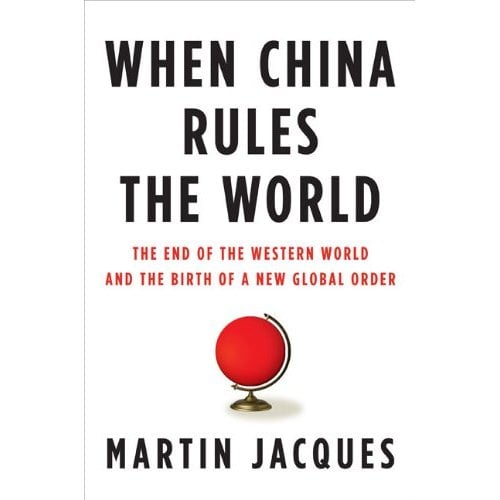
The recent BBC article by Martin Jacques, entitled “A Point of view: is China more legitimate than the West?”, has provoked the ire of seasoned “China Watchers” everywhere. A few intelligent rebuttals have already been produced. I saw the article yesterday, and the reason I wasn’t surprised by its content is that I had already browsed through Jacques’s recent book, When China Rules the World.

The fact is that for anyone with a real knowledge of China, it is impossible to take Jacques too seriously. His triumphalism about the Chinese model masquerading as impartial analysis just does not fit in with the actual situation in China, and few Chinese would share it. His idea that the Chinese see the state as the head of their family, even some sort of “extension of themselves”, and that the government enjoys great authority and legitimacy, doesn’t coincide with what those who really know the Chinese will tell you. And as it has been remarked elsewhere, the surveys of satisfaction with the Chinese government which he quotes cannot be taken too seriously.

It is funny that in his article, Jacques mentions Italy as an example of a country where, in spite of constant elections, the government lacks popular legitimacy. This is supposed to be in opposition to China, where the government enjoys great legitimacy in spite of the lack of elections. In fact the Italians and the Chinese are actually rather similar in their attitudes: the only thing they take seriously is their circle of family and friends. Outside of that, nothing really matters. The state is seen as something which has to be put up with, and the corruption of those in power is met with cynical acceptance. 

Unsurprisingly Martin Jacques has little personal experience of China, and cannot speak Chinese. He apparently spent a short period as a visiting professor in Renmin University. Not enough time to really understand the country, but just enough time to be awed and overwhelmed, while not having to deal with any of the real problems of living here.

The tragedy is that the most basic arguments outlined in Jacques’s book are correct, or at least deserve a hearing. China is indeed going to become more important in the future, the West will no longer dominate the global order, China and other Asian countries are not going to become more Western as they become more modern. China is the product of a different history, and we cannot hope to understand it by just applying Western concepts and prejudices in a different context. And yes, the Chinese state is quite efficient and effective in a number of ways, while managing to retain a certain amount of consensus (does that equate legitimacy?), even though none of the Confucian-style devotion he imagines.

All this is true and needs to be said, but it would take somebody who actually knows Chinese society to say it, someone who is aware of China’s problems and negative sides and does not just engage in blind sycophancy towards Beijing. We may need Sinophiles, but intelligent, informed and balanced ones.

Wednesday, November 7, 2012

On Japan and the Diaoyu islands


 (above, one of the many Chinese demonstrations against Japan's control of the Diaoyu islands)

China Daily reported last week that Kawahare Keiichiro, a 28 year old Japanese nurse and globe-trotter, is continuing to volunteer in the earthquake-hit areas of Yunnan Province in spite of the current animosity towards Japan within China. Kawahare first caught the Chinese media’s attention last February, when the expensive bicycle on which he planned to travel around the world was stolen in Wuhan, but then improbably returned after three days by the local police after he publically called for help on Weibo. This caught people’s eye mainly because bicycles are stolen the whole time in China, and usually nobody even bothers to report it. The idea of the police actually finding your bicycle again would normally be ludicrous.

Anyway, during the last few months the young Japanese idealist has apparently had to lie about his country of origin to protect his safety numerous times, had service refused in shops, and was even surrounded by a group of young men yelling at him in Guiyang after they identified him as Japanese. Even so, he is planning to carry on volunteering in China, and stated to China Daily: "I don't care about politics and the stupid islands thing, I care about victims of the earthquake. People are people, and governments are governments."

Here in Beijing people are still as fired up as ever over the Diaoyu islands issue. It has become quite common to see stickers on cars and shop windows with patriotic slogans on how the Diaoyus belong to China. The owners of Japanese-made cars will sometimes display a sticker on the back window saying things like “the car is Japanese, but the heart Chinese” in an attempt to dissuade hot-heads from damaging the car.

Practically all the Chinese I have spoken to are adamant that the islands belong to China and that China should, if necessary, use force to get them back (although one young man did tell me that they are “just some stupid islands where nobody lives”). When I suggested to my Chinese friends that the Chinese government was making a big deal of the issue to divert the people’s attention at this delicate time when the country’s leadership is about to be changed, their reply was along the lines of “yes, that’s probably true, but that’s the government’s thing, it’s nothing to do with us, the islands belong to China”.

Although China has territorial issues with other countries as well, it is a safe bet that emotions would not be running so high if the other country involved wasn’t Japan. Dislike of Japan runs deep in China, as anyone who has lived here will know. Most Chinese, although not all, strongly resent Japan’s occupation of China during the Second World War, and their perceived lack of contrition or recognition of their mistakes. The Chinese educational system and Chinese television, which features constant re-runs of old war films on the Japanese occupation, reinforce this resentment.

Western “China-watchers” tend to blame the Chinese government for encouraging generations of Chinese to hate Japan as a way to deflect the people’s anger on an external target and fan the flames of nationalism. I personally feel that it would be unfair to present Chinese resentment of Japan as being solely the result of manipulation and propaganda, although the government certainly has an interest in encouraging it. After all the South Koreans with their different government also resent Japan, perhaps even more strongly than the Chinese do. 

When the Chinese claim that “unlike Germany, Japan never apologized for the War”, they are technically incorrect. It is a fact that Japanese prime ministers have on various occasions apologized directly for what their country did to its neighbours, including China, during the War. Having said this, it is also a fact that Japanese society’s attitudes towards the Second World War are deeply different from German attitudes. While the mainstream of German society unreservedly condemns Nazism and is acutely aware of all the atrocities Germany committed, Japanese society seems to be far less aware of the darker side of its past, less willing to discuss it openly and more ambiguous in how it judges the war-time regime.

There are still constant cases of mainstream Japanese politicians either minimizing or outright denying the atrocities committed by Japanese troops during the war, and presenting the country’s war effort as a benign push to liberate the rest of Asia from Western imperialism. Most official Japanese apologies were made as a result of similar outbursts causing a scandal in the rest of Asia. It is still common to hear Japanese people voice the opinion that their country was pushed into war, and justifying its wartime actions.

It is hard to say what Europe would be like nowadays if Germany had maintained such an attitude. I wonder if the European Union would even exist. As it is resentment against Germany took decades to die down in the rest of the continent, in spite of the fact that the German state unreservedly apologized, paid reparations to some of its victims and taught its younger generations all about the Holocaust and the War.

Even nowadays the memory of Nazi occupation seems to be rekindled whenever there is a disagreement between Germany and another European country. Only recently Greek politicians raised the issue of the money Germany plundered from Greece during the war, money which was never repaid. In 2010 the Greek prime minister rather implausibly blamed the state of the country’s finances on this fact.

Across much of Europe, the image of a German chancellor trying to impose policies on local governments leaves an uncomfortable feeling. While memories of the War may not usually translate into resentment of modern day Germans, they often do so when relations with Germany sour. Given this fact, can Europeans really be surprised that the Japanese, who are far less repentant than the Germans, are still resented in China?

Having said this, it is undeniable that Chinese animosity against Japan can reach unenlightened and ridiculous extremes. It is sometimes possible to hear Chinese people claiming (only half-seriously I hope) that their country should one day attack Japan in revenge. Terms of abuse like 小日本鬼子 are constantly used when discussing Japan. The blanket dislike of all things Japanese expressed by Chinese youngsters whose parents were not even born during the war, and who probably grew up watching Japanese cartoons, feels like an induced reflex more than a result of genuine grievances.

Although not all Chinese share these attitudes, they remain widespread amongst the young as much as the old, and the islands dispute is now exacerbating people’s feelings. Although Japanese individuals don’t usually encounter actual violence in China, as long as the Diaoyu islands remain front page news Japanese people may well be wise not to advertise their origins too loudly. In the mean time it can only be hoped that people like the brave young Japanese nurse in Yunnan will continue working to build bridges, and that the Chinese media will continue reporting with honesty on such people.

Thursday, October 11, 2012

National Day Crowds


The week-long holiday for China’s National Day (which has just finished) has always been the busiest week for internal tourism within the country, with hordes of visitors jostling for space at all the country’s major and minor attractions. As more and more Chinese have the money to travel internally, the number of people moving within the country during the holidays is becoming increasingly unsustainable.

This year new peaks of overcrowding have been reached. The Forbidden City received 182.000 visitors on the 2nd of October, an all time record for a single day. According to an article in Xinhua, by the 3rd of October the 119 national tourist sites under monitoring (supposedly the most important ones) had received 609 million visitors! That would be half the population of China.

Many tourist sites were working at almost ten times their optimal capacity. In Dunhuang, Gansu Province, some camels died from overwork after carrying tourists back and forth for days. On Mount Hua, Shaanxi Province, thousands of visitors were stuck until midnight on the 2nd of October, because the cable cars were unable to cope with the crowds. There were chaotic scenes as visitors were refused entry, others demanded refunds, and a few fights broke out between visitors and staff.

Personally I had never traveled during the National Day holidays, but I had the brilliant idea to do so for the first time this year, thus joining this madness (and adding to it I suppose). What’s more I had the even better idea to go to Hangzhou, one of China’s most popular tourist destinations of all (well it wasn’t really my idea, a Chinese friend who was going there suggested I come along). 
Hangzhou is a big city just south of Shanghai. The main attraction is the West Lake, a large lake at the center of the city which is renowned throughout the country for its beauty and its historical relics. The Lake has influenced Chinese poets and artists throughout the ages, and it is associated with numerous important figures in the country’s history. As the Chinese saying goes, 上有天堂,下有苏杭 (above there is heaven, below there are Suzhou and Hangzhou).

As one might imagine, train tickets for the holiday period are extremely hard to come by, even if you start queuing on the morning of the first day when the tickets you need are on sale. Flights cost double the usual amount. Somehow my friend managed to get me a ticket for the Beijing-Hangzhou high speed railway for the first day of the holiday. It must be said that the new high speed trains connecting China’s major coastal cities really are very fast. This particular train takes only six and a half hours to get from Beijing to Hangzhou, a distance only slightly shorter than going from London to Nice.

Hotels also tend to be fully booked during the holidays, and I had to settle for an expensive and overpriced room in Home Inn. What has really stayed with me of Hangzhou’s West Lake is not the beauty of the Lake, but the size of the crowds swarming around it. The Lake is kilometers long in circumference, but there were so many tour groups on site that it was almost impossible to move. I tried renting a bike, but the road around the lake was so packed with people, cars and other tourists on rented bicycles that cycling was both difficult and potentially dangerous. Honestly I doubt that I would have found the Lake as beautiful as most Chinese visitors do even at the best of times, but I was so fed up with the constant mass of people surrounding me on all sides that I really couldn’t focus on its supposed beauty anyway.

My friend and I attempted to visit the famous Lei Feng Pagoda (no connection with the selfless soldier of Maoist propaganda; the second character is slightly different). There was such a mass of Chinese humanity swarming around it that I felt dizzy by the time I got near. Spotting my friend was utterly hopeless, and we had to go to the closest bus stop to find each other. By then we both agreed that we had no interest in visiting the pagoda anymore, especially since we would have had to queue for hours to get in.

My original plan was to continue traveling to Henan Province after going to Hangzhou, but after a few days I was so fed up that I just booked a flight back to Beijing on the 4th of October and spent the remainder of the holiday in my flat.

This year many Chinese holidaymakers have also complained that the size of the crowds at the places they visited affected their enjoyment of the vacation, in spite of the Chinese tolerance for overcrowded environments. It is clear that having hundreds of millions of people traveling through China at the same time and visiting the same places is becoming unfeasible, damaging for the tourist sites, uncomfortable and even dangerous (especially for the poor camels in Dunhuang). In any case, I know that I am not traveling anywhere in China for the National Day ever again. 


(Above: tourists turning Tiananmen Square into a campsite over the holidays)